
Embracing Natural Solutions for Stress and Anxiety
Stress and anxiety rise when the HPA axis becomes dysregulated, when GABA signaling drops, and when inflammation pushes neurotransmitters out of balance. This isn’t speculation. It is well documented across endocrinology and neuroscience literature. Chronic stress elevates cortisol, which then disrupts sleep architecture, increases amygdala activity, and suppresses prefrontal regulation. That sequence alone explains why many people feel anxious, unfocused, and wired at the same time.
Natural supplements are gaining attention because several ingredients reliably influence these biological systems. Ashwagandha has repeated human trials showing reductions in serum cortisol and improvements in perceived stress scales. L theanine increases alpha wave activity and boosts GABA, which improves calmness without sedation. Rhodiola reduces fatigue under stress and improves cognitive performance under pressure. Magnesium improves NMDA and GABA receptor balance and lowers symptoms in people with mild anxiety. These effects are not placebo level. The trials use validated measures like DASS, HAM A, PSS, and salivary cortisol.
Stress and anxiety often overlap, but they are not identical conditions. This article fits into our broader understanding of anxiety mechanisms and nutritional support strategies outlined in the anxiety relief and management hub.
The Rise of Natural Remedies
The growth of natural remedies is tied to evidence and accessibility. Most people with stress or mild anxiety are dealing with lifestyle driven dysregulation, not clinical anxiety disorders. For them, prescription drugs can be excessive and introduce risks that don’t match the severity of their symptoms. This is why supplements with proven anxiolytic mechanisms have gained traction.
Ashwagandha, L theanine, Rhodiola, saffron extract, omega 3s, and magnesium all have data showing measurable changes in cortisol patterns, neurotransmitter activity, heart rate variability, and subjective anxiety scores. Saffron, for example, performs comparably to low dose SSRIs in several head to head studies involving mild depressive and anxious symptoms. Omega 3s reduce inflammation that interferes with serotonin transmission. Magnesium glycinate improves sleep depth, which stabilizes the HPA axis and reduces next day reactivity.
These compounds support existing systems rather than forcing abrupt chemical shifts. They help regulate stress hormones, improve inhibitory neurotransmission, restore circadian alignment, and reduce the inflammatory load that worsens anxiety.

Understanding the Science Behind Supplements
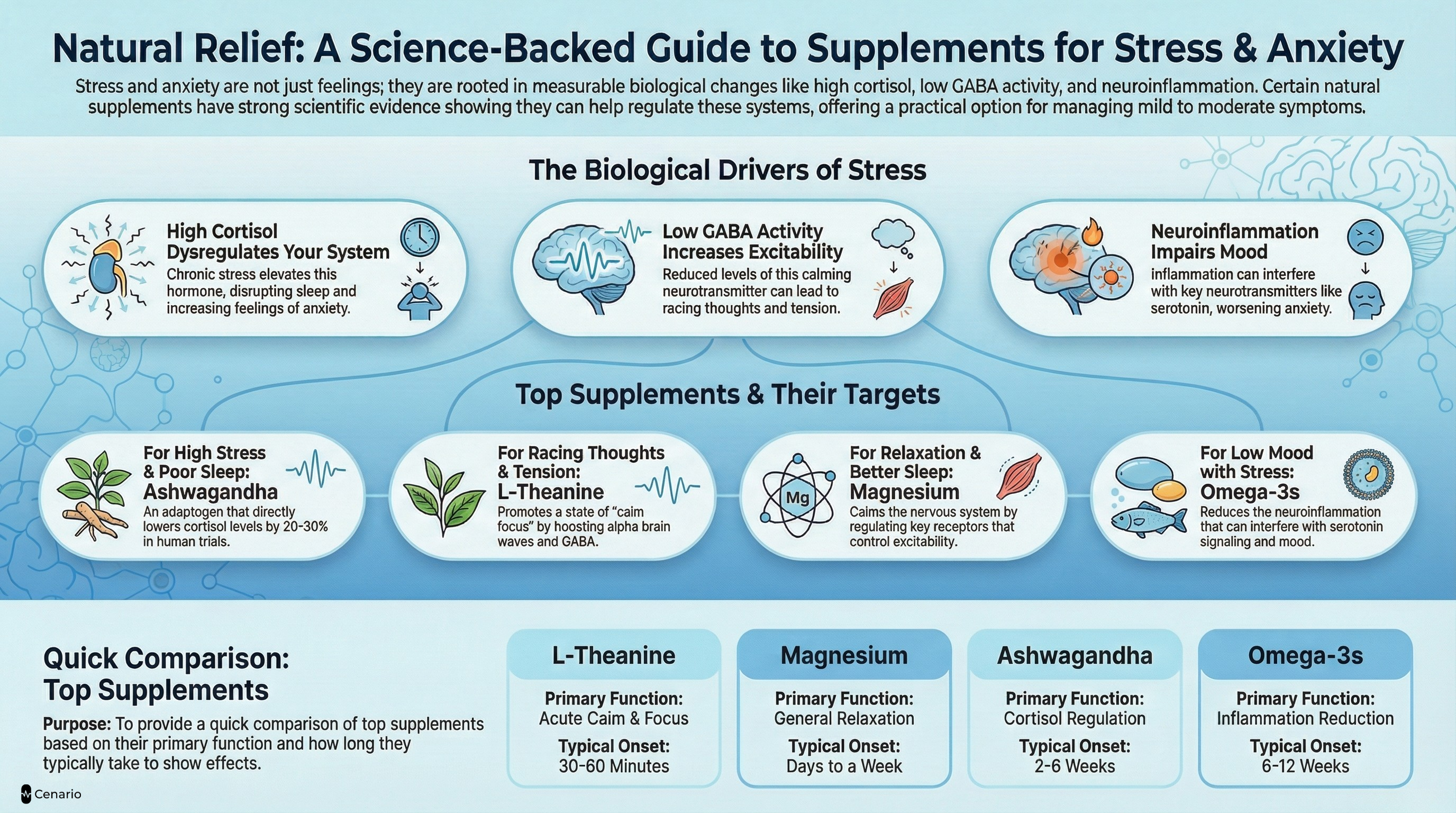
Stress and anxiety are not vague emotional states. They come from measurable biological changes like elevated cortisol, reduced GABA activity, impaired serotonin signaling, and increased neuroinflammation. Effective supplements work because they influence one or more of these mechanisms. Ashwagandha lowers cortisol through direct effects on the HPA axis. Multiple randomized controlled trials show reductions of 20 to 30 percent in serum cortisol along with improvements in validated stress scales. L theanine increases alpha wave activity and supports GABA and glycine receptors. That produces calmness without sedation and reduces anxiety responses during cognitive stress tests.
Choosing the right supplement requires understanding these biochemical pathways. People with high stress and sleep disruption respond better to ashwagandha or magnesium because both regulate cortisol and support inhibitory neurotransmission. Individuals with racing thoughts or tension-related anxiety often respond to L theanine because it modulates glutamate. If low mood is part of the picture, saffron or omega 3s work better because they influence serotonin and reduce inflammatory interference. Without this understanding you are guessing, and guessing is the reason most people get poor results from supplements.
The Role of Supplements in Mental Health
Supplements support mental health by targeting specific physiological drivers behind stress and anxiety. Cortisol modulators stabilize the HPA axis. GABA supportive compounds reduce hyperexcitability. Anti inflammatory nutrients lower cytokines that block serotonin. Sleep supportive ingredients like magnesium glycinate improve slow wave sleep, which reduces next day anxiety by restoring circadian stability. These are not soft claims. They are documented across human trials that measure outcomes through HAM A, PSS, salivary cortisol, HRV, and inflammatory markers.
For people who don’t want to rely immediately on prescription medication, this creates a practical middle ground. Supplements do not override brain chemistry. They help normalize it when symptoms come from lifestyle driven dysregulation. This explains why they work best for mild to moderate stress and anxiety rather than severe clinical disorders that require medical intervention.
This post will break down the supplements with the strongest evidence, explain their mechanisms clearly, and show who benefits the most from each one. If you want, I can extend this into the next section with clinical data summaries for each ingredient.
Top Supplements for Stress and Anxiety
Ashwagandha: The Ancient Adaptogen
Ashwagandha is one of the few herbal compounds with consistent reductions in cortisol shown across human trials. Multiple randomized controlled trials report drops of roughly 20 to 30 percent in serum cortisol along with improvements in subjective stress scores. The effect comes from direct modulation of the HPA axis. It reduces stress reactivity and prevents the chronic cortisol elevation that drives anxiety, sleep disruption, and emotional volatility. Best suited for people with high stress, poor sleep, and elevated mental load.
L Theanine: Promoting Calm Focus
L theanine produces measurable increases in alpha brain wave activity and acts on GABA and glycine receptors. This combination provides a relaxed but focused state without sedation. Several double blind trials show reduced heart rate and salivary cortisol under stress tests, along with improved attention. This makes it useful for people with racing thoughts, tension, and cognitive overload. It works within thirty to sixty minutes and has a clean safety profile.
Magnesium: Essential for Relaxation
Magnesium regulates NMDA and GABA receptors, which control excitability in the nervous system. Low magnesium makes the brain more reactive to stress and increases anxiety symptoms. Supplementation lowers anxiety in individuals with mild to moderate symptoms and improves sleep depth, which further stabilizes the stress response. Magnesium glycinate and threonate are the preferred forms because they absorb well and cause fewer gastrointestinal issues.
B Vitamins: The Mood Regulators
B vitamins support the synthesis of neurotransmitters such as serotonin, dopamine, and GABA. Deficiencies in B6, B9, or B12 can impair neurotransmission and increase anxiety or low mood. Trials show improvements in stress, fatigue, and cognitive function when deficiencies are corrected. They are not direct anxiolytics. They are foundational nutrients that prevent mood instability driven by poor methylation or low neurotransmitter production.
Omega 3 Fatty Acids: Boosting Brain Health
Omega 3s reduce neuroinflammation and improve the fluidity of cell membranes, which affects serotonin signaling. Meta analyses show meaningful reductions in anxiety symptoms when EPA is the dominant fatty acid. They also help stabilize mood in people with high stress or low baseline intake of fatty fish. The mechanism is inflammation reduction, not sedation or acute anxiolysis, so the benefits build gradually.
Additional Supplements to Consider
Saffron (Affron): Mood Enhancement
Saffron extract has some of the strongest data among natural mood support ingredients. Meta analyses show improvements in mild depressive and anxious symptoms that are comparable to low dose SSRIs in several head to head trials. The mechanism is a combination of serotonin reuptake modulation and reduced inflammatory signaling. Standardized extracts like Affron use consistent dosage ranges, which produces more reliable outcomes than generic saffron powders. It works best for people with low mood plus stress rather than high stress alone.
Rhodiola Rosea: The Stress Fighting Adaptogen
Rhodiola reduces fatigue under stress and improves mental performance in pressure based tasks. It reduces cortisol responses to acute stressors and influences key neurotransmitters such as serotonin and dopamine. The biggest effect is improved resilience rather than sedation. People who feel depleted, mentally drained, or incapable of handling stress loads often respond well. It is not ideal for people who already feel wired or overstimulated because it can be activating.
Probiotics: The Gut Brain Connection
The gut brain axis affects anxiety through inflammatory pathways, serotonin production, and vagus nerve signaling. Specific probiotic strains, such as Lactobacillus rhamnosus and Bifidobacterium longum, have been shown to reduce anxiety like behavior and improve stress biomarkers. Human trials show mild improvements, but the effects depend heavily on strain specificity. A generic probiotic blend will not produce the same results. Probiotics are most useful when digestive issues or chronic inflammation are part of the stress picture.
CBD and Kava: A Balanced Perspective
CBD shows some anxiolytic effects in acute stress tests, particularly at higher doses. The problem is inconsistent product quality and a wide range of doses required to see an effect. Kava can reduce anxiety by acting on GABA receptors, but it carries documented liver toxicity risks when used incorrectly or in poor quality preparations. The evidence is mixed, and the safety margin is narrower than with most natural supplements. These options require caution and should only be used with proper medical guidance.
Comparison of Supplements
To assist in making an informed choice, consider the following table comparing the various supplements discussed:
| Supplement | Mechanism | Recommended Form | Evidence Level |
|---|---|---|---|
| Ashwagandha | Reduces cortisol, improves stress resilience | Standardized extract | High (RCTs) |
| L-Theanine | Increases GABA/serotonin, promotes calm focus | Capsules | Moderate (Double-blind studies) |
| Magnesium | Supports relaxation, GABA activity | Glycinate, Threonate | High |
| B Vitamins | Supports neurotransmitter synthesis | B-complex | Moderate |
| Omega-3 Fatty Acids | Improves mood, reduces inflammation | Fish oil capsules | High (RCTs) |
Making Evidence Based Choices
By understanding the mechanisms and evidence levels behind each supplement, you avoid trial and error and choose compounds that match your symptoms. This is the only way to get consistent outcomes. Medical supervision is still required if you have underlying conditions or take prescription medications because interactions with antidepressants, stimulants, and sedatives are real.
Emerging Research and Considerations
Choline: A Developing Area of Interest
Low brain choline levels correlate with elevated anxiety in imaging studies. Choline drives acetylcholine synthesis, which governs stress reactivity and parasympathetic tone. Early findings suggest that correcting low choline status may reduce anxiety for specific subgroups. The research is early, and this is not a frontline supplement, but the mechanism is plausible.
Lemon Balm: Mild Anxiolytic Effects
Lemon balm shows small but consistent reductions in anxiety across several small trials. Its mechanism appears tied to GABA modulation and reduced cortisol during stress tasks. It works best for mild tension or situational stress. It is not strong enough for moderate or severe symptoms.
Safety and Efficacy
Why Caution Still Matters
Influencing neurotransmission or cortisol is not risk free. Interactions with medications exist. If you take SSRIs, SNRIs, benzodiazepines, ADHD stimulants, or thyroid medication, you need medical oversight before adding supplements that act on the same pathways.
When Combining Supplements Makes Sense
Synergy only works when mechanisms complement each other.
A rational example:
• Ashwagandha for cortisol modulation
• Magnesium for GABA balance
• B vitamins for neurotransmitter synthesis
Random combinations with no mechanistic logic increase overstimulation, reduce absorption, or waste money.
Take the Cenario Quiz and get a personalized plan that shows exactly which nutrients your symptoms point to.
Frequently Asked Questions
What is the best supplement for daytime anxiety?
L theanine is the most reliable non sedating option. It reduces stress, improves focus, and works within an hour. Ashwagandha supports long term cortisol regulation but is not fast acting.
Are there side effects?
Yes. Ashwagandha may cause digestive discomfort. Magnesium can cause loose stools if you use poor forms. Rhodiola can feel stimulating for people who already feel wired. These effects are manageable when dosing and form are correct.
How long do supplements take to work?
• L theanine: 30 to 60 minutes
• Magnesium: a few days to a week
• Ashwagandha: 2 to 6 weeks
• Omega 3s: 6 to 12 weeks
Onset depends entirely on the mechanism being targeted.
Can these supplements be combined with prescription medications?
Only with medical approval. Ashwagandha interacts with thyroid medication. Rhodiola may interact with antidepressants. CBD affects CYP450 metabolism. Do not guess.
What are the general dosing guidelines?
• Ashwagandha: 300 to 600 mg standardized extract
• L theanine: 200 to 400 mg
• Magnesium glycinate: 200 to 400 mg elemental magnesium
• Omega 3s: 1 to 2 g EPA dominant formulas
Doses outside evidence based ranges produce unreliable results.
.