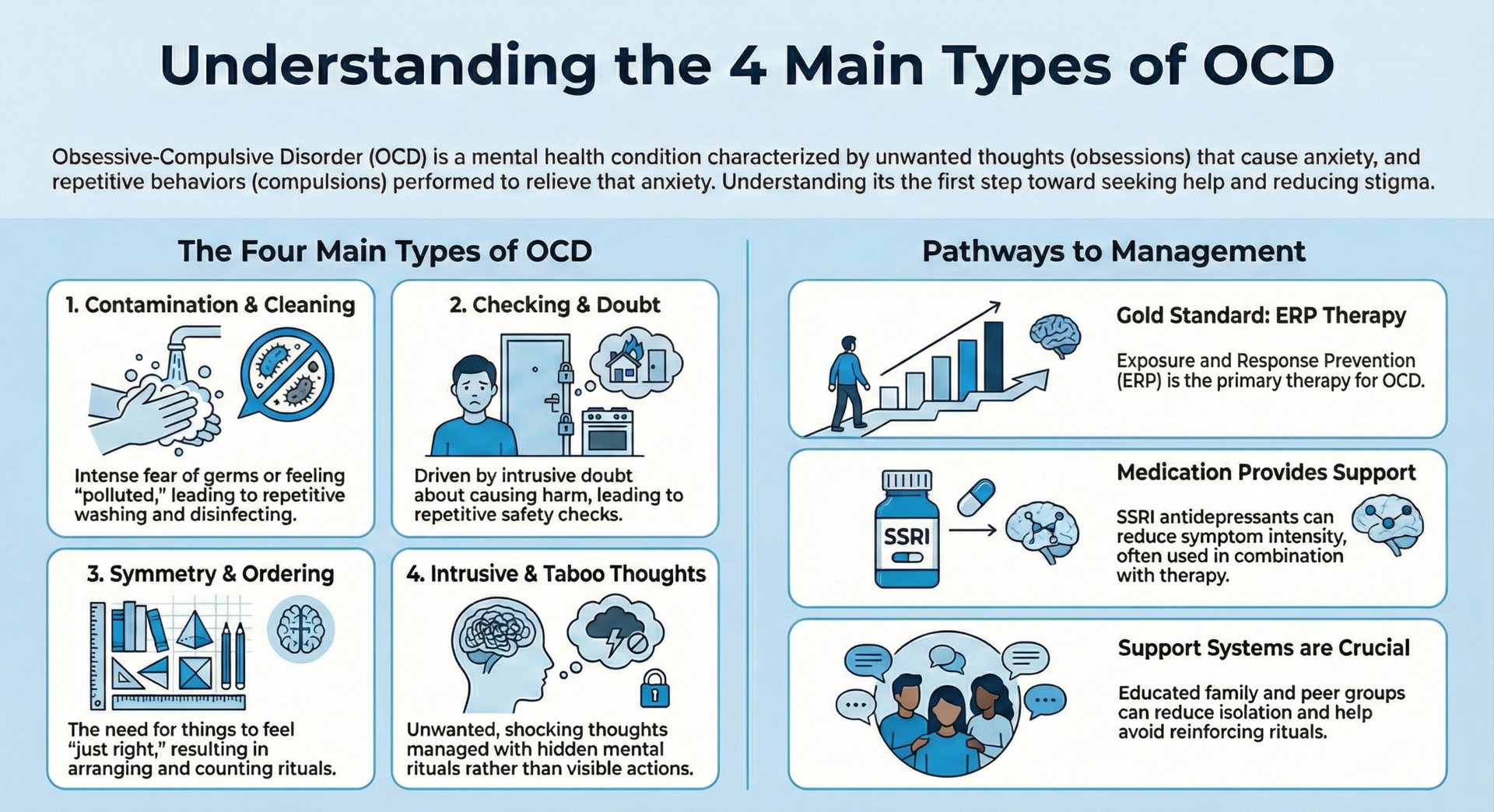

What Are the 4 Types of OCD?
Obsessive-Compulsive Disorder affects millions of people worldwide, yet it is still widely misunderstood. For someone living with OCD, daily routines, work, relationships, and even private thoughts can feel taken over by anxiety-driven patterns that are hard to explain to others. If you have searched what are the 4 types of OCD, you are likely trying to make sense of behaviors or thoughts that feel overwhelming or confusing.
Clinicians and educators often group OCD symptoms into four broad types. These are not official diagnostic subtypes, but practical categories that help describe common themes. Understanding these patterns helps people recognize symptoms earlier, seek appropriate treatment, and reduce shame.
What Is Obsessive-Compulsive Disorder?
OCD is a mental health condition defined by two core features:
- Obsessions: intrusive, unwanted thoughts, images, or urges that cause distress
- Compulsions: behaviors or mental actions done to reduce that distress
Obsessions are not simply worries. They feel invasive, sticky, and difficult to dismiss. Compulsions are not habits. They are driven by anxiety and feel necessary, even when the person knows they are irrational.
The reason many people ask what are the 4 types of OCD is because OCD does not look the same for everyone. Some people wash their hands. Others never do. Some have no visible behaviors at all, which makes OCD harder to recognize and easier to hide.
Why These Categories Matter
Grouping OCD symptoms into common types helps in several ways:
- It gives people language to describe experiences that feel isolating
- It helps clinicians tailor exposure therapy more precisely
- It reduces the myth that OCD is only about cleanliness
- It makes invisible OCD easier to recognize and treat
These categories are tools, not boxes. Many people experience overlap, shifts over time, or symptoms from multiple types at once.
The Four Common Types of OCD Explained in Depth
Contamination, Washing, and Cleaning OCD
This is the most widely recognized form of OCD, but it is often misunderstood as being about hygiene. In reality, it is about intolerance of uncertainty and perceived danger.
People with this type fear being contaminated by germs, chemicals, bodily fluids, or even abstract “unclean” sensations.
Common patterns include:
- Excessive hand washing or showering
- Cleaning objects or spaces repeatedly
- Avoiding public places, restrooms, or shared items
- Using gloves, wipes, or barriers constantly
What drives it:
The anxiety is not relieved by logic or reassurance. Even after cleaning, relief is temporary, and the fear quickly returns.
Why it becomes disabling:
Rituals grow longer and more frequent. Skin damage, social avoidance, and exhaustion are common outcomes.
Checking and Doubt OCD
This type is fueled by chronic doubt and fear of responsibility. The core fear is often “What if I made a mistake and didn’t notice?”
People are not checking because they are careless. They are checking because their brain refuses to register certainty.
Common behaviors include:
- Rechecking locks, stoves, appliances, doors
- Re-reading messages or emails repeatedly
- Seeking reassurance from others
- Mentally replaying events to “confirm” safety
What makes this type persistent:
Each check briefly lowers anxiety, but it also teaches the brain that checking is necessary. Over time, confidence erodes, and checking increases.
Impact on life:
Tasks take far longer than expected. Sleep is disrupted. Decision-making becomes exhausting.
Symmetry, Ordering, and “Just Right” OCD
This type is less about fear and more about internal discomfort. Things feel wrong, incomplete, or off-balance until corrected.
Typical patterns include:
- Lining objects up perfectly
- Adjusting angles, spacing, or symmetry
- Counting or repeating actions
- Re-doing movements until they feel correct
Key difference:
The person is not usually afraid something bad will happen. Instead, there is a powerful urge to resolve internal tension.
Why it is distressing:
Interruptions feel unbearable. Daily tasks take much longer. Frustration and anger can spike quickly.
Intrusive, Taboo, and Unacceptable Thoughts OCD
This is the most hidden and stigmatized type of OCD. It involves unwanted thoughts about violence, sex, religion, or morality that go against the person’s values.
Examples include:
- Fear of harming loved ones
- Sexual thoughts about inappropriate targets
- Blasphemous or immoral images
- Obsessions about being a bad or dangerous person
Important clarification:
These thoughts are not desires. They are the opposite of what the person wants. The distress comes from the fear of what the thought “means.”
Common compulsions (often invisible):
- Mental reviewing
- Silent prayers or phrases
- Avoidance of triggers
- Seeking reassurance about character
Because there are few outward behaviors, this type is often misdiagnosed as anxiety, depression, or even suppressed desire.
Overlap and Misunderstanding
Many people experience more than one type of OCD at the same time.
- Checking often overlaps with harm-related intrusive thoughts
- Symmetry and contamination can blend when items must be “clean and aligned”
- Mental compulsions can exist in every type
Understanding what are the 4 types of OCD helps organize symptoms, but real-life OCD is rarely clean-cut.
How OCD Affects Daily Life
Across all types, OCD commonly leads to:
- Loss of time and productivity
- Strained relationships due to reassurance seeking or avoidance
- Shame and secrecy
- Increased risk of depression
Many people delay seeking help for years because they believe their symptoms are unique or unacceptable.
Treatment and Long-Term Management
Knowing what are the 4 types of OCD is useful, but recovery depends on evidence-based treatment.
Exposure and Response Prevention (ERP)
ERP is the most effective treatment for OCD. It works by teaching the brain that anxiety can fall without performing compulsions.
- Exposure targets the obsession
- Response prevention blocks the compulsion
- Repetition retrains threat processing
ERP is tailored to each OCD type and can be done in standard, intensive, or remote formats.
Medication Support
SSRIs are commonly prescribed to reduce symptom intensity. Medication does not “cure” OCD but can lower anxiety enough to make ERP more effective.
Daily Skills That Support Recovery
- Reducing reassurance gradually
- Allowing discomfort without neutralizing it
- Tracking progress rather than perfection
- Maintaining sleep, movement, and nutrition
Relapse and Long-Term Outlook
OCD often fluctuates. Setbacks are common and do not mean failure. Long-term success comes from:
- Early identification of warning signs
- Periodic booster therapy
- Practicing response prevention consistently
Final Takeaway
Asking what are the 4 types of OCD is often the beginning of understanding a condition that thrives on confusion and silence. These categories help name patterns, reduce shame, and guide effective treatment.
OCD is highly treatable. With the right support, people regain time, confidence, and control over their lives.
If these descriptions resonate with you, consider reaching out for a professional assessment and exploring ERP-based treatment. Recognition is not the end of the journey. It is the starting point.
Still unsure what to take?
Answer a few questions and get a personalized supplement recommendation instantly. Take Cenario quiz now!
Frequently Asked Questions (FAQ)
Can someone have more than one type of OCD?
Yes. Many people experience symptoms from multiple types at the same time or shift between types over time. The four types are practical groupings, not rigid categories. Clinicians focus on the dominant themes to guide treatment.
Are the four types of OCD official diagnoses?
No. They are commonly used clinical and educational frameworks, not separate diagnoses in diagnostic manuals. They help describe symptom patterns and tailor treatment, especially exposure and response prevention.
How do I know if my thoughts are OCD or something I actually want to do?
A key marker of OCD is that the thoughts are unwanted, distressing, and ego-dystonic, meaning they go against your values. People with OCD fear what the thoughts might mean and try to neutralize them with rituals or avoidance.
Is OCD just anxiety?
OCD involves anxiety, but it is distinct. The defining feature is the obsession–compulsion cycle. Anxiety disorders center on worry and avoidance, while OCD centers on intrusive thoughts and ritualized responses to reduce distress.
Can OCD exist without visible compulsions?
Yes. Many compulsions are mental, such as counting, replaying events, or silently reassuring oneself. This is sometimes called “pure O,” though compulsions are still present, just less visible.