
Cognitive performance has turned into a competitive requirement.
Modern work punishes slow thinking, poor focus, and weak memory. This is why brain supplements have exploded in popularity. People want faster recall, sharper concentration, and better mental endurance. They are not chasing superhuman intelligence. They are trying to keep up with a world that moves faster than their biology evolved to handle.
Cognitive performance depends on far more than stimulants or nootropics alone. Memory, focus, and mental clarity are influenced by sleep quality, stress load, nutrient status, and long-term brain health. This guide is part of our larger evidence-based overview of cognitive support, explored across the Supplements Knowledge Hub.
A Market of Promises and Pitfalls
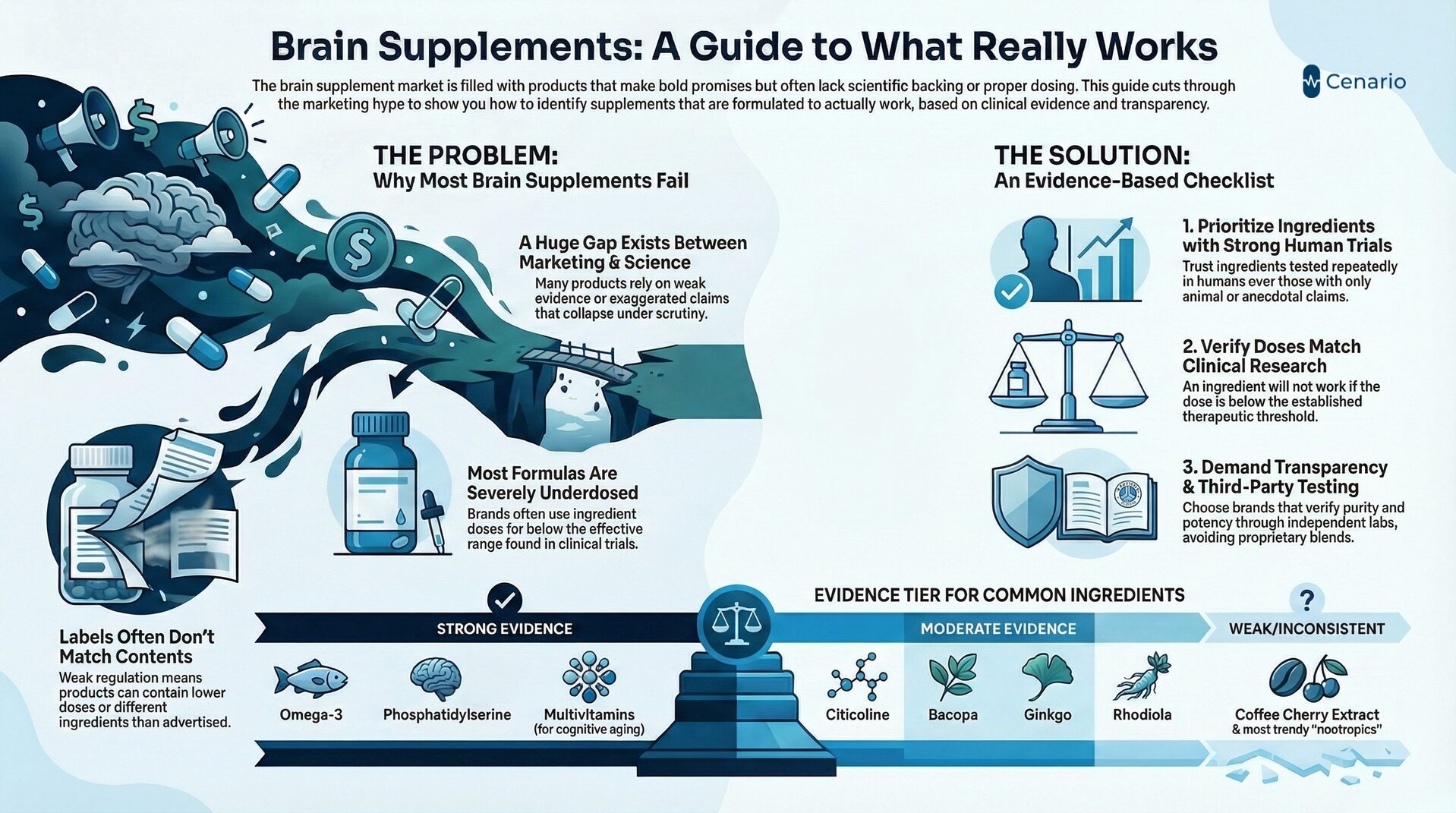
The supplement industry knows this. It sells cognitive enhancement as if it were simple. Bottles promise instant focus, limitless brain power, and productivity on demand. The reality is not that clean. The science behind these ingredients is uneven. Some compounds have strong clinical evidence. Others rely on marketing language, not data. The gap between what works and what sells is enormous, and most consumers do not know how to separate the two.
This creates a predictable problem. People buy the wrong products, take subtherapeutic doses, combine ingredients with overlapping mechanisms, and then wonder why nothing changes. The issue is not that brain supplements do not work. The issue is that most products are built poorly, underdosed, or based on claims that collapse under scrutiny.
Purpose of This Post
This post focuses on evidence and mechanism, not hype. It breaks down which brain supplements actually improve memory, focus, and cognitive processing, and which ones are mostly noise. You get a clear assessment of benefits, limitations, and safety considerations. No marketing. No exaggerated claims. The goal is to give you a framework to evaluate cognitive supplements without getting manipulated by the typical wellness-industry vocabulary.
Understanding Brain Supplements: Ingredients and Efficacy
Brain supplements are built around compounds that influence neurotransmitters, cellular energy, blood flow, or membrane integrity. The industry markets them as if everything works the same, but each ingredient operates in a completely different way. Phosphatidylserine is a good example. It is a structural phospholipid that supports membrane fluidity and signaling efficiency, which is why some trials show improvements in memory and processing speed. The effect is not dramatic, and it depends heavily on dose and extract quality, but it is one of the few ingredients with repeatedly positive data in older adults.
Coffee cherry extract is marketed aggressively, usually under claims about increasing BDNF. The antioxidant content is real, and there are early studies showing short term changes in neurotrophic markers, but the evidence is inconsistent and not strong enough to treat it as a primary cognitive enhancer. It is closer to a supportive compound rather than a core driver of performance.
Vitamins show up in almost every formula because they are required for basic neurological function. B6 and B12 are involved in neurotransmitter synthesis, and deficiencies in either will degrade cognitive performance. Vitamin E protects neurons from oxidative damage. These nutrients matter, but they only help if you are deficient. Most people expect nootropic effects from vitamins, but vitamins are maintenance tools, not performance enhancers.
The scientific evidence behind brain supplements varies more than consumers realize. Some ingredients have decades of research behind them, and others survive purely because marketing outpaces science. Phosphatidylserine, for example, has real human data and consistently shows modest cognitive benefits in specific groups, especially older adults with memory decline. Omega 3 fatty acids also have strong mechanistic support, but clinical outcomes differ depending on EPA to DHA ratios, baseline diet, and inflammation levels. The effectiveness is not universal, which is why results vary so widely between individuals.
The opposite end of the spectrum is filled with ingredients that appear in supplements simply because they sound convincing. They might have a promising animal study or one small human trial, and that becomes the foundation for an entire marketing campaign. This fuels the belief that all brain supplements behave the same, when in reality only a handful have reliable human data behind them.
Understanding this difference is the key to choosing effective products. Cognitive enhancement does not come from long ingredient lists or trendy extracts. It comes from compounds that have been tested repeatedly, in real humans, at doses high enough to create measurable biological change.
.jpg)
Interpreting the Evidence Graph: What Clinical Trial Volume Really Shows
The first graph exposes a reality most people never see. Some brain supplement ingredients have been tested repeatedly in controlled human trials, while others rely on weak or anecdotal claims. High trial volume does not guarantee effectiveness, but it does show that an ingredient has been investigated enough to understand its limits. Omega 3 is at the top because researchers have spent decades studying its role in membrane structure, inflammation, and cognitive aging. That depth of research gives you predictable outcomes, and it gives scientists a clear sense of what the ingredient can and cannot do.
Citicoline, Bacopa, Ginkgo, and Rhodiola form the middle tier. They each have a respectable amount of human data. These ingredients show measurable improvements in memory, processing speed, mental fatigue, or stress resilience when dosed correctly. Their trial volume is lower than Omega 3, but still high enough to justify their reputation as legitimate cognitive enhancers.
When an ingredient has very few human trials, the risk of exaggerated claims increases. Many products in the nootropic space rely on compounds that have only been tested in animals or in tiny, low quality studies. The graph makes the point clearly. Trust ingredients that have been tested often enough to understand their real biological effect.
.png)
Understanding the Dosing Range Graph: Why Most Products Underdose
The second graph explains the biggest problem in the cognitive supplement world. Most commercial formulas use doses that are far below the clinically effective range. Brands do this to reduce cost, extend profit margins, and make room for more ingredients on the label. Consumers get a formula that looks complex but has no chance of delivering meaningful biological change.
Real cognitive enhancement requires ingredients to reach specific thresholds. Bacopa needs several hundred milligrams of standardized extract before it influences memory pathways. Ginkgo needs a full clinical dose before it increases cerebral blood flow. Citicoline needs a high enough dose to influence acetylcholine production and phospholipid synthesis. Omega 3 requires gram level intake to shift membrane composition and inflammation markers. None of these effects happen at trace amounts.
The dosing range graph shows the gap between what works and what is sold. The lower points represent the minimum levels seen in real trials. The upper points show the full therapeutic ranges. If a supplement falls below this range, the ingredient will not deliver the cognitive benefits associated with its research. This gap explains why many people try brain supplements and feel no change. The formula itself was never built to work.
Why These Graphs Matter for Choosing a Brain Supplement
Once you understand the data behind these graphs, the market becomes easier to navigate. You can ignore complicated labels and focus on two simple questions. Does the ingredient have enough human research to justify using it, and is the dose in line with what studies actually used. Most products fail one or both of these criteria. The graphs give you a way to evaluate supplements without guessing, without relying on hype, and without falling for formulas designed to look impressive rather than perform.
.png)
Quality and Regulation Concerns
The brain supplement industry has a quality control problem. Labels often fail to match what is actually inside the product. Independent analyses regularly find formulas that contain lower doses than advertised, different extracts than declared, or ingredients that were never listed at all. This is not a minor issue. When labeling is inconsistent, nothing about the product’s safety or efficacy can be trusted. The problem persists because regulation is weak and manufacturers face almost no consequences for misrepresentation. Until oversight improves, the burden falls on consumers to separate legitimate formulas from unreliable ones.
Selecting Products That Are Actually Trustworthy
People assume supplements are standardized and tested, but the majority are not. The only reliable way to navigate this market is to favor brands that publish testing data, verify purity through independent labs, and commit to transparent formulation. Products that hide behind vague blends, inflated claims, or proprietary doses should be treated as a warning sign rather than a feature. Choosing a supplement becomes significantly safer when a company demonstrates that its ingredients match the label and that the formula has been validated outside of its own marketing.
The Role of Multivitamins in Cognitive Health
Large-scale clinical research has changed the conversation around multivitamins. For years, they were dismissed as general wellness add-ons with no clear cognitive benefit. Recent evidence contradicts that view. Studies involving older adults show that daily multivitamin use can slow the rate of cognitive aging by roughly two years. The improvements are not dramatic, but they are consistent, especially in memory-related tasks. The effect makes sense biologically. Even minor nutrient gaps can impair neurotransmitter synthesis and cellular metabolism, so correcting those gaps produces measurable cognitive differences over time. For people concerned about long-term brain health, multivitamins now carry stronger scientific justification than many of the trendier nootropic ingredients on the market.
Comparative Analysis: Multivitamins vs. Targeted Brain Supplements
When comparing multivitamins to targeted brain supplements, several differences emerge in terms of ingredients, intended outcomes, and scientific backing. Multivitamins typically offer a broad spectrum of essential nutrients that support overall health, including brain function. In contrast, targeted brain supplements often focus on specific ingredients like phosphatidylserine or coffee cherry extract, aiming to enhance particular cognitive functions such as memory or focus.
To illustrate these differences, the following table provides a comparative overview:
| Aspect | Multivitamins | Targeted Brain Supplements |
|---|---|---|
| Ingredients | Broad range of essential vitamins and minerals | Specific compounds like phosphatidylserine, coffee cherry extract |
| Target Outcomes | General health, cognitive maintenance | Enhanced memory, focus, attention |
| Scientific Backing | Strong evidence for overall health benefits | Varied; some ingredients have modest support |
Take the Cenario Quiz and get a personalized supplement plan built around your symptoms, not generic guesses.
Frequently Asked Questions
What are the most effective brain supplements?
A small group of ingredients consistently shows real cognitive effects in human studies. Phosphatidylserine and omega 3 are at the top because they have enough data to justify their claims. Their impact is measurable but not dramatic and depends heavily on dose, extract quality, and the user’s baseline health. Most other ingredients marketed as cognitive enhancers do not come close to this level of evidence.
Are brain supplements safe to use?
Most are safe for the general population, but “safe” does not mean consequence free. Some ingredients interact with medications, and others cause issues when doses exceed what the body can handle. People often assume supplements cannot cause harm because they are sold over the counter, which is false. If you take prescription drugs or have underlying conditions, you need medical oversight before adding anything new.
Can brain supplements replace a healthy lifestyle?
No. Supplements cannot compensate for chronic sleep loss, nutrient deficiencies, high stress, or physical inactivity. Cognitive performance is built on basic physiology. A supplement can amplify a system that already functions well but it cannot rescue one that is collapsing from poor habits. Anyone treating supplements as shortcuts will get mediocre results.
How can I choose a reliable brain supplement?
You choose based on evidence and transparency, not marketing. A legitimate product shows third party verification, publishes purity testing, and uses doses that match clinical research. Anything built around proprietary blends, vague claims, or flashy ingredient lists is designed to sell, not to work. Research the manufacturer, verify the science, and ignore anything that relies on hype instead of data.