

Supplement bundles solve a problem most people do not notice.
Buying single ingredients separately forces you into guesswork. You try one ingredient at a time, mix random formulas, and end up with overlap, contradicting mechanisms, and inconsistent results. People often assume more supplements create better outcomes, but physiology does not work that way. You get stable results only when ingredients are combined with a clear biological logic. That is the reason bundles exist. Not for aesthetics, but for predictable outcomes.
A well built bundle follows three rules.
One, every ingredient must target a different point in the pathway.
Two, dosing must sit inside clinical ranges, not marketing ranges.
Three, timing must match how the body operates across the day.
If those three are missing, the bundle is cosmetic and delivers weak output.
Bundled supplements can be useful or redundant depending on formulation and individual needs. This guide fits into our wider analysis of formulation strategy and supplement stacking within the core supplements knowledge category.
Why Supplement Bundles Exist
Most real world symptoms are multifactorial.
Stress involves cortisol rhythm, nervous system activation, sleep quality, and inflammatory signaling.
Mood involves serotonin, dopamine, inflammatory tone, HPA activity, and circadian stability.
Focus involves acetylcholine, dopamine, mitochondrial output, and blood flow.
Energy involves ATP production, metabolic enzymes, electrolytes, cortisol balance, and nutrient sufficiency.
Trying to fix these with one ingredient is inefficient. That is the biological equivalent of trying to fix an entire car by replacing a single bolt. You may get a tiny shift, but the system does not move enough to generate real change.
Supplement bundles exist because the body uses interconnected pathways.
Examples:
- Cortisol control requires adaptogens to regulate stress, magnesium to calm neural activity, and circadian support to correct evening alertness.
- Mood support requires a combination of anti inflammatory compounds, neurotransmitter precursors, and stress reduction to stabilize signaling.
- Cognitive performance requires dopamine support for motivation, choline donors for acetylcholine, B vitamins for methylation, and mitochondrial fuels for neural output.
Another reason bundles exist is consistency. When people build supplement stacks on their own, the dosing swings every day. They forget one ingredient, increase another, or run out and replace it with a cheaper substitute. That kills the cumulative effect. Bundles remove the variability and lock the routine into something stable.
Cost efficiency is another factor. Buying five separate ingredients at correct doses is usually more expensive than buying a combined formula that uses bulk ingredient sourcing.
Finally, bundles reduce decision fatigue. Most people are busy. They are not interested in reading twenty clinical trials across five pathways. They want a targeted outcome that does not require them to build the formula themselves.
When Bundles Actually Make Sense
Bundles only work when structured around clinical logic. That means each component must fill a distinct role.
For example:
- A stress bundle needs something that regulates cortisol output, something that calms the nervous system, and something that improves recovery.
- A focus bundle needs something that influences dopamine, something that supports acetylcholine, and something that improves cellular energy.
- A mood bundle needs something that targets serotonin pathways, something that reduces inflammation, and something that supports sleep quality.
When a manufacturer builds a bundle by adding random herbs with the same function, the formula becomes useless. You get redundancy and wasted capsule space. Effective bundles avoid this and operate like a synchronized system.
Why This Matters for Results
Biology rewards combinational approaches.
Cortisol drops faster when magnesium and phosphatidylserine both modulate the stress system.
Mood improves faster when saffron and omega 3s work together on serotonin and inflammation.
Focus improves faster when choline donors and mitochondrial fuels raise neural output at the same time.
If you want predictable, measurable improvement, you need multi pathway support.
This is why serious researchers almost never test single ingredients in isolation. Real world physiology does not operate in isolation.
-min.jpg)
Core Principles Behind Effective Bundles
A bundle only works when it respects biological structure. Most formulas fail because the creator focuses on marketing variety instead of mechanistic logic. You judge quality using four principles. These principles apply to every supplement category.
1. Mechanistic coverage
Your body does not run on single pathway switches. It runs on networks.
A bundle must cover multiple parts of the network without repeating the same function.
Example for stress:
- One ingredient lowers cortisol output.
- One ingredient reduces sympathetic nervous system activity.
- One ingredient improves recovery quality.
- One ingredient corrects circadian timing.
This creates cumulative stability.
Example for focus:
- One compound supports dopamine for motivation.
- One compound supports acetylcholine for precision and working memory.
- One compound supports mitochondrial output for energy.
- One compound supports blood flow for nutrient delivery.
When each ingredient plays a different role, the effect compounds.
When two ingredients perform the same task, you are paying for redundancy.
Most bad bundles fail here. They throw five adaptogens into one formula. All five do the same job. That delivers no meaningful improvement compared to one or two well chosen adaptogens at proper dose.
2. Correct clinical dosing
Underdosing is the fastest way to ruin a formula. Brands often shrink doses to squeeze more ingredients on the label. They do it for optics, not performance.
You can spot this instantly.
Low dose examples:
- 25 mg magnesium glycinate
- 5 mg saffron
- 30 mg ashwagandha extract
- 50 mg alpha GPC
- 25 mg CoQ10
- 10 mg ginseng
These do nothing. They sit far below the ranges used in clinical studies.
High quality bundles focus on fewer ingredients at real therapeutic levels.
Correct ranges look like this:
- Magnesium glycinate: 200 to 350 mg
- Saffron extract: 28 to 60 mg
- Ashwagandha (KSM 66 or Sensoril): 300 to 600 mg
- Alpha GPC: 300 to 600 mg
- CoQ10: 100 to 200 mg
- Panax ginseng: 200 to 400 mg
If a brand is serious, they hit these ranges. Anything lower is cosmetic.
3. Synergy without interference
This is where most DIY supplement stacks fail. They mix ingredients that cancel each other out or amplify side effects.
Good synergy examples:
- Rhodiola with tyrosine for clean mental energy and motivation.
- Magnesium with theanine for evening relaxation and sleep initiation.
- Lion’s mane with choline donors for neuroplasticity and sharper cognitive output.
- EPA heavy omega 3 with saffron for mood stability.
Bad synergy examples:
- Combining multiple stimulants inside a focus bundle. You get jittery output and stress spikes.
- Adding strong sedatives inside a mood bundle. You get emotional flattening.
- Putting high dose melatonin inside a sleep formula. You disrupt long term circadian rhythm.
- Combining high dose adaptogens indiscriminately. Some adaptogens raise cortisol in low cortisol individuals.
The goal is targeted synergy, not stacking everything that seems relevant.
4. Timing and lifestyle integration
Timing determines half the result.
If a formula is not designed around the body’s rhythm, its effectiveness drops sharply.
Examples:
- Cortisol regulators should be taken in the morning or early afternoon.
- Dopamine and acetylcholine supporters should be dosed in the earlier part of the day to avoid evening overstimulation.
- Sleep nutrients must be dosed in the evening to influence GABA activity, body temperature, and circadian signaling.
- Mood stabilizers that influence serotonin pathways should be dosed consistently at the same time each day.
Brands that ignore timing are not thinking about real human physiology.
A formula without timing guidance is a formula designed without a biological plan.
Why these four principles matter
They prevent you from wasting money, and they ensure that every capsule you take moves the needle.
The entire purpose of a bundle is to take advantage of well understood interactions between ingredients.
If a bundle fails even one of these principles, its effect will be weak, unreliable, or unpredictable.
Most people fail at evaluating supplement bundles because they rely on marketing descriptions instead of measurable criteria. These visuals show you how to judge a formula in under a minute.
Clinical Dosing Ranges
Brands often shrink doses to make the label look impressive. They add ten ingredients at micro doses that have no physiological impact. You avoid that trap by comparing any formula against clinical ranges that actually produce measurable changes in studies.
The chart reveals a clear pattern.
There is a large gap between “label doses” and “clinical doses.”
For example, most low quality formulas use about 50 to 100 mg of ashwagandha. Clinical studies use 300 to 600 mg.
Same problem with Alpha GPC. Most commercial products dose it at 50 mg. Research uses 300 mg or more.
This is why most supplement bundles feel weak. They do not meet the minimum threshold where biology responds.
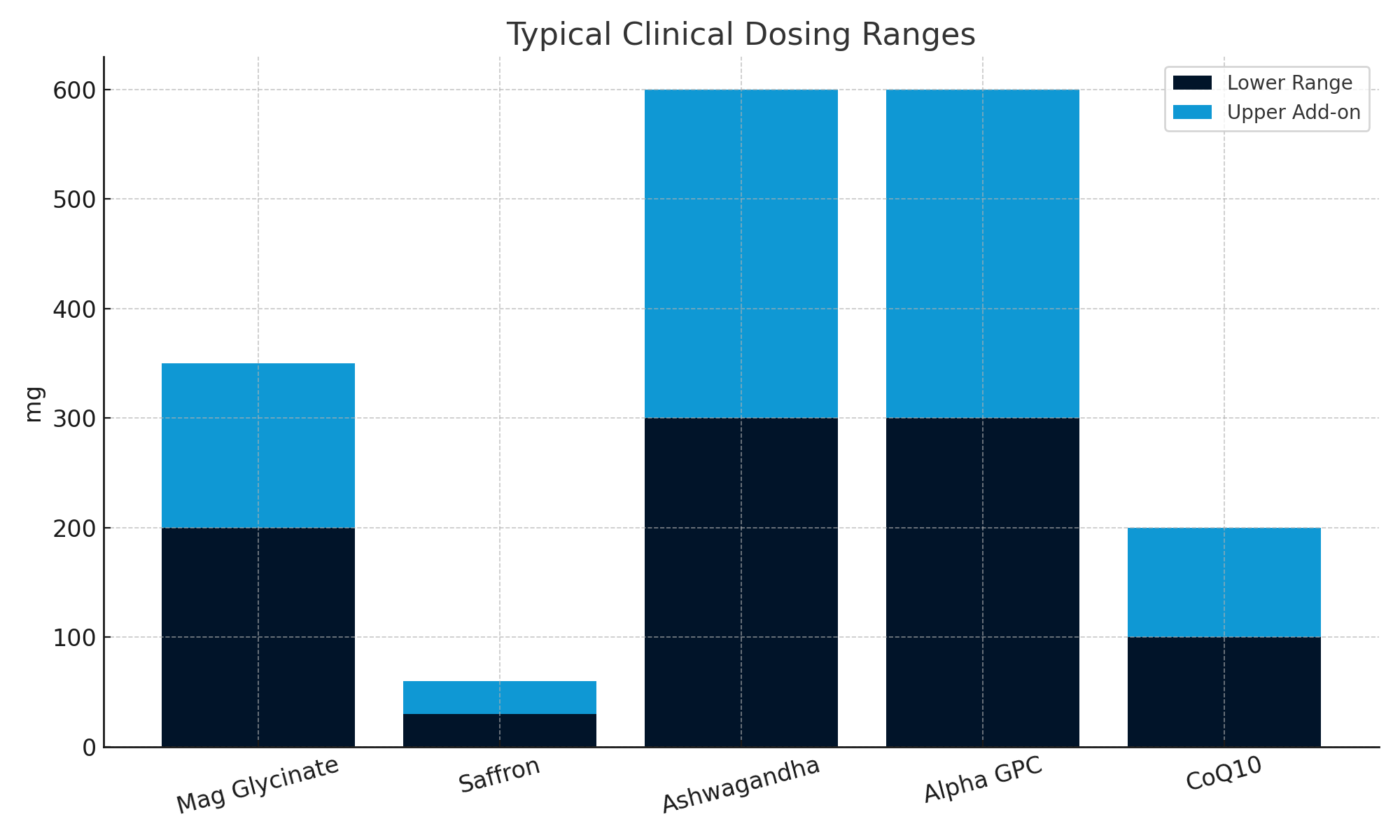
Download the chart and keep it as a reference when shopping.
What this chart actually shows you
- If a supplement hits the lower bar or above, it is in the real therapeutic range.
- If it sits far below the lower bar, it will not move the needle.
- If the upper bar is exceeded without a clear reason, the brand is compensating for weak ingredient form or trying to inflate perceived strength.
This single chart filters out ninety percent of bad formulas instantly.
Chart 2. Mechanistic Coverage
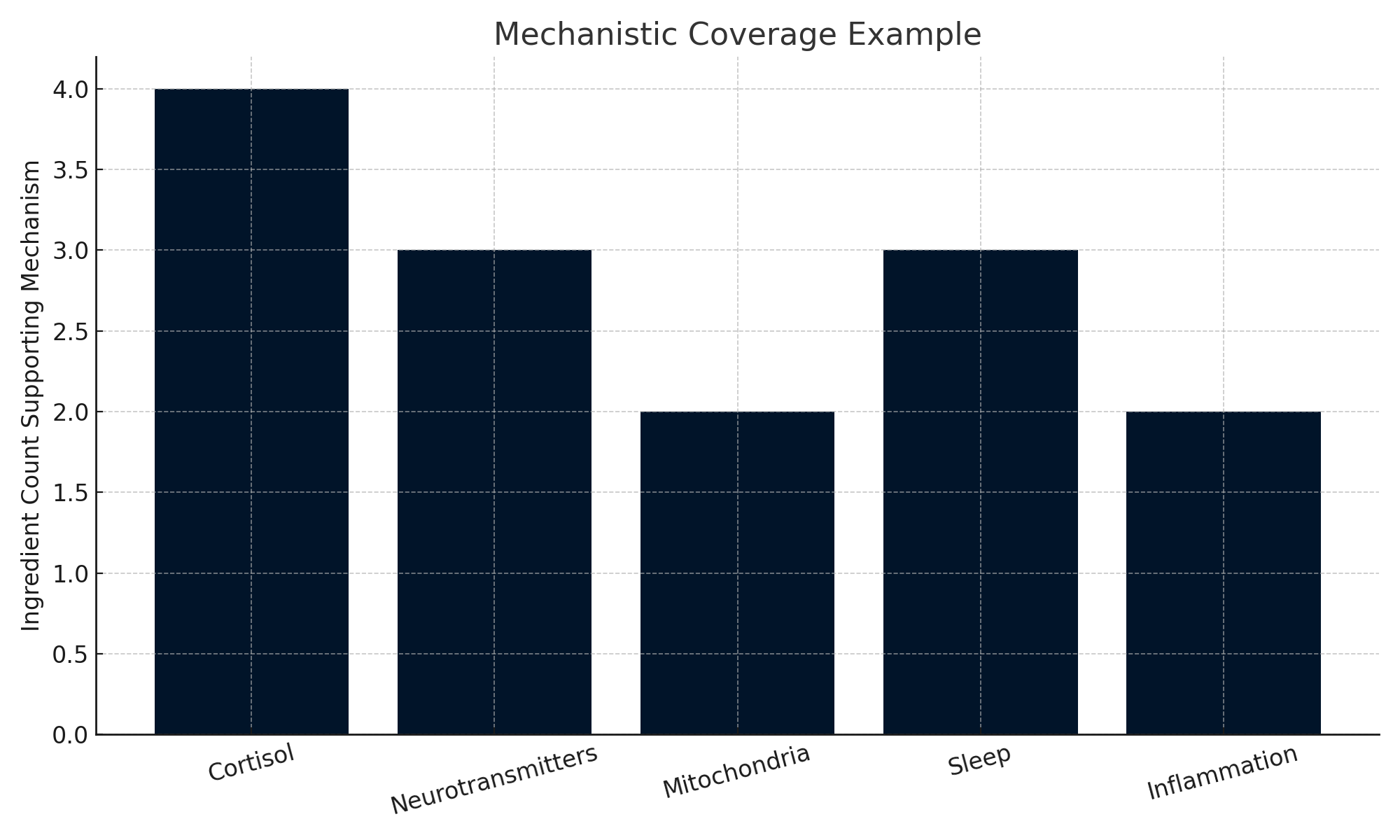
Bundled ingredients must cover different parts of the biological pathway. If a stress formula contains five adaptogens with identical actions, it is redundant. You get no additive benefit because all ingredients compete for the same mechanism.
A well thought out bundle spreads coverage across several systems.
For example:
- One ingredient lowers cortisol.
- One improves relaxation.
- One improves sleep quality.
- One supports inflammation control.
- One protects energy stability.
This is the type of layout shown in the chart.
The height of each bar represents how many ingredients support a specific biological mechanism in a balanced formula.
Why this chart matters
Mechanistic coverage determines whether a bundle produces a noticeable effect or just a minor change.
If all ingredients crowd into one pathway:
- You hit a ceiling quickly.
- You get no additional improvement.
- You waste capsule space.
If coverage is evenly distributed:
- Stress resilience goes up faster.
- Mood stability becomes more consistent.
- Focus and cognitive performance rise in a predictable way.
- Sleep improves because multiple factors are corrected at once.
This chart is the shortcut for identifying formulas built by people who understand biology instead of marketing.
How to Use These Charts When Evaluating Products
- Pull up any supplement bundle.
- Check every ingredient dose against the clinical ranges in Chart 1.
- Categorize each ingredient according to mechanism using the categories in Chart 2.
- If you see underdosed ingredients plus repeated mechanisms, the bundle is weak.
- If you see clinical doses plus distributed mechanisms, the bundle is well engineered.
This process takes less than two minutes once you understand it.
It also prevents wasting money on formulas that look complex but do nothing.

Who Should Actually Use Supplement Bundles
Bundles are not for everyone. They are for people who want predictable outcomes without wasting time testing single ingredients one at a time. The body responds better when multiple pathways are corrected simultaneously, and bundles simplify the process by giving you a structured system instead of a scattered approach.
Who benefits the most
- People with clusters of symptoms instead of isolated issues.
- People who want measurable improvements in stress, mood, focus, sleep, or energy.
- People who want fewer daily decisions and a consistent routine.
- People who prefer clinically aligned dosing without researching each ingredient.
Bundles are also useful for people who have tried random supplements with weak results. The issue is usually poor dose planning or inconsistent timing. Bundles fix that.
Who should avoid bundles
- Anyone trying to fix a single, narrow issue. A single ingredient is more efficient in that case.
- Anyone already taking many supplements. Bundles on top of that create overlap.
- Anyone managing a medical condition that requires physician oversight.
- Anyone expecting prescription level outcomes. Bundles support biology. They do not replace clinical treatment.
How to choose the right category
Pick the bundle that matches the dominant issue, not all possible issues.
If your primary problem is stress, start with a stress bundle.
If your main problem is sleep, start with sleep recovery.
If your primary issue is low daytime output, pick focus or energy.
People ruin their progress by stacking three categories at once. Start with one, evaluate, then adjust.
How long it takes to see results
Different systems respond at different speeds.
- Stress regulation starts improving within days.
- Focus and motivation improve within hours to days.
- Mood stability improves across two to four weeks.
- Sleep quality improves within one to two weeks.
- Energy output improves once nutrient levels stabilize.
The timeline you experience depends on baseline deficiencies, sleep habits, stress load, and training volume.
The main reason bundles work
Biology rewards combined approaches.
When cortisol, neurotransmitters, inflammation, and circadian signals improve together, the overall system becomes more stable.
A single supplement rarely shifts the system enough to matter.
A well engineered bundle does.
Take the Cenario Supplement Quiz and get a personalized plan based on your symptoms today!
Frequently Asked Questions
Are supplement bundles safe?
Yes, when they use proper dosing and avoid duplicate mechanisms. Safety becomes a problem only when brands underdose, mix stimulants, or stack too many sedatives.
Can I take multiple bundles at the same time?
You should not stack more than two categories. For example, stress plus sleep works. Focus plus energy works. Stress plus focus plus sleep is excessive and leads to interference.
Do bundles replace lifestyle changes?
No. They amplify the return you get from sleep, diet, and recovery. If those are broken, results weaken.
How do I know if a bundle is underdosed?
Compare ingredient amounts to clinical ranges. Anything far below the typical range in Section 2 will not produce meaningful effects.
Can I build my own bundle instead?
Yes, but most people end up with dosing errors. They also buy ingredients that overlap. A well built bundle solves both problems.
Do bundles work for severe mood or stress problems?
They support mild to moderate symptoms. Severe cases require medical intervention. Use bundles to strengthen the baseline, not to replace treatment.
Should I take bundles every day?
Yes for mood, stress, and sleep formulas.
For focus and energy formulas, use them on work days or performance days.
.