
Understanding Cortisol and Its Impact
Cortisol is not simply the stress hormone. It is a central regulatory signal that keeps you alive by adjusting energy availability, immune activity, blood pressure, and neural alertness. The problem is not cortisol itself. The problem is a system that stays switched on long after the threat is gone.
The adrenal glands release cortisol when the brain detects a stressor. Early in the day, cortisol rises naturally to wake you. Throughout the day it responds to psychological stress, physical strain, inflammation, and blood sugar fluctuations. At night, cortisol should drop to allow melatonin to rise. That pattern is called the diurnal cortisol curve. When it is stable, you feel alert in the morning and calm at night. When it is distorted, you get a mix of fatigue, anxiety, irritability, weight gain, and poor sleep.
Chronic stress keeps the hypothalamic pituitary adrenal axis firing constantly. This flood of signals forces the body into permanent vigilance. Over time, this causes measurable changes in memory, sleep architecture, insulin sensitivity, appetite regulation, muscle protein synthesis, and inflammatory activity.
You do not need intuition to understand this. The biology is straightforward. Persistent stress elevates cortisol. Elevated cortisol shifts metabolic priorities. These shifts create symptoms that people identify as burnout, anxiety, low motivation, poor recovery, or midsection fat gain.
Reducing cortisol effectively requires understanding stress pathways and hormonal feedback loops. This article complements our in-depth coverage of stress-related supplementation in the stress and supplement strategy hub.
How Elevated Cortisol Affects Health
Cortisol does not just make you feel stressed. It changes how the body behaves at a systemic level.
Appetite and weight regulation
High cortisol pushes the body toward easily available fuel. This increases cravings for sugar and processed carbohydrates. It shifts fat storage to the abdominal region because visceral fat reacts strongly to cortisol. This is why people under chronic stress develop central fat even if their diet has not changed.
Sleep disruption
Cortisol suppresses melatonin. When cortisol stays high at night, your brain cannot enter deep sleep efficiently. You fall asleep slower and wake up more often. Poor sleep then increases cortisol further. This feedback loop is one of the primary drivers of chronic stress symptoms.
Mood and cognitive effects
Long term high cortisol reduces hippocampal volume and interferes with memory formation. It increases amygdala activation, which heightens fear, irritability, and anxiety. That is why people under chronic pressure feel mentally scattered and emotionally reactive.
Immune and inflammatory changes
Short term cortisol suppresses inflammation, which is useful. Chronic exposure causes immune dysfunction. You become more prone to illness yet also more inflamed at baseline. This double effect contributes to fatigue and joint pain.
Physical stress and recovery
Cortisol increases protein breakdown to release amino acids for energy. This slows muscle repair and makes recovery from training less efficient. Athletes with chronically high cortisol see slower progress and greater injury risk.
Most symptoms people associate with modern stress are direct downstream effects of disrupted cortisol patterns.
Supplements as a Solution
People gravitate toward supplements because they want a controllable intervention that does not require restructuring their entire lifestyle. Supplements work when they modify the HPA axis, improve sleep quality, modulate neurotransmitters, or correct nutrient deficiencies.
They do not work when lifestyle factors remain chaotic. If you sleep at inconsistent hours, dose yourself with caffeine late in the day, and run on chronic stress, supplements become background noise.
The correct framing is simple. Supplements are tools that support the nervous system. They are not substitutes for behavioral or environmental control.
The Search for the Best Supplement
People searching for cortisol relief have two motivations. First, they want practical ways to reduce stress symptoms. Second, they want a supplement they can buy immediately. This dual intent requires content that separates effective products from weak ones without overselling anything.
The essential rule is that no supplement is universally best. Supplement choice depends on the source of the stress, the severity of the symptoms, sleep quality, caffeine habits, training volume, medications, and baseline deficiencies.
Most people do not consider any of these variables, which is why they get poor results.
Scientific Backing and Individual Needs
You only get meaningful cortisol reduction if you match the supplement to the stress profile. A supplement that works for psychological stress may not help with circadian disruption or overtraining.
You also need to filter out evidence that cannot be trusted. Manufacturer-funded trials often show inflated effects. Small pilot studies cannot be generalized. Mechanisms matter more than marketing.
Top Supplements for Reducing Cortisol
Ashwagandha
Ashwagandha regulates cortisol by dampening excessive HPA axis activity. Trials consistently show meaningful reductions in perceived stress and morning cortisol. It also improves sleep quality and resilience under sustained pressure.
Key points:
- Best for chronic psychological stress.
- Works on both cortisol and anxiety pathways.
- Strong evidence compared to most adaptogens.
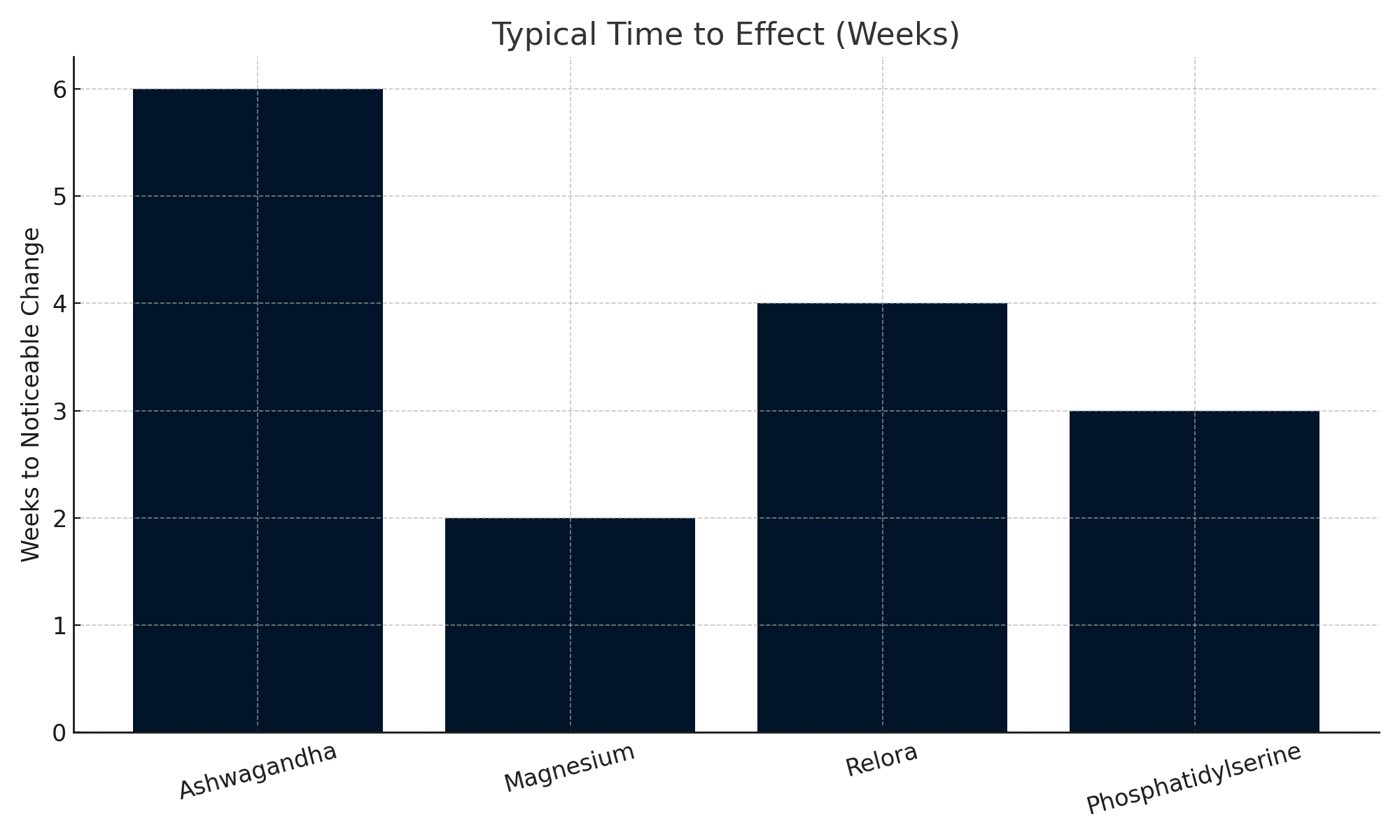
- Results require four to eight weeks at proper dosing.
It is not a stimulant and not a sedative. It shifts the system toward balance.
Magnesium
Magnesium does not blunt cortisol directly. It reduces nervous system tension, improves sleep, and stabilizes neuromuscular signaling. These effects reduce the triggers that keep cortisol elevated.
Key points:
- Best for sleep disruption, anxiety, and tight muscles.
- Works mainly through GABA activity and NMDA receptor regulation.
- Most useful in people with low dietary intake.
- Fast subjective impact but indirect cortisol modulation.
Magnesium is a baseline regulator. Not a cortisol suppressor.
Magnolia and Phellodendron (Relora)
Relora reduces stress related eating, improves mood, and lowers subjective stress levels. Cortisol reduction appears in some studies but is less consistent than the psychological benefits.
Key points:
- Fastest supplement for feeling “calmer” without sedation.
- Works best for mental tension and emotional stress.
- Noticeable within four weeks.
This is a direct mood stabilizer rather than a broad adaptogen.
Phosphatidylserine
Phosphatidylserine reduces cortisol spikes caused by heavy training or prolonged physical stress. It improves recovery and stabilizes mood post workout.
Key points:
- Ideal for athletes and high volume exercisers.
- Does not help much with psychological stress.
- Useful for people with evening cortisol elevation after training.
It solves a specific problem instead of general stress.
Specialty Compounds
Cortitrol, tangeretin, and NAD boosters have narrow use cases. Some influence inflammation or cellular energy, but their cortisol impact is secondary.
They should not be top choices unless you have a specific biological reason to use them.
Comparative Analysis of Supplements
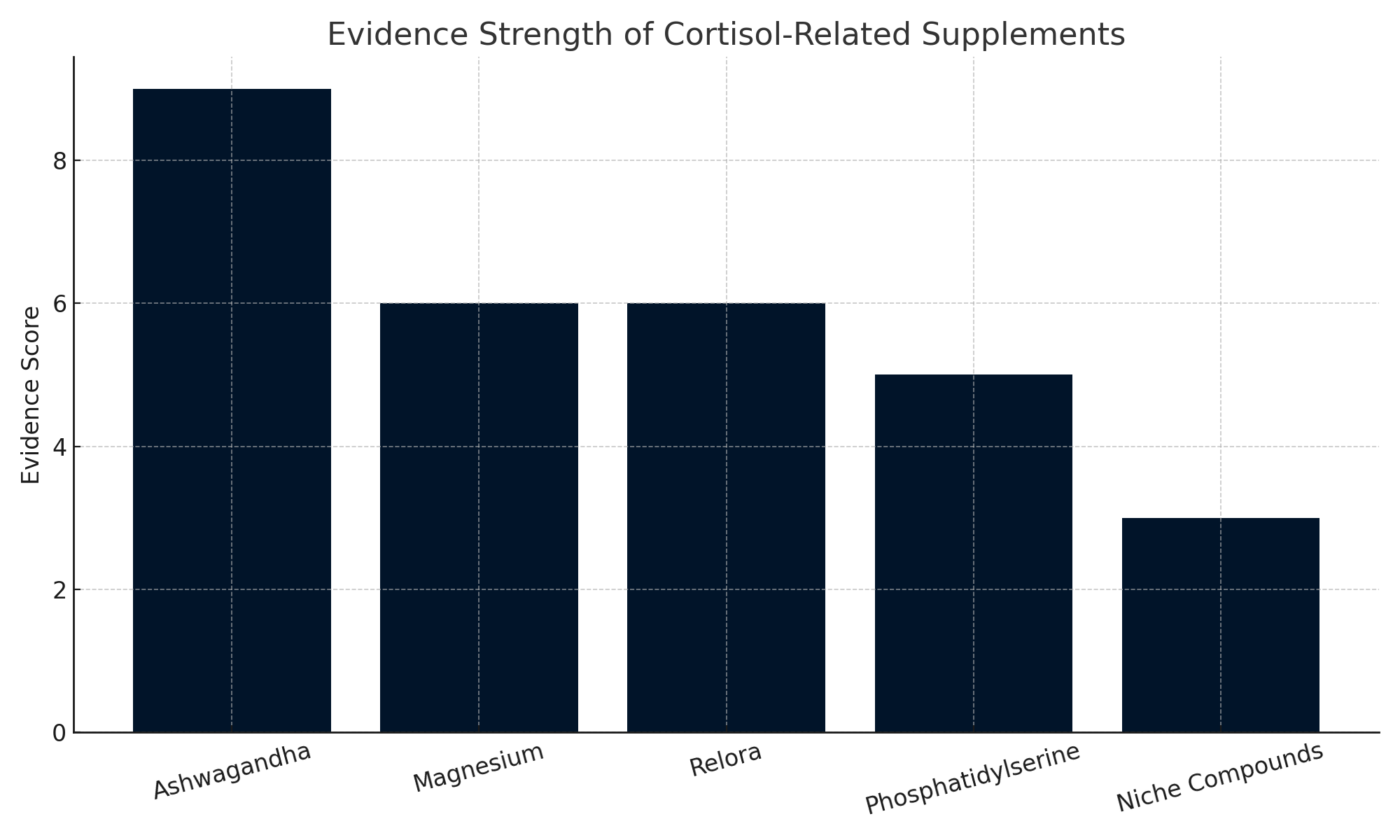
Evidence hierarchy:
- Ashwagandha is strongest.
- Magnesium, Relora, and phosphatidylserine are moderate.
- Niche compounds are low.
Time to effectiveness:
- Relora is fastest.
- Ashwagandha requires consistent dosing.
- Magnesium depends on deficiency correction.
- Phosphatidylserine works rapidly for exercise stress.
Cost:
- Magnesium is cheapest.
- Ashwagandha is moderate.
- Phosphatidylserine and specialty ingredients are higher cost.
Use case matching is the most important variable. You choose based on your stress profile, not based on a top ten list.
Strategic Considerations for Choosing a Supplement
Choosing a cortisol supplement without understanding your stress pattern is guesswork. The supplement industry tries to sell you on universal solutions. Biology does not work that way. Stress has different origins, different mechanisms, and different downstream effects. You match the supplement to the mechanism, not the marketing.
Below are the expanded strategic frameworks you actually need.
Specific Use Cases
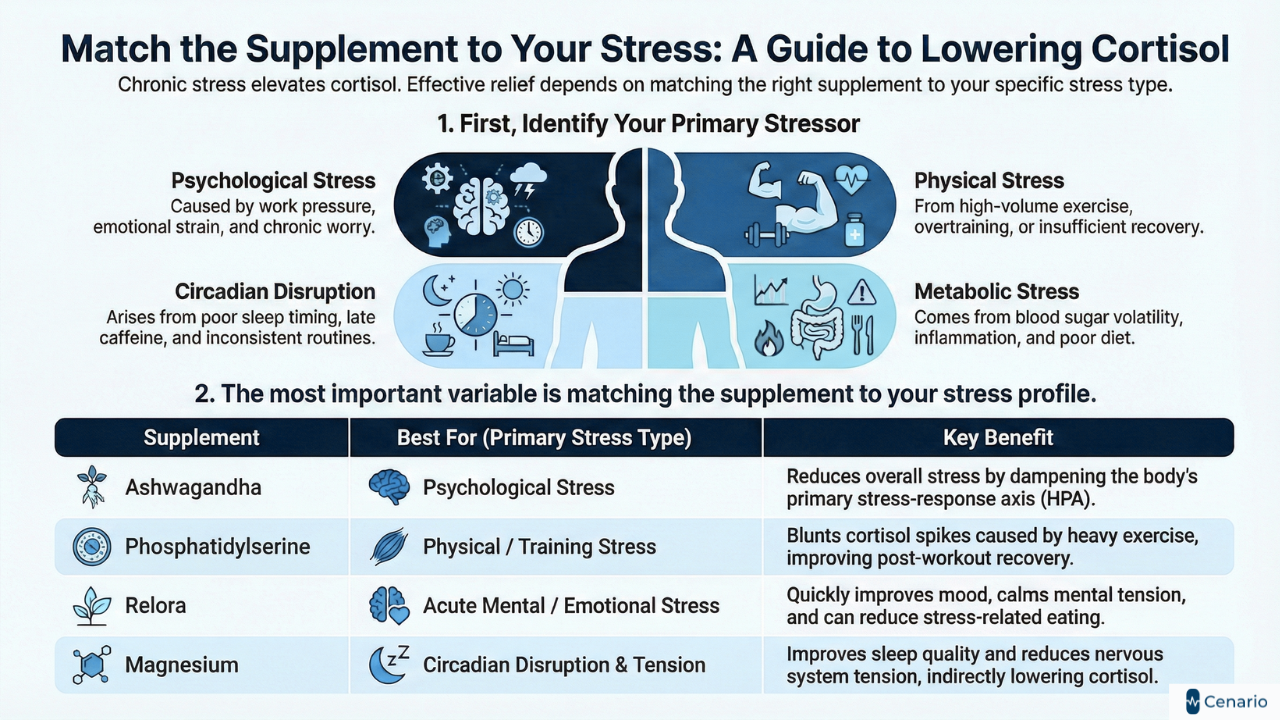
Stress is not one thing. It comes from at least four different sources, and each pattern responds to different interventions.
1. Psychological Stress
This comes from work pressure, emotional strain, chronic worry, or overthinking. Psychological stress keeps the HPA axis activated even when the body is physically rested.
Best choices:
- Ashwagandha for broad HPA modulation.
- Relora for fast mood-calming effects.
- Magnesium if sleep quality is part of the problem.
2. Circadian Disruption
This comes from poor sleep timing, inconsistent wake cycles, late caffeine intake, late workouts, screens at night, and irregular routines.
Best choices:
- Magnesium for sleep quality.
- Ashwagandha for evening relaxation.
- L theanine if stimulation is excessive.
Most cortisol supplements fail if the circadian rhythm is broken. Fixing rhythm multiplies supplement effectiveness.
3. Physical or Training Stress
This comes from high workout volume, insufficient recovery, caloric deficit, or overtraining. Cortisol spikes here are not “bad,” but they become problematic when elevated chronically.
Best choices:
- Phosphatidylserine to blunt training induced cortisol spikes.
- Magnesium for muscle relaxation and recovery.
- Carbohydrate timing during training if cortisol is elevated post workout.
4. Metabolic Stress
This comes from blood sugar volatility, poor diet, inflammation, and chronic low grade immune activation.
Best choices:
- Ashwagandha for HPA support.
- Magnesium for insulin sensitivity.
- Omega 3 if inflammation is contributing.
Ignoring the type of stress leads to weak outcomes. Identifying the source is the first step in choosing the correct supplement.
Personalization Framework
Most people buy supplements based on symptoms. That is the wrong entry point. You get better results by starting with mechanism.
Use this decision structure:
Step 1: Identify cortisol pattern
- Trouble winding down at night: evening cortisol high
- Morning fatigue: morning cortisol low
- Midday crash: irregular cortisol curve
- Anxiety spikes: HPA hyperreactivity
- Overtraining: exercise induced cortisol spikes
Step 2: Identify dominant stressor
Psychological, metabolic, circadian, physical.
Step 3: Match supplement
- Ashwagandha for chronic systemic overactivation
- Magnesium for sleep and baseline tension
- Relora for acute mental stress
- Phosphatidylserine for exercise stress
- L theanine for caffeine modulation
Step 4: Remove conflicts
Check medications, caffeine habits, sleep schedule, alcohol use, and training load. Supplements will not override poor habits.
This framework removes 90 percent of the guesswork.
Cost Benefit Analysis
Cost matters because many people attempt long term supplementation. You need to know what delivers the highest return per dollar.
High Return, Low Cost
- Magnesium: strong baseline benefits, especially if deficient.
- Ashwagandha: moderate cost with strong evidence.
Mid Tier Return
- Relora: noticeable effects, slightly higher cost.
- L theanine: inexpensive but limited impact on cortisol itself.
Low Return, High Cost
- NAD boosters: overpriced for cortisol effects.
- Tangeretin: niche compound with unclear cost effectiveness.
- Novel “anti stress” blends: usually underdosed and expensive.
The smart move is to start with high ROI compounds and only add niche products if you have a specific identified need.
Stack and Synergy
Stacking only works when mechanisms complement each other. The mistake is combining five supplements that all do the same thing.
Best stacks:
Ashwagandha + Magnesium
This handles psychological stress and sleep quality. It is the most reliable two piece stack for general stress.
Ashwagandha + Relora
This is for people with both chronic HPA elevation and acute emotional stress. Use it for short periods, not long term.
Phosphatidylserine + Magnesium
Ideal for athletes. One controls the cortisol spike. The other improves recovery and sleep.
L Theanine + Magnesium
For people who take caffeine but want to stabilize its impact.
Avoid stacks like multiple adaptogens (ashwagandha, rhodiola, schisandra, holy basil). They overlap too much and give diminishing returns.
Lifestyle Integration
Supplements amplify lifestyle. They cannot replace basic stress interventions. The fastest way to flatten cortisol is still behavioral.
Most impactful lifestyle changes:
- Strict sleep window within the same one hour each night.
- Zero caffeine past 2 pm.
- Bright morning light exposure for cortisol rhythm reset.
- Reduced late night screen exposure.
- Carb centric evening meals for relaxation.
- Consistent training instead of sporadic intense sessions.
If these are unstable, supplement results will be weaker.
Take our quiz and get a personalized plan that shows exactly which nutrients your symptoms point to.
Frequently Asked Questions
How do I know if my cortisol is high without doing a lab test?
You can identify patterns through symptom clusters.
High evening cortisol shows up as difficulty winding down, racing thoughts at night, and fragmented sleep.
Morning low cortisol shows as grogginess, caffeine dependence, and slow mental activation.
Frequent irritability, sugar cravings, and abdominal fat gain also point toward cortisol dysregulation.
Labs help, but symptoms often tell the story clearly.
Are cortisol supplements safe to take long term?
Most evidence-based compounds like magnesium, L-theanine, and ashwagandha are safe when used at clinical doses.
However, cortisol-specific agents like phosphatidylserine or Relora are best used strategically, not continuously, because long-term suppression may blunt normal stress responses.
The safer approach is cycles: 8–12 weeks on, followed by reassessment.
Will cortisol supplements help if I’m also consuming caffeine daily?
They can help, but results are weaker if caffeine intake is high or taken late in the day.
Caffeine elevates cortisol, increases HPA activation, and delays recovery.
If you want stronger results, reduce caffeine after 2 pm or switch half your intake to L-theanine-paired coffee to blunt stimulant-driven stress.
Can cortisol supplements help with emotional eating or cravings?
Yes, specifically Relora and ashwagandha.
High cortisol increases hunger for fast-energy foods (sugar, processed carbs).
Relora has human data showing reductions in stress-driven eating, while ashwagandha reduces the psychological stress that triggers cravings.
They work best when paired with stable meal timing and improved sleep.
.