
In a world filled with pressure, uncertainty, and emotional turbulence, learning how to navigate your thoughts and feelings without being overwhelmed is crucial for long-term mental well-being. Acceptance and Commitment Therapy (ACT), pronounced as “act” – offers a fresh and highly effective approach to handling the challenges of life.
Unlike traditional forms of psychotherapy that often focus on symptom reduction or thought control, commitment therapy ACT emphasizes psychological flexibility, mindfulness, and values-based living. This comprehensive guide will explore ACT in-depth, revealing how it works, why it’s effective, and how it can transform your quality of life.
What is Acceptance and Commitment Therapy?
Acceptance and Commitment Therapy (ACT) is a modern, evidence-based form of psychotherapy rooted in behavioral science. It was developed in the 1980s by psychologist Steven C. Hayes and has become a widely accepted approach in both clinical settings and self-help programs.
At its core, ACT helps individuals accept difficult internal experiences, such as painful thoughts, emotions, and memories, while simultaneously encouraging them to take meaningful, values-driven actions. Rather than trying to eliminate negative thoughts and feelings, ACT teaches us to develop a healthier relationship with them, allowing us to live more fully and intentionally in the present moment.
The Philosophy Behind Commitment Therapy ACT
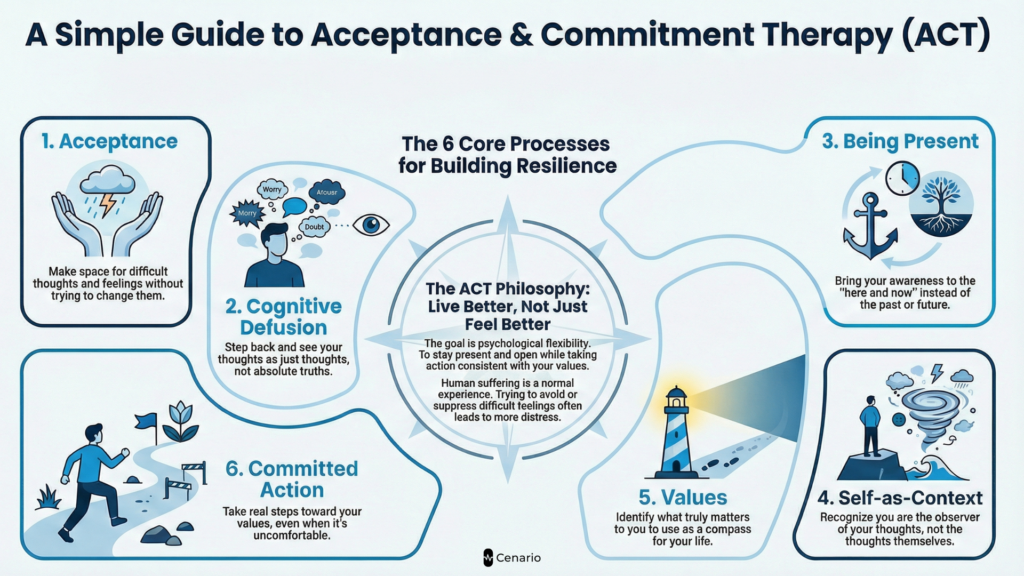
ACT is grounded in the belief that suffering is a natural part of the human experience. Trying to avoid or suppress difficult thoughts, emotions, or memories often leads to more psychological distress. Instead of fighting these experiences, ACT encourages acceptance, mindfulness, and purposeful action.
The goal of ACT is not to help people feel better, but to help them live better. That distinction matters.
ACT is based on increasing psychological flexibility, your ability to stay present and open, regardless of how you feel, while still taking steps that are consistent with your values. In other words, ACT empowers you to live a meaningful life even when life gets tough.
The Six Core Psychological Processes of ACT
The model of acceptance and commitment therapy is structured around six core psychological processes, which work together to promote psychological flexibility. These six pillars provide the foundation for emotional resilience, effective behavior, and improved mental health.
1. Acceptance
Acceptance in ACT means actively embracing difficult thoughts and feelings without trying to change, suppress, or avoid them. This doesn’t mean giving up or being passive, it means letting go of the internal battle and making space for all aspects of the human experience.
Example: Instead of distracting yourself from anxiety, you allow yourself to feel it and observe it without judgment.
2. Cognitive Defusion
Cognitive defusion is the process of stepping back from your thoughts and seeing them for what they are, just words, not absolute truths or commands. It helps you break free from the mental traps that often dictate your behavior.
Example: Rather than thinking, “I’m a failure,” you can say, “I’m having the thought that I’m a failure,” which creates distance and reduces the thought’s impact.
This process is crucial for creating flexibility in your response to your internal experiences.
3. Being Present (Contact with the Present Moment)
ACT emphasizes mindfulness and present-moment awareness. Instead of getting lost in regrets about the past or worries about the future, ACT helps you bring your attention to the present moment, where life actually happens.
This process enhances clarity, awareness, and the ability to respond effectively rather than react automatically.
Practice: Simple grounding techniques like noticing five things you see, four things you hear, or three things you feel can reconnect you to the now.
4. Self-as-Context
In ACT, self-as-context is the idea that there is a part of you, your observing self that remains constant even as your thoughts and feelings change. It’s a deeper sense of self that is distinct from the content of your experiences.
Benefit: This psychological process allows you to recognize that you are not your thoughts or emotions, you are the awareness behind them.
5. Values
Your values are your chosen life directions, what truly matters to you at your core. They act as a compass, guiding your behavior and decision-making in meaningful ways.
ACT helps you clarify your values so you can live in alignment with them, even when it’s uncomfortable. This gives life a deeper sense of meaning and purpose.
Questions to ask: What do I want to stand for? What kind of relationships do I want to build? What matters most to me?
6. Committed Action
Once you’ve clarified your values, ACT encourages committed action, taking real steps toward your goals, even in the presence of fear, doubt, or emotional discomfort.
This process involves setting achievable goals, staying consistent with your values, and acting with persistence over time.
Example: If you value connection but fear social situations, committed action might mean reaching out to a friend or attending a group, even if it feels uncomfortable.
The Role of Mindfulness in ACT
Mindfulness is one of the foundational skills in Acceptance and Commitment Therapy (ACT). In ACT, mindfulness means bringing your full attention to the present moment, not just in a meditative way, but as a way of living. It helps individuals become aware of their thoughts and feelings without judgment or the need to control them.
This awareness allows people to experience life more directly, without being ruled by past regrets or future anxieties. Instead of reacting automatically or trying to avoid discomfort, mindfulness helps create psychological flexibility, the ability to consciously choose actions aligned with your values.
Key Benefits of Mindfulness in ACT:
- Reduces emotional reactivity
- Builds tolerance for distressing internal experiences
- Enhances clarity in decision-making
- Supports cognitive defusion (i.e., detaching from unhelpful thoughts)
Mindfulness Tip: Try a “3-minute breathing space” during your day. Pause, notice your breath, observe your body, and gently bring awareness to your surroundings. This simple practice strengthens your ability to stay grounded and responsive.
Values Clarification: The Compass of ACT
A unique and powerful element of ACT is its emphasis on values. In this context, values are not goals or achievements but guiding principles, the qualities of being and living that matter most to you. They represent what gives your life meaning.
ACT uses structured values clarification exercises to help individuals identify these core values. Once clear, these values serve as a compass, guiding committed action even in the face of difficult emotions or fears.
Common ACT Values Exercises:
- Write Your Own Eulogy: What would you want people to say about your life?
- Top Values List: Choose 3–5 values from a longer list, and reflect on how well you’re living them.
- Journaling Prompt: “What would I do if fear didn’t hold me back?”
When values are clear, you become more willing to experience emotional discomfort if it means living in alignment with what really matters to you.
ACT for Common Mental Health Conditions
ACT isn’t a one-size-fits-all therapy, it’s a versatile, evidence-based approach that addresses universal psychological processes. Because of this, it has been shown to be effective for a wide range of mental health conditions.
Here’s how ACT supports recovery in different areas:
- Anxiety Disorders: Helps individuals stop avoiding anxiety and instead learn to accept it, reducing its control over daily life.
- Depression: Encourages action toward meaningful goals even when motivation is low, breaking patterns of avoidance.
- Chronic Pain: Supports pain acceptance and helps individuals engage more fully in life despite discomfort.
- PTSD and OCD: Teaches clients to relate to traumatic or intrusive thoughts without being consumed by them, reducing avoidance and fear responses.
Because ACT targets the way we relate to our thoughts and feelings, it can be applied across age groups, cultures, and clinical diagnoses, making it one of the most flexible and inclusive therapeutic models available.
ACT vs. Other Popular Therapies
Many people wonder how commitment therapy ACT compares to more traditional therapies like CBT (Cognitive Behavioral Therapy) or DBT (Dialectical Behavior Therapy). Here’s a simplified comparison:
| Therapy | Primary Focus | Thought Strategy | Use of Values |
|---|---|---|---|
| CBT (Cognitive Behavioral Therapy) | Symptom reduction | Identify and challenge distorted thoughts | Secondary or optional |
| DBT (Dialectical Behavior Therapy) | Emotional regulation & skill-building | Mindfulness, validation, and coping skills | Less emphasized |
| ACT (Acceptance and Commitment Therapy) | Psychological flexibility & values-based living | Accept and defuse from unhelpful thoughts | Central and essential |
Key Difference:
Unlike CBT, which aims to correct irrational thoughts, ACT helps you change your relationship to your thoughts. Instead of battling or replacing them, you learn to observe them, make room for them, and still take action toward your values.
This shift from “control” to acceptance and action is what makes ACT so empowering and sustainable.
The Science Behind ACT: Why It Works
ACT is not just a feel-good philosophy, it’s a deeply researched, evidence-based therapy with a strong scientific foundation. Over 300+ randomized controlled trials (RCTs) have confirmed its effectiveness for a variety of challenges, including:
- Anxiety and depression
- Substance use disorders
- Chronic illness and pain
- Stress, burnout, and trauma
- Emotional regulation and relationship distress
ACT is officially recognized by major organizations such as the American Psychological Association (APA) and the National Institute for Health and Care Excellence (NICE) in the UK as an effective treatment for numerous mental health conditions.
By focusing on psychological flexibility, ACT creates lasting improvements in both symptom management and overall quality of life, even when painful experiences continue to exist.
ACT in Practice: The “Leaves on a Stream” Exercise
Here’s a simple but powerful ACT technique that illustrates mindfulness and cognitive defusion in action:
“Leaves on a Stream” Visualization
- Close your eyes and imagine sitting beside a gentle, flowing stream.
- Visualize each of your thoughts pleasant or unpleasant as leaves floating on the water.
- As a thought arises, place it on a leaf and watch it gently drift by.
- Don’t try to stop the thoughts or push them away just notice them and let them pass.
- Keep returning your focus to the stream and your breathing.
This exercise helps you observe your thoughts without becoming entangled in them, and builds your ability to stay in the present moment.
How ACT Improves Mental Health and Quality of Life
The ultimate aim of ACT is to improve your ability to live a rich, full, and meaningful life, not to avoid pain or eliminate all symptoms.
Benefits of Practicing ACT:
- Reduced anxiety and depression
- Increased engagement in life
- Stronger, more fulfilling relationships
- Greater emotional resilience
- Improved overall quality of life
ACT works because it frees you from the struggle with your inner world and helps you focus your energy on what truly matters, values-based living.
Who Can Benefit from ACT?
ACT is used successfully to help individuals facing a wide range of challenges, including:
- Generalized Anxiety Disorder (GAD)
- Major Depression
- Obsessive-Compulsive Disorder (OCD)
- Post-Traumatic Stress Disorder (PTSD)
- Eating Disorders
- Chronic Pain and Health Conditions
- Substance Use
- Stress and burnout
But ACT is not just for clinical diagnoses, it’s also incredibly useful for anyone feeling stuck, overwhelmed, or disconnected from their purpose. Because it focuses on universal human experience, ACT can help anyone build a more resilient, mindful, and meaningful life.
Final Thoughts: Living a Rich and Meaningful Life
At its essence, acceptance and commitment therapy invites us to be present, open, and committed, to embrace our full internal experiences without avoidance, and to take action aligned with our values. This is the path to true freedom not the absence of pain, but the freedom to live fully with it.
ACT recognizes that the human experience is messy, complex, and rich, and that healing doesn’t come from fighting yourself, but from accepting yourself.
Looking for Additional Support?
If you’re ready to take control of your mental wellness from the inside out, we’re here to help.
Take the Cenario Wellness Quiz to get a personalized supplement recommendation tailored to your unique stressors, emotional patterns, and lifestyle. Designed by experts, this quiz connects your psychological needs with science-backed natural support.
Start the Quiz Now and begin your journey toward a more balanced, values-driven life.
Frequently Asked Questions (FAQs)
1. What is the main goal of Acceptance and Commitment Therapy (ACT)?
The primary goal of Acceptance and Commitment Therapy (ACT) is to increase psychological flexibility, the ability to stay present and open to your internal experiences while taking meaningful action aligned with your values. Rather than trying to eliminate negative thoughts and feelings, ACT helps you build a healthier relationship with them so you can live a fuller, richer life.
2. How does ACT differ from traditional therapy methods like CBT?
While both ACT and Cognitive Behavioral Therapy (CBT) are evidence-based and rooted in behavioral psychology, they have different focuses. CBT aims to change or challenge negative thoughts, while ACT emphasizes cognitive defusion, helping you observe your thoughts without getting entangled in them. ACT promotes acceptance, present moment awareness, and committed action based on your values, rather than symptom reduction alone.
3. Can Acceptance and Commitment Therapy help with anxiety and depression?
Yes, ACT is highly effective for conditions like anxiety and depression. By teaching you to accept rather than fight unpleasant emotions and thoughts, and by guiding you toward actions that align with your values, ACT addresses the root of emotional suffering. It helps reduce the control that distressing thoughts and feelings have over your life and improves overall mental health and quality of life.
4. Is ACT only for people with mental health disorders?
Not at all. While ACT is used to treat a variety of mental health conditions, it is equally valuable for anyone seeking personal growth, emotional resilience, or greater life satisfaction. Because it focuses on universal psychological processes, like mindfulness, values, and acceptance, ACT is beneficial for anyone navigating the complexities of the human experience.
5. How long does it take to see results with ACT?
The timeframe for noticeable results with ACT varies depending on the individual, the complexity of the issue, and the frequency of practice. Some people begin to feel a shift in perspective within a few sessions, especially as they start applying mindfulness, acceptance, and committed action in daily life. However, ACT is not a quick fix, lasting change often comes from consistent engagement with the process and a willingness to stay present and act in alignment with your values, even during discomfort.
6. Can I practice ACT on my own, or do I need a therapist?
Yes, you can absolutely start practicing ACT on your own. Many people benefit from self-help books like The Happiness Trap by Russ Harris or use online resources and exercises. However, working with a trained ACT therapist can provide deeper insight, accountability, and personalized strategies, especially for more complex mental health challenges. Whether self-guided or with a professional, ACT can be a transformative tool when practiced consistently.