


Parenting young children can be one of life’s most rewarding experiences, but also one of the most challenging. While parents anticipate joy, connection, and growth, they’re often unprepared for the emotional intensity that early childhood can bring. Tantrums, defiance, outbursts, and aggression can quickly turn simple routines into daily battles.
Over time, these behaviors can leave parents feeling exhausted, isolated, and unsure of how to help. Traditional strategies like sticker charts, time-outs, or firm warnings may work for some, but often fall short, especially for children with persistent behavioral or emotional difficulties.
That’s where Parent-Child Interaction Therapy (PCIT) comes in. PCIT is a research-based treatment that helps reduce challenging behaviors while strengthening the emotional bond between parent and child. Through live coaching and hands-on support, it empowers caregivers with practical, compassionate tools that create real change at home.
In this blog post, you’ll learn:
- What PCIT is and how it works
- When to seek support for your child’s behavior
- How early intervention can transform family life
If you’ve been feeling overwhelmed, discouraged, or simply out of options, you’re not alone, and there’s help.
What Is Parent-Child Interaction Therapy (PCIT)?
Parent-Child Interaction Therapy (PCIT) is a structured, short-term therapy designed for children between the ages of 2 and 7 who exhibit disruptive or emotionally dysregulated behaviors. Unlike traditional therapy models that focus primarily on the child, PCIT actively involves the parent or primary caregiver as the agent of change.
Origins and Evidence-Based Foundation
PCIT was developed in the 1970s by Dr. Sheila Eyberg, a clinical psychologist who recognized that lasting behavior change occurs when parents are taught effective, consistent interaction strategies. Drawing from:
- Behavioral therapy
- Attachment theory
- Social learning theory
PCIT was designed to address both behavioral symptoms and relational dynamics within the family.
Over decades of research, PCIT has been shown to:
- Reduce disruptive behaviors
- Improve emotional regulation
- Strengthen parent-child attachment
- Lower parental stress
- Produce long-lasting results
Today, PCIT is widely used in clinical settings, schools, foster care systems, child welfare programs, and through telehealth platforms.
Who Is PCIT Designed For?
PCIT is most effective for young children who struggle with:
- Frequent tantrums or emotional outbursts
- Defiance and refusal to follow instructions
- Aggressive behaviors such as hitting, biting, or yelling
- Difficulty with transitions or limits
- Attention and impulse-control difficulties (including ADHD)
- Behavioral challenges related to trauma, neglect, or attachment disruptions
It is also especially helpful for families who feel:
- Overwhelmed or exhausted by daily conflict
- Unsure how to discipline without yelling or giving in
- Disconnected from their child due to constant power struggles
- Concerned that behavior is worsening over time
PCIT is inclusive and adaptable, working well with:
- Biological, adoptive, and foster parents
- Single-parent and multigenerational households
- Families from diverse cultural and socioeconomic backgrounds
What Makes PCIT Different from Traditional Therapy?
Unlike talk-based therapy, PCIT focuses on real-life interactions. Parents don’t just learn about strategies, they practice them live with their child while receiving immediate feedback from a trained therapist.
This approach ensures that:
- Skills are applied correctly
- Parents gain confidence quickly
- Children experience consistent responses
- Progress is observable and measurable
PCIT is not about labeling a child as “bad” or blaming parents. Instead, it views behavior as communication and teaches families how to respond in ways that promote cooperation, security, and growth.
When to Seek Help: Red Flags in Early Childhood Behavior
One of the most common reasons parents delay seeking therapy is uncertainty. Many ask themselves:
- “Isn’t this just a phase?”
- “All kids have tantrums – don’t they?”
- “Am I overreacting?”
These questions are valid. Early childhood is a period of rapid emotional and behavioral development, and some degree of misbehavior is expected. However, there is an important distinction between developmentally appropriate behavior and behavior that signals a deeper need for support.
Developmentally Appropriate Behavior vs. Clinical Concerns
Developmentally typical behaviors often include:
- Occasional tantrums when tired or frustrated
- Testing limits by saying “no”
- Short emotional outbursts that resolve with adult support
- Difficulty waiting or sharing at young ages
These behaviors are usually brief, situational, and responsive to guidance.
Concerning behaviors, on the other hand, tend to be:
- Frequent and intense
- Difficult to de-escalate
- Disruptive across multiple settings
- Emotionally draining for caregivers
Key Red Flags That May Indicate a Need for Professional Support
Parents may want to consider PCIT or professional evaluation if a child consistently shows:
- Tantrums lasting longer than 15–20 minutes, occurring multiple times a day
- Aggression toward siblings, peers, caregivers, or animals
- Defiance that escalates into screaming, threats, or destruction
- Inability to calm down, even with comfort or reassurance
- Extreme emotional reactions to small frustrations
- Withdrawal, fearfulness, or lack of emotional connection
- Regression in language, toileting, or social skills
If behavior is affecting:
- Family relationships
- School or daycare participation
- The parent’s mental health or confidence
…it’s a strong sign that additional support could be beneficial.
How PCIT Works
Parent-Child Interaction Therapy stands out from many traditional therapeutic models because of its hands-on, coaching-based approach. It doesn’t rely solely on the therapist working one-on-one with the child or talking with the parent about strategies to try at home. Instead, PCIT involves both parent and child directly in the therapy session, with a therapist guiding the parent in real time as they interact with their child.
This structure allows for immediate feedback, real-world practice, and faster progress in skill-building , all in a supportive, nonjudgmental environment.
A Closer Look at the PCIT Format
Each PCIT session follows a structured format:
Check-In and Review (5–10 minutes):
The session begins with the therapist and parent(s) reviewing the week — how home practice went, any difficulties encountered, and observations about the child’s behavior. Progress is tracked using standardized assessment tools, like the Eyberg Child Behavior Inventory (ECBI).
Parent-Child Coaching Session (30–40 minutes):
The parent and child go into a playroom or engage in a structured activity together. The therapist observes the interaction from a separate room through a one-way mirror or secure video feed (especially for telehealth sessions). The parent wears a discreet earpiece, through which the therapist provides real-time coaching on communication, praise, discipline, and emotional attunement.
Debrief and Homework (10 minutes):
The therapist and parent regroup to reflect on the session. The therapist highlights successes, offers encouragement, and provides homework assignments to reinforce skills between sessions. These assignments are critical, as consistent practice helps parents internalize the new strategies and apply them naturally in daily life.
What Is Live Coaching?
Live coaching is at the heart of PCIT. It allows therapists to:
- Correct misunderstandings immediately (e.g., if a parent gives a vague command or misses a chance to praise)
- Support parents during challenging moments, such as tantrums or defiance
- Model tone, phrasing, and body language that promote positive outcomes
- Reinforce successes, helping build parental confidence
This method helps parents master skills faster than traditional instruction-only models. It also provides emotional support, parents aren’t left to struggle on their own. Instead, they’re guided step-by-step, like a coach walking them through a game plan.
Individualized and Mastery-Based
PCIT is not a one-size-fits-all program, and it doesn’t have a fixed number of sessions. Families graduate when parents have demonstrated mastery of the skills and behavioral improvements are documented. This ensures that progress is real and sustainable, not just theoretical.
Mastery is evaluated through:
- Observation checklists completed by the therapist
- Parent self-reports (e.g., ECBI scores)
- Demonstrated ability to handle problem behaviors effectively
On average, PCIT takes 12 to 20 weekly sessions, but the pace is tailored to each family’s unique needs and goals.
In-Person and Telehealth Options
PCIT can be delivered in a clinic with a one-way mirror, in the home, or virtually through telehealth. Tele-PCIT is especially helpful for families in rural areas, with busy schedules, or during public health disruptions. No matter the format, the core of PCIT remains the same — real-time coaching, skill-building, and a strong focus on the parent-child bond.
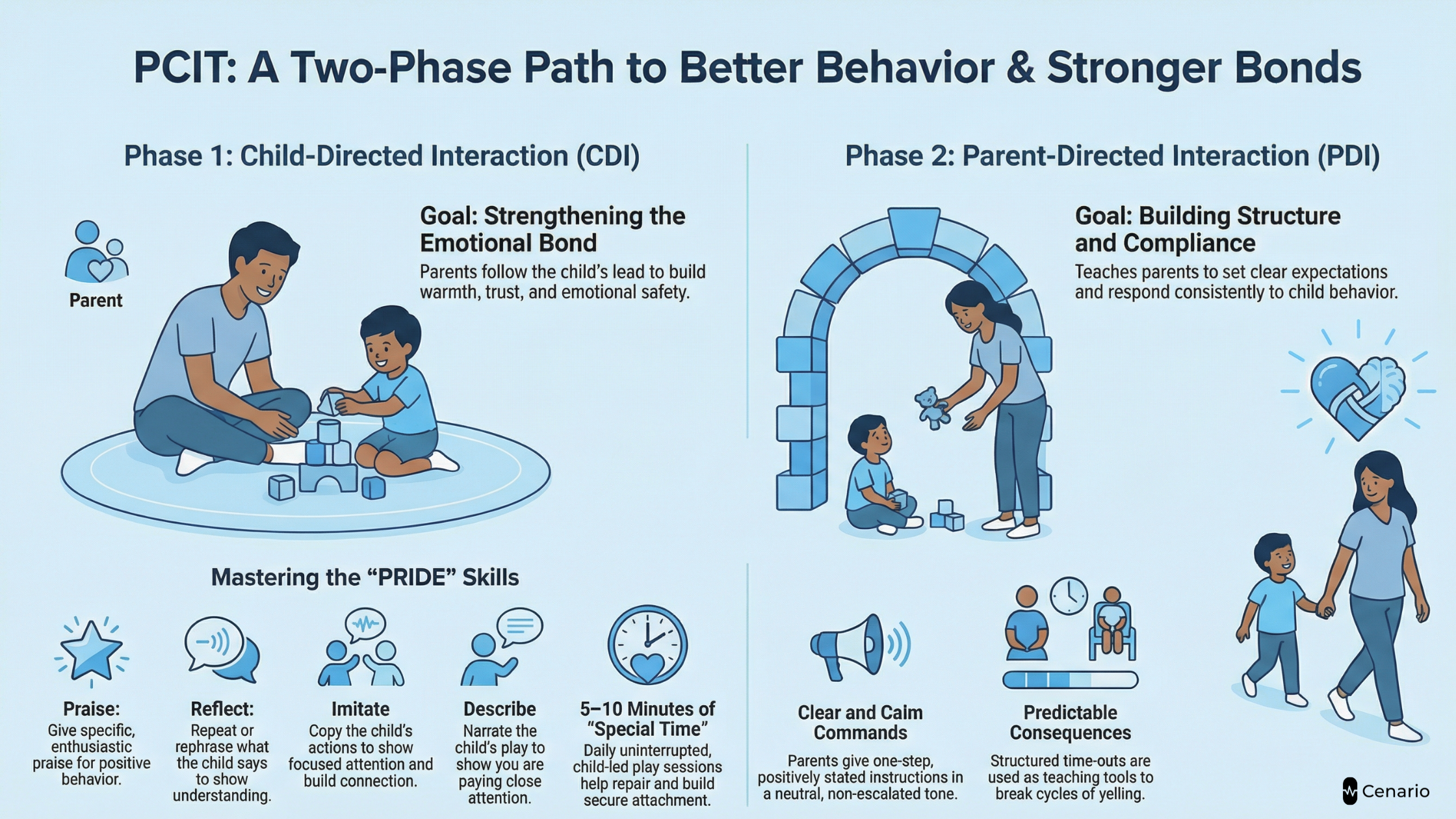
PCIT Phases Explained
Parent-Child Interaction Therapy (PCIT) is delivered in two structured phases, each with clear goals, skills, and outcomes. The phases are taught sequentially, ensuring that effective discipline is built on a foundation of trust and emotional connection.
- Phase 1: Child-Directed Interaction (CDI) focuses on strengthening the parent-child relationship.
- Phase 2: Parent-Directed Interaction (PDI) focuses on teaching calm, consistent discipline and improving child compliance.
Families must successfully complete CDI before moving on to PDI, helping ensure long-term behavior change without emotional harm.
Child-Directed Interaction (CDI): Building Connection
The goal of CDI is to strengthen the emotional bond between caregiver and child. Parents are coached to follow their child’s lead during play and provide positive, non-directive attention, which reduces attention-seeking and oppositional behavior.
This child-centered interaction communicates a powerful message to the child:
“I see you. I enjoy you. You are safe and valued with me.”
Core Objectives of CDI
Increase warmth and trust in the parent-child relationship
Encourage positive behavior through attention and praise
Help children feel emotionally safe and understood
Reduce minor misbehavior through planned ignoring
Improve self-esteem, focus, and cooperation
The PRIDE Skills
Parents learn five core skills, known as PRIDE, to guide interactions:
- Praise – Give specific, enthusiastic praise for positive behavior
“I love how gently you’re playing with the blocks.”
- Reflect – Repeat or rephrase what the child says to show understanding
- Imitate – Join in the child’s play to show approval
- Describe – Narrate the child’s actions to show attention
- Enjoy – Be present, relaxed, and emotionally engaged
What to Avoid During CDI
Parents are coached to avoid:
- Asking questions
- Giving commands
- Criticizing or correcting
- Showing disapproval through tone or facial expressions
CDI Practice at Home
Parents practice 5–10 minutes of special playtime daily, using only PRIDE skills. This consistent routine builds connection and begins shifting overall behavior patterns.
Parent-Directed Interaction (PDI): Building Structure and Compliance
Once a strong emotional foundation is established, families move into PDI. This phase teaches parents how to set clear expectations and respond consistently to both compliance and noncompliance, while remaining calm and supportive.
Core Objectives of PDI
- Improve child compliance and rule-following
- Reduce disruptive or unsafe behaviors
- Teach parents to give effective, clear commands
- Use predictable consequences, such as time-outs
- Break cycles of yelling, threats, or giving in
Giving Effective Commands
Parents learn to give commands that are:
- Clear and specific
- One step at a time
- Stated positively (what to do, not what not to do)
- Delivered in a calm, neutral tone
Managing Noncompliance
If a child does not follow a command after a warning, a structured time-out is used. Time-out is not a punishment, but a teaching tool that:
- Removes attention from misbehavior
- Allows the child to calm down
- Reinforces the connection between choices and outcomes
Therapists coach parents step-by-step to ensure consistency and emotional neutrality.
Benefits of PDI
Through consistent structure, children learn to:
- Pause before reacting
- Accept limits
- Increase frustration tolerance
- Feel secure within predictable boundaries
This is especially helpful for children with ADHD, anxiety, or trauma histories.
Graduation from PCIT
Families graduate from PCIT when parents:
- Use CDI and PDI skills confidently without coaching
- Respond calmly and consistently to misbehavior
- Report significant improvement across settings
- Feel confident and empowered in their parenting role
Booster sessions may be offered to support long-term success.
The Role of Attachment in Child Behavior
At the core of every child’s development is their relationship with their caregiver. This emotional connection, known as attachment, forms the blueprint for how children understand safety, trust, boundaries, and self-worth. It deeply influences a child’s behavior, emotional regulation, and their ability to interact with the world.
When discussing behavior, especially challenging behavior, it’s essential to consider the role of attachment. PCIT is built on this understanding and integrates attachment theory into its therapeutic approach, particularly in the Child-Directed Interaction (CDI) phase.
Let’s explore what attachment really means, how it forms, and why it matters so much in behavior-based therapy like PCIT.
What Is Attachment?
Attachment is the emotional bond that develops between an infant or young child and their primary caregiver. It’s how children learn whether the world is safe and whether they can rely on others for comfort, protection, and support.
From birth, babies look to their caregivers for cues:
- Will someone come when I cry?
- Am I soothed when I’m scared?
- Do I feel seen and valued?
These early interactions shape a child’s internal model of relationships and their ability to self-regulate emotions.
Types of Attachment Styles
Attachment theory, developed by John Bowlby and expanded by Mary Ainsworth, identifies the emotional bond between a child and caregiver as a key factor in emotional and behavioral development. The quality of this attachment shapes how a child sees the world, manages emotions, and responds to discipline.
Secure Attachment
- The child trusts their caregiver to meet their needs.
- They explore confidently and return to the caregiver as a safe base.
- When upset, they seek comfort and calm down with support.
Children with secure attachments:
- Regulate emotions more effectively
- Accept guidance and discipline
- Form healthy relationships
Insecure-Avoidant Attachment
- The child learns that emotional needs may be dismissed.
- They appear overly independent and suppress emotion.
Common behaviors:
- Resisting closeness or affection
- Avoiding help or emotional expression
Insecure-Ambivalent/Resistant Attachment
- The child receives inconsistent caregiving — sometimes attentive, sometimes not.
- They become anxious and clingy, unsure of how the caregiver will respond.
Behaviors may include:
- Intense separation anxiety
- Mood swings and difficulty calming
- Strong reactions to limits
Disorganized Attachment
- Often results from trauma, neglect, or fear-based caregiving.
- The child is confused by the caregiver’s mixed signals — comfort may come with fear or unpredictability.
May display:
- Aggression or self-harm
- Emotional shutdown or dissociation
- Chaotic relationships
Why Attachment Affects Behavior
Challenging behavior isn’t always “acting out”, it can be a signal of unmet attachment needs. Children with insecure or disorganized attachment may:
- Use negative behavior to get attention or feel control
- Struggle with trust and direction
- React strongly to discipline or change
This is common in children who’ve experienced:
- Early trauma or inconsistent caregiving
- Foster care, adoption, or parental stress
- Emotionally unavailable parenting
Without emotional safety, discipline alone isn’t effective. Children must first feel seen, safe, and soothed.
How PCIT Builds Secure Attachment
PCIT directly supports attachment through its Child-Directed Interaction (CDI) phase, where therapists coach parents to:
- Focus completely on the child without giving commands
- Respond warmly and attentively to play and emotional cues
- Praise positive behaviors
- Show consistent joy and availability
These attuned interactions begin repairing the attachment bond, even in families with histories of trauma or disconnection.
As the child begins to feel more emotionally secure, they become:
- Calmer and more cooperative
- Less reliant on negative behavior
- More open to listening and accepting limits
In PDI, attachment continues to grow as parents provide calm, firm boundaries, reinforcing security through consistent responses.
Example: Attachment in Action
A 4-year-old in foster care begins PCIT with defiance and aggression.
In early CDI sessions, they avoid eye contact and throw toys.
With consistent PRIDE skills and reflection by the caregiver:
- The child begins seeking connection
- Tantrums decrease
- Affection and trust emerge naturally
This marks a shift toward secure attachment, making space for behavioral growth.
What Parents Should Know
- It’s never too late to repair or build attachment
- You don’t need to be perfect, just consistent, present, and responsive
- PCIT gives you the tools to reconnect, even in tough circumstances
Whether your child’s struggles stem from trauma, ADHD, or emotional delays, secure attachment is the foundation for lasting behavioral change — and PCIT helps you build it.
Parenting Children with ADHD or Sensory Issues
Parenting a child with ADHD or Sensory Processing Disorder (SPD) can be incredibly rewarding, and incredibly challenging. These children are often bright, creative, and loving, but they may struggle with impulsivity, emotional outbursts, and difficulty following instructions, making daily routines feel like uphill battles.
Many parents feel exhausted trying everything, books, routines, rewards, consequences, only to see behaviors persist. That’s because these children aren’t being “bad” or “defiant”; their brains process the world differently.
Parent-Child Interaction Therapy (PCIT) is a proven, structured approach that supports children with ADHD or sensory needs while empowering parents with tools that actually work.
Understanding ADHD in Young Children
ADHD is a neurodevelopmental condition affecting attention, impulse control, and emotional regulation, often noticeable between ages 3–7.
Common behaviors include:
- Constant movement or restlessness
- Talking excessively or interrupting
- Difficulty following directions
- Appearing inattentive or “not listening”
- Emotional overreactions
These children want to do well, but lack the self-regulation skills to pause and think before acting. Misunderstood, they’re often labeled “defiant” or “unmotivated,” which damages both confidence and relationships.
Understanding Sensory Processing Disorder (SPD)
SPD occurs when the brain struggles to process sensory input, making everyday experiences overwhelming.
Children with SPD may:
- Avoid certain textures, sounds, or lights
- React strongly to transitions or changes
- Seek intense movement or pressure
- Melt down when overstimulated
These are not “behavior problems” they’re signs of neurological overload. Without support, children can become anxious, rigid, or aggressive.
Why Traditional Discipline Doesn’t Work
Conventional strategies (timeouts, consequences, lectures) often fail with ADHD or SPD because:
- Rules are easily forgotten or misunderstood
- Impulsivity makes “thinking before acting” difficult
- Sensory overload can trigger meltdowns during discipline
- Harsh tone or criticism escalates anxiety and resistance
This can create a cycle of conflict and guilt, leaving parents frustrated and children feeling unsafe or unheard.
How PCIT Supports Children with ADHD and SPD
PCIT uses live coaching and structured phases to meet neurodiverse children where they are — starting with connection and moving into discipline.
CDI (Child-Directed Interaction)
In this phase, parents:
- Follow the child’s lead during play
- Use PRIDE skills (Praise, Reflect, Imitate, Describe, Enjoy)
- Focus on emotional connection over correction
This helps children:
- Feel safe, seen, and supported
- Associate calm behavior with positive attention
- Reduce outbursts and increase cooperation
Example: Praising a child with ADHD for sitting calmly for 30 seconds builds their attention span. Reflecting a sensory-sensitive child’s words lowers anxiety and increases connection.
PDI (Parent-Directed Interaction)
Once trust is built, parents learn how to:
- Give clear, one-step commands
- Use predictable consequences like time-outs
- Maintain a calm, neutral tone — avoiding escalation
This phase helps:
- ADHD children respond to structured rules and quick feedback
- SPD children manage correction without sensory overload
- Parents stay regulated, which models calm behavior for the child
Extra Tools Often Used with PCIT
Therapists may integrate supports such as:
- Visual schedules and timers
- Sensory tools (fidget toys, noise-reducing headphones)
- Feelings charts and calming routines
- Collaboration with occupational or developmental therapists
Support for the Parent
PCIT also supports caregivers, not just children. Many parents feel judged, blamed, or burnt out. Through coaching, they receive:
- Encouragement and validation
- Tailored strategies for their child’s unique brain
- Relief in knowing they’re not alone, and not failing

Positive Parenting Strategies at Home
While PCIT offers structured, therapist-guided sessions, the real change often happens at home, through small, consistent interactions that build connection, trust, and emotional safety.
Positive parenting doesn’t mean being permissive. It’s about setting firm boundaries with empathy and using discipline to teach, not punish. Whether you’re in PCIT or not, the following strategies can help create a calmer, more connected home.
1. Routines and Consistency
Children thrive on predictability. Consistent routines help reduce anxiety, prevent power struggles, and make transitions smoother.
Why It Matters:
- Kids feel safer when they know what to expect
- Routines reduce the need for constant correction
- Mirrors the structured consistency taught in PCIT
Tips:
- Establish basic routines for mornings, meals, and bedtime
- Use visual schedules for younger kids
- Give gentle warnings before transitions (“5 more minutes, then cleanup”)
Consistency builds trust — not rigidity, but a sense of reliable structure.
2. Natural Consequences vs. Punishment
Rather than using harsh or arbitrary punishment, positive parenting focuses on natural or logical consequences that help children connect actions with outcomes.
| Punishment | Natural/Logical Consequence |
|---|---|
| “Go to your room!” | “You threw your toy, so it’s put away.” |
| Emotion-driven | Teaches responsibility calmly |
| Escalates power struggles | Promotes learning and accountability |
Examples:
- Refuses coat: Feels cold outside
- Throws food: Meal ends and they help clean up
- Yells at sibling: Loses playtime until ready to be kind
This approach aligns with PCIT’s PDI phase, which emphasizes clear, calm, and consistent consequences.
3. Emotion Coaching
Children aren’t born knowing how to manage emotions, they need guidance. Emotion coaching helps kids name, understand, and regulate their feelings.
Steps:
- Notice the emotion
- Name it (“You look frustrated”)
- Validate it (“It’s okay to feel mad”)
- Guide a calm-down strategy (“Let’s take deep breaths”)
PCIT’s CDI phase supports emotion coaching by helping parents respond calmly and empathetically to their child’s emotional cues, even during tough moments.
4. Catching Your Child Being Good
Kids often hear “stop” and “don’t” more than anything else. But positive reinforcement is far more effective in shaping behavior.
How to Practice:
- Notice small acts of cooperation or kindness
- Label the praise: “Great job putting your toys away!”
- Be enthusiastic: Use smiles, high-fives, or hugs
This is a core PCIT skill (especially in CDI), where labeled praise becomes a powerful tool to build self-esteem and cooperation.
5. Limit Screen Time, Increase Connection
Too much screen time can reduce chances for meaningful connection and play. Children crave real interaction, even more than entertainment.
Tips:
- Limit passive screen time (per AAP, under 1 hour/day for preschoolers)
- Schedule 5–10 minutes of daily “Special Time” uninterrupted, child-led play using PRIDE skills
- Use screens wisely, not as the main method for calming or discipline
Investing in one-on-one attention helps kids feel secure, improving their behavior and responsiveness to limits.
6. Be Calm and Predictable in Discipline
Effective discipline isn’t about being harsh, it’s about being consistent and calm.
Children do best when:
- Rules are clearly stated
- Consequences are predictable
- Adults stay calm during enforcement
This mirrors PCIT’s PDI approach, where parents learn to lead with confidence, not conflict.
What Makes PCIT Unique
There are many parenting programs and behavioral interventions available today, but Parent-Child Interaction Therapy (PCIT) stands out for several key reasons. What makes PCIT truly unique is its combination of live coaching, evidence-based structure, and deep focus on the parent-child relationship, all customized in real time for each family’s needs.
Here’s what sets PCIT apart from other approaches:
1. Real-Time Coaching, Not Just Advice
Most parenting programs teach strategies in group sessions, videos, or handouts. While helpful, these often leave parents wondering, “Am I doing this right?” or “What do I do in the moment when things go wrong?”
In PCIT, the therapist observes the parent and child during actual interactions and coaches the parent in real time through an earpiece. The therapist is in another room (or on video for telehealth), offering step-by-step guidance as situations unfold.
This “live coaching” turns theory into action, helping parents stay calm, connected, and consistent, even under stress.
2. Grounded in Science and Long-Term Results
PCIT isn’t a trend, it’s an evidence-based therapy with over four decades of research supporting its effectiveness.
Studies consistently show that PCIT:
- Reduces disruptive behaviors in children
- Improves parenting confidence and satisfaction
- Strengthens attachment and emotional connection
- Produces long-lasting results, often sustained months or years after treatment ends
It’s one of the most research-validated therapies for children ages 2–7 with behavioral challenges.
3. Tailored to the Individual Child and Family
PCIT is not one-size-fits-all. While the structure is standardized, the pace and content are customized.
Therapists adapt strategies for:
- Neurodivergent children (e.g., ADHD, autism, sensory issues)
- Trauma-informed care for foster/adoptive families
- Cultural values, family structures, and language needs
Progress is tracked weekly, and families move forward based on mastery, not just time spent in sessions.
4. Relationship-First, Behavior-Focused
Unlike many discipline programs that focus solely on behavior correction, PCIT balances nurture and structure. It’s not just about reducing tantrums, it’s about helping parents and children feel emotionally connected and secure, even in hard moments.
The CDI phase helps repair or strengthen attachment. The PDI phase builds structure without fear, shame, or emotional damage. This combination is what makes the results of PCIT so transformative and sustainable.
5. Skills You Can Use for Life
PCIT doesn’t just solve today’s problems, it gives parents a toolkit they can use for years to come.
The skills taught in PCIT:
- Apply across ages and stages
- Work with siblings and other children
- Strengthen emotional intelligence and resilience in both parent and child
Parents leave PCIT not just with a “better behaved” child, but with a renewed sense of control, calm, and connection in their parenting approach.
In the Words of a Parent:
“PCIT didn’t just help my child listen better, it helped me enjoy parenting again. I stopped yelling, my child started smiling more, and we both felt like we were on the same team.”
How to Get Started with PCIT
If you’ve been reading through this guide and thinking, “This sounds like what my family needs,” — you’re not alone. Many parents feel relief just knowing there’s a structured, research-backed approach like Parent-Child Interaction Therapy (PCIT) that focuses on real change, not blame.
Whether you’re ready to begin therapy or just exploring your options, here’s how to take the first step.
1. Finding a Certified PCIT Therapist
PCIT requires specialized training and certification, so it’s important to work with a licensed therapist who is formally trained in the PCIT model.
Where to look:
- Visit the official PCIT International directory
- Ask your child’s pediatrician or school counselor for a referral
- Search therapy platforms (like Psychology Today) and filter for PCIT-certified clinicians
What to look for:
- Licensed mental health professional (LMFT, LCSW, PsyD, etc.)
- PCIT certification or training
- Experience with young children (ages 2–7)
- Specialization in behavioral concerns, trauma, or neurodiversity
Tip: If PCIT isn’t available in your area, ask providers if they offer virtual sessions (see below).
2 . What to Expect in the First Few Sessions
Starting therapy can feel overwhelming — but PCIT is designed to be structured, supportive, and easy to follow. Here’s what typically happens:
Session 1: Intake & Assessment
- Therapist meets with the caregiver(s) to discuss concerns
- Behavioral questionnaires are completed (e.g., ECBI)
- Goals and expectations are set together
Session 2: Teaching
- Therapist explains the two phases (CDI and PDI)
- Caregivers learn about PRIDE skills and how coaching works
- Families get instructions for home practice
Session 3 and beyond: Coaching Begins
- You’ll engage in play with your child while the therapist observes
- Through a small earpiece, the therapist coaches you in real-time
- You’ll gradually build confidence and see behavior shift over time
Important: PCIT progresses based on skill mastery, not a fixed timeline — most families complete treatment in 12–20 sessions, depending on consistency and progress.
3. Telehealth Options
PCIT is traditionally done in person, but many therapists now offer virtual PCIT, also called Internet-Based PCIT (I-PCIT).
Benefits of virtual PCIT:
- Convenient for families in remote or underserved areas
- Allows therapy to take place in the child’s natural environment (home)
- Flexible scheduling for busy families
All you need is:
- A stable internet connection
- A private space where your child can play and you can be coached
- A computer or tablet with a camera
Many families report excellent results through virtual PCIT — especially when therapist and parent communicate regularly and practice consistently.
4. Insurance Coverage & Costs
Good news: Because PCIT is an evidence-based treatment, it’s often covered by insurance, especially when a child has a behavioral or emotional diagnosis (like ADHD, ODD, or adjustment disorder).
Tips:
- Call your insurance company and ask if PCIT is covered under your behavioral health benefits
- Ask the therapist if they are in-network or offer superbills for reimbursement
- Some clinics offer sliding scale fees or grants for families in need
Bonus: PCIT is often funded through state agencies, early intervention programs, or nonprofit organizations, especially for families involved in child welfare or foster care systems.
Getting Help Is a Strength
Starting therapy is an act of courage and commitment. PCIT meets parents where they are, overwhelmed, uncertain, or hopeful, and walks alongside them with structure, support, and real tools that work.
Whether your child is defiant, anxious, hyperactive, or simply struggling to cope, you don’t have to navigate it alone. PCIT offers a proven path forward, one calm, connected step at a time.
Final Thoughts: You Don’t Have to Do This Alone
Parenting through behavior challenges is not a sign of failure, it’s a call for support. Every caregiver deserves to feel empowered, equipped, and connected to their child, even in the toughest moments.
Parent-Child Interaction Therapy (PCIT) doesn’t just reduce tantrums or defiance. It transforms the relationship between parent and child. It rebuilds trust, strengthens emotional safety, and gives families real tools that work, not just in the therapy room, but in everyday life.
Whether you’re parenting a child with ADHD, managing big emotions, or simply feeling exhausted by constant conflict, know this: You’re not alone, and things can get better.
PCIT is not about being perfect. It’s about learning, growing, and showing up for your child in new ways, one small moment at a time.
Need Support for Your Mental Health Too?
While PCIT helps children thrive, parents need support too. Caregiver stress, anxiety, sleep struggles, and burnout are real, and often overlooked.
If you’re feeling drained, overwhelmed, or emotionally off-balance, taking care of your own well-being is not optional, it’s essential.
Take Our Quick Quiz to get personalized supplement recommendations based on your current emotional and mental health needs.
Frequently Asked Questions
1. How do I know if PCIT is right for my child?
If your child is between ages 2–7 and struggles with frequent tantrums, aggression, defiance, or emotional regulation, especially if it’s impacting daily life, PCIT may be a great fit. It’s also highly effective for children with ADHD, trauma, or attachment issues.
2. Can I do PCIT if I’m a single parent or not the biological caregiver?
Yes! PCIT works with a wide range of caregivers, including single parents, foster parents, grandparents, or adoptive families. The therapy is customized to support your relationship with the child, regardless of family structure.
3. How quickly will I see results with PCIT?
Many families begin noticing changes within the first few weeks, especially during the CDI phase. On average, PCIT takes 12–20 sessions, but progress depends on consistency and regular home practice.