

Breakups are universally painful. Whether it was a mutual decision or a sudden heartbreak, ending a relationship can leave a deep emotional void. Many people experience feelings of grief, confusion, and overwhelming sadness after a breakup. What most don’t realize, however, is how profoundly a breakup can affect your mental health.
In today’s world where emotional well-being is prioritized more than ever, therapy for breakup is not just helpful, it’s essential. It’s a guided path toward emotional recovery, self-discovery, and personal growth. In this comprehensive guide, we’ll dive deep into why breakups are so emotionally impactful, how therapy can help you move forward, and how tools like cognitive behavioral therapy and setting boundaries play a critical role in the post breakup healing journey.
Breaking up with someone isn’t just about ending a relationship, it’s about losing a part of your life that once felt like home. Whether the decision was mutual, one-sided, expected, or sudden, the emotional impact can be intense and destabilizing.
Why It Feels Like Grief
When a romantic relationship ends, you’re not just letting go of a person—you’re grieving a complex web of emotional investments, including:
- Shared memories and daily routines – Those little habits, inside jokes, and moments that used to bring comfort now trigger pain or nostalgia.
- Emotional intimacy – You’ve lost someone who knew your vulnerabilities, your laughter, your fears, someone who felt emotionally close and safe.
- Future dreams and plans – Whether it was a vacation next summer or a vision of building a life together, those imagined futures disappear, leaving a void.
- Your identity as part of a couple – Relationships often shape how we see ourselves. After a breakup, the “we” becomes “me,” and that transition can cause deep confusion and emotional disorientation.
The Whiplash Effect
One of the hardest parts of a breakup is the sudden shift:
The person who once provided you with love, safety, and emotional connection now becomes a source of pain. That contrast can feel jarring and deeply unsettling.
This emotional whiplash affects more than just your mood, it can impact your sense of safety, belonging, and identity, making it difficult to navigate daily life, especially in the early post breakup days.
The Impact on Mental Health
Breakups don’t just break your heart, they can also affect your mental health in serious ways. Many people experience:
- Anxiety and Depression – Constant worrying, sadness, hopelessness, or loss of motivation are common emotional responses.
- Low Self-Esteem – You may start questioning your worth or blaming yourself for the breakup.
- Obsessive Thoughts – Replay loops of what went wrong, stalking your ex’s social media, or mentally rewriting conversations can consume your energy.
- Sleep Disturbances – Either you can’t sleep at all, or you’re oversleeping to avoid emotional pain.
- Changes in Appetite – You may lose interest in food altogether or use it as a coping mechanism, leading to overeating.
- Social Withdrawal – Isolation is common when you feel like no one understands the depth of your emotional pain.
Post Breakup Decline in Mental Health
During the post breakup period, your emotional balance can shift dramatically. Without the right coping tools or emotional support, this can lead to:
- Prolonged depression
- Generalized anxiety disorder
- Compulsive behaviors
- Difficulty trusting others in future relationships
This is why therapy for breakup is so vital. It provides not only a space to talk but also a structured approach to healing holistically, emotionally, mentally, and even physically.
Why Therapy Is a Critical Part of Recovery
Unlike well-meaning friends who might say, “Just move on,” therapy acknowledges that a breakup is real emotional trauma. It helps you:
- Understand and normalize your emotions
- Rebuild your identity and self-worth
- Learn how to regulate emotional ups and downs
- Replace destructive thought patterns with healthier ones
- Gain tools to manage triggers and future relationships
What Is Therapy for Breakup?
Breakup therapy is a specialized form of counseling that helps individuals navigate the emotional, psychological, and even physical effects of a romantic separation. It’s much more than just talking about your ex, it’s a structured and intentional healing process that supports both short-term emotional relief and long-term personal growth.
In a breakup, you’re not only losing a partner, you may also be losing your emotional support system, daily routines, plans for the future, and part of your own identity. This can lead to deep emotional wounds that affect your mental health, self-esteem, and ability to function in day-to-day life.
Therapy helps you process these losses in a healthy way, offering tools and guidance to rebuild yourself from the inside out.
How Therapy for Breakup Helps
Breakup therapy is designed to help you heal on multiple levels. Here’s how it works:
1. Processes Complex Emotions
A breakup can trigger a wave of intense emotions:
- Anger at your partner or yourself
- Guilt over mistakes made
- Grief for the relationship you lost
- Sadness and emotional emptiness
Therapy gives you a safe space to feel and express these emotions without shame, helping you release what you’re holding inside.
2. Rebuilds Self-Worth and Identity
Breakups can leave you questioning your value. You might feel like you’re “not good enough” or fear that no one else will love you. A therapist helps you:
- Reframe negative beliefs
- Reconnect with who you are outside the relationship
- Reclaim your confidence and individuality
3. Provides Tools for Emotional Regulation
You’ll learn practical strategies to manage emotional overwhelm, stop obsessive thinking about your ex, and calm anxiety. This might include:
- Breathing techniques
- Journaling exercises
- Thought-challenging frameworks from Cognitive Behavioral Therapy (CBT)
4. Teaches You How to Set Boundaries
In many cases, continued contact with an ex can delay healing. Therapy helps you:
- Understand the importance of setting boundaries
- Establish clear guidelines for communication (or no contact)
- Handle mutual friends, shared spaces, or co-parenting dynamics with emotional balance
5. Encourages Introspection and Growth
Breakup therapy isn’t just about recovering from the past, it’s about growing into your future. With time, therapy helps you:
- Reflect on relationship patterns
- Learn more about your emotional needs
- Set healthier expectations for future partners
In contrast to venting to friends, who may give biased or emotionally charged advice—a therapist offers structured, neutral, and evidence-based support. You’re not just being heard, you’re being guided toward healing and empowerment.
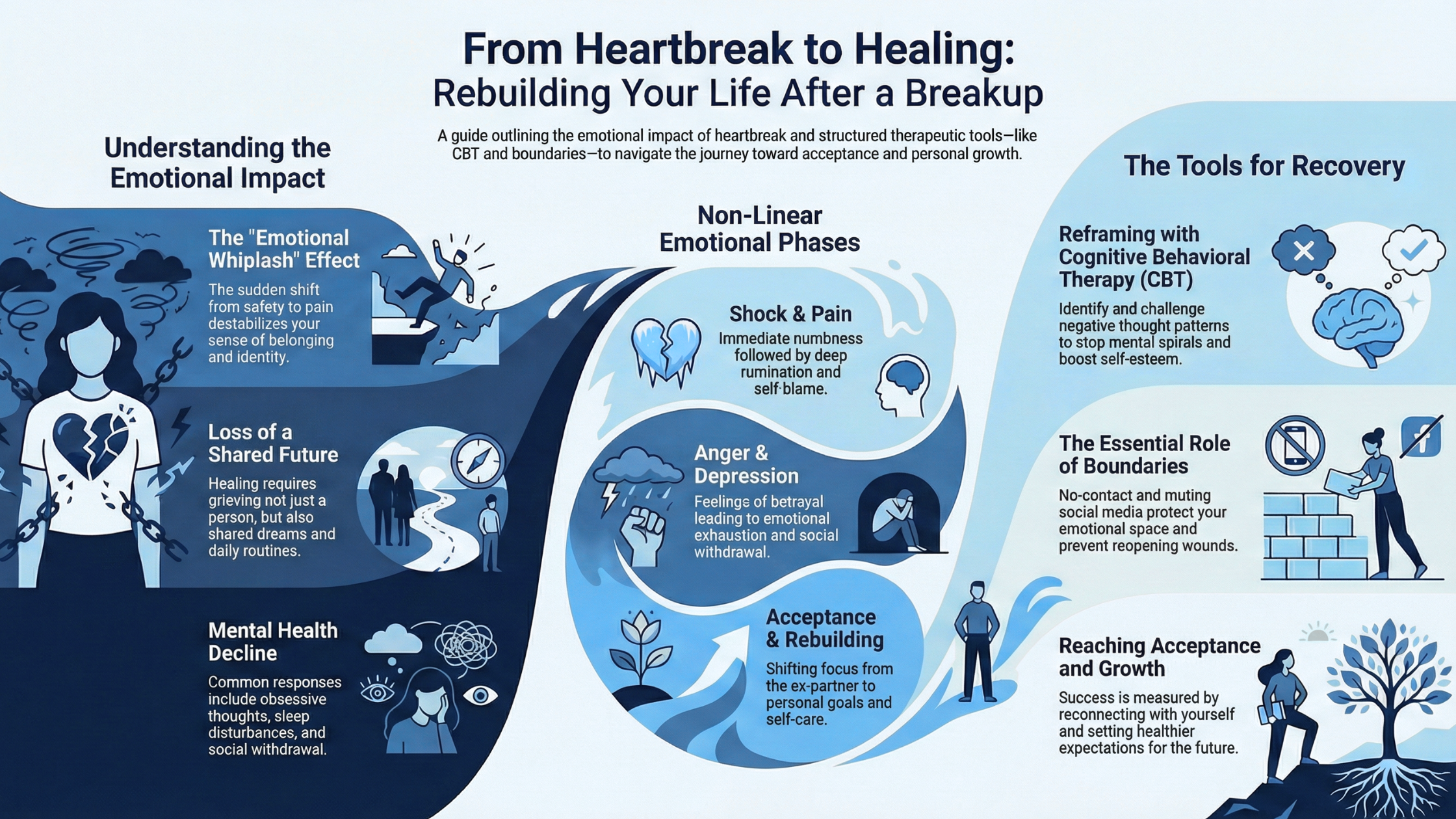
The Emotional Phases of a Breakup
Understanding the emotional rollercoaster of a breakup can normalize your experience and make you feel less alone. Most people go through several emotional phases after a relationship ends, though not always in a straight line.
1. Shock & Denial
This often occurs immediately after the breakup, especially if it was unexpected. You may feel numb or in disbelief. You might catch yourself thinking, “This can’t really be happening.”
2. Pain & Guilt
As the reality sinks in, deep emotional pain often follows. Many people ruminate on the relationship, asking questions like:
- “What did I do wrong?”
- “Could I have saved it?”
- “Was it all my fault?”
Therapy can help you work through these painful thoughts without spiraling into self-blame.
3. Anger & Bargaining
Anger can arise from feelings of betrayal, rejection, or injustice. You might find yourself blaming your ex, or bargaining emotionally:
- “If I change, maybe they’ll come back.”
- “What if I reach out one more time?”
A therapist helps you process this anger and redirect it into healthy emotional outlets.
4. Depression
This phase is marked by emotional exhaustion, sadness, and hopelessness. You might withdraw from friends, lose interest in activities, or feel like your life has lost direction. This is also when mental health may suffer the most.
Therapy provides emotional support and tools to lift you out of this low point, while helping you build healthier habits for recovery.
5. Acceptance & Rebuilding
Eventually, you begin to accept the breakup, not just intellectually, but emotionally. You stop obsessing about your ex. You feel more hopeful. You start focusing on yourself, your goals, and your future.
Therapy helps you make the most of this phase by encouraging self-growth, self-care, and readiness for healthier future relationships.
Cognitive Behavioral Therapy (CBT) After a Breakup
One of the most effective approaches in breakup therapy is Cognitive Behavioral Therapy (CBT). It’s especially helpful for those experiencing anxiety, depression, or obsessive thoughts post breakup.
What is CBT?
CBT is a structured, goal-oriented form of therapy that focuses on identifying and changing negative thought patterns and behaviors.
How CBT Helps After a Breakup
- Reframes Negative Beliefs: You might think, “I’ll never be loved again” or “It was all my fault.” CBT helps you challenge and change these distorted beliefs.
- Stops Mental Spirals: If you keep replaying what went wrong or stalking your ex online, CBT offers strategies to break these patterns.
- Improves Emotional Regulation: You’ll learn practical skills to manage overwhelming emotions like sadness or rage.
- Builds Confidence: Through CBT, you regain control over your thoughts and actions, which boosts your self-esteem.
Therapists trained in CBT will often assign exercises, journaling, or “thought records” to help you track and reshape your thinking.
Setting Boundaries: A Critical Step in Healing
During the post breakup phase, one of the hardest—but most essential—steps is setting boundaries.
What Are Boundaries After a Breakup?
- Choosing no-contact (or low contact) with your ex
- Asking mutual friends not to give you updates
- Blocking or muting your ex on social media
- Refusing to engage in arguments or emotional manipulation
- Protecting your emotional space
Why Boundaries Matter
After a breakup, emotional wounds are fresh. Constant communication or social media exposure can reopen those wounds daily. Therapy for breakup helps you define and enforce boundaries that serve your healing.
Remember, setting boundaries is not about being cold or unforgiving—it’s about self-respect and emotional recovery.
Additional Therapy Techniques for Post Breakup Recovery
1. Mindfulness and Meditation
Staying grounded in the present moment helps manage anxiety and prevent emotional overwhelm.
2. Narrative Therapy
This approach encourages you to rewrite the story of the relationship in a way that empowers you—focusing on growth instead of victimhood.
3. Grief Counseling
Because breakups are a form of loss, grief counseling can help process deep emotional pain with compassion and structure.
4. Art or Music Therapy
Creative outlets allow you to express what words often can’t, releasing emotion and promoting healing.
How Long Does It Take to Heal?
There’s no universal timeline for healing. Some people start to feel better after a few weeks, while others take months, or even years. The key is to not rush the process. Healing isn’t linear. You may feel okay one day and overwhelmed the next. That’s normal.
Therapy for breakup doesn’t promise overnight relief, but it offers a map through the chaos and a steady hand to guide you.
Self-Care Practices to Support Your Healing
Alongside therapy, here are daily habits that support emotional healing:
- Sleep well: Rest is crucial for emotional regulation.
- Eat nourishing food: Your brain needs fuel to function and heal.
- Stay active: Even a short walk boosts endorphins.
- Connect with others: Don’t isolate yourself completely.
- Avoid rebounds: They may distract but rarely heal the deeper wounds.
- Practice gratitude: Focus on the good that still exists in your life.
Final Thoughts: Rebuilding After the Breakup
Going through a breakup may feel like the end of the world, but in many cases, it’s actually the beginning of something more authentic, more empowered, and more self-aware.
With the support of therapy for breakup, especially structured methods like cognitive behavioral therapy (CBT), and the intentional use of healthy boundaries, you don’t just survive heartbreak, you grow from it.
You begin to reconnect with yourself.
You begin to rebuild your life, your worth, and your future, on your terms.
Your heartbreak does not define you. What you do after the heartbreak does.
So take it one day at a time. Be patient. Be compassionate with yourself. Healing isn’t linear, and that’s okay. And if you’re struggling, remember: you don’t have to do this alone. Professional support, healing tools, and emotional guidance are always within reach.
Ready to Start Healing in a Healthier Way?
Take our quick Cenario Quiz to get a personalized supplement recommendation designed to support your mood, stress levels, sleep, and emotional resilience during this transition.
Because you deserve peace.
You deserve healing.
And most of all, you deserve yourself back.
Frequently Asked Questions (FAQs)
1. How soon should I start therapy after a breakup?
There’s no “perfect” time, but starting therapy sooner rather than later can help prevent emotional pain from escalating into long-term issues like depression or anxiety. If you’re feeling overwhelmed, stuck in obsessive thoughts, or unable to function normally in daily life, it’s a sign that professional support could be very helpful. Therapy can also guide you through the early post breakup stages and help you process your emotions in a healthy way.
2. What kind of therapy is best for healing after a breakup?
Cognitive Behavioral Therapy (CBT) is one of the most effective approaches for breakup recovery. It helps identify and challenge negative thought patterns, improve emotional regulation, and rebuild self-worth. Depending on your unique needs, other modalities like mindfulness-based therapy, emotion-focused therapy, or narrative therapy may also be helpful. A licensed therapist can help tailor the approach to best support your healing journey.
3. Can supplements really help after a breakup?
While therapy addresses the emotional and psychological aspects of healing, certain natural supplements may support your mental health during the post breakup period, especially with symptoms like stress, poor sleep, low mood, or anxiety. Adaptogens like ashwagandha, magnesium for relaxation, or mood-balancing herbs like St. John’s Wort may help.
Always consult with a healthcare provider before starting any supplement.
Want to know what works best for your unique situation? Take the Cenario Quiz to get a personalized supplement recommendation tailored to your emotional recovery.
Frequently Asked Questions
1. How soon should I start therapy after a breakup?
There’s no “perfect” time, but starting therapy sooner rather than later can help prevent emotional pain from escalating into long-term issues like depression or anxiety. If you’re feeling overwhelmed, stuck in obsessive thoughts, or unable to function normally in daily life, it’s a sign that professional support could be very helpful. Therapy can also guide you through the early post breakup stages and help you process your emotions in a healthy way.
2. What kind of therapy is best for healing after a breakup?
Cognitive Behavioral Therapy (CBT) is one of the most effective approaches for breakup recovery. It helps identify and challenge negative thought patterns, improve emotional regulation, and rebuild self-worth. Depending on your unique needs, other modalities like mindfulness-based therapy, emotion-focused therapy, or narrative therapy may also be helpful. A licensed therapist can help tailor the approach to best support your healing journey.
3. Can supplements really help after a breakup?
While therapy addresses the emotional and psychological aspects of healing, certain natural supplements may support your mental health during the post breakup period, especially with symptoms like stress, poor sleep, low mood, or anxiety. Adaptogens like ashwagandha, magnesium for relaxation, or mood-balancing herbs like St. John’s Wort may help.
Always consult with a healthcare provider before starting any supplement.
Want to know what works best for your unique situation? Take the Cenario Quiz to get a personalized supplement recommendation tailored to your emotional recovery.