
Human beings naturally try to understand why things happen. When something goes well or goes wrong, people often search for explanations. For example, a student who receives a high grade may believe it happened because of hard work, while another student might think it was simply luck. These explanations are known as attributions, and the psychological framework that studies them is called attribution theory.
Attribution theory explores how individuals interpret events and how these interpretations influence their thoughts, emotions, and future behavior. The theory suggests that people constantly try to identify the causes behind actions, successes, and failures, both in themselves and in others.
Understanding attribution theory helps explain everyday behaviors such as assigning blame, giving credit for success, forming opinions about others, and making decisions about future actions. It also plays an important role in fields such as psychology, education, business, and social relationships.
If you want to explore more topics related to psychology, mental health, and human behavior, read or explore more here at Knowledge Hub for additional mental health–related articles designed to simplify complex psychological concepts. You can also take our quick quiz to get personalized supplement recommendations designed to support brain health, focus, and overall cognitive performance.
What Is Attribution Theory?
Attribution theory is a psychological concept that explains how people interpret the causes of behavior and events. It focuses on how individuals determine why something happened and how these explanations influence their reactions.
The theory was first introduced by psychologist Fritz Heider in the 1950s. Heider proposed that people naturally act as “everyday psychologists,” constantly analyzing situations and trying to understand the reasons behind behavior.
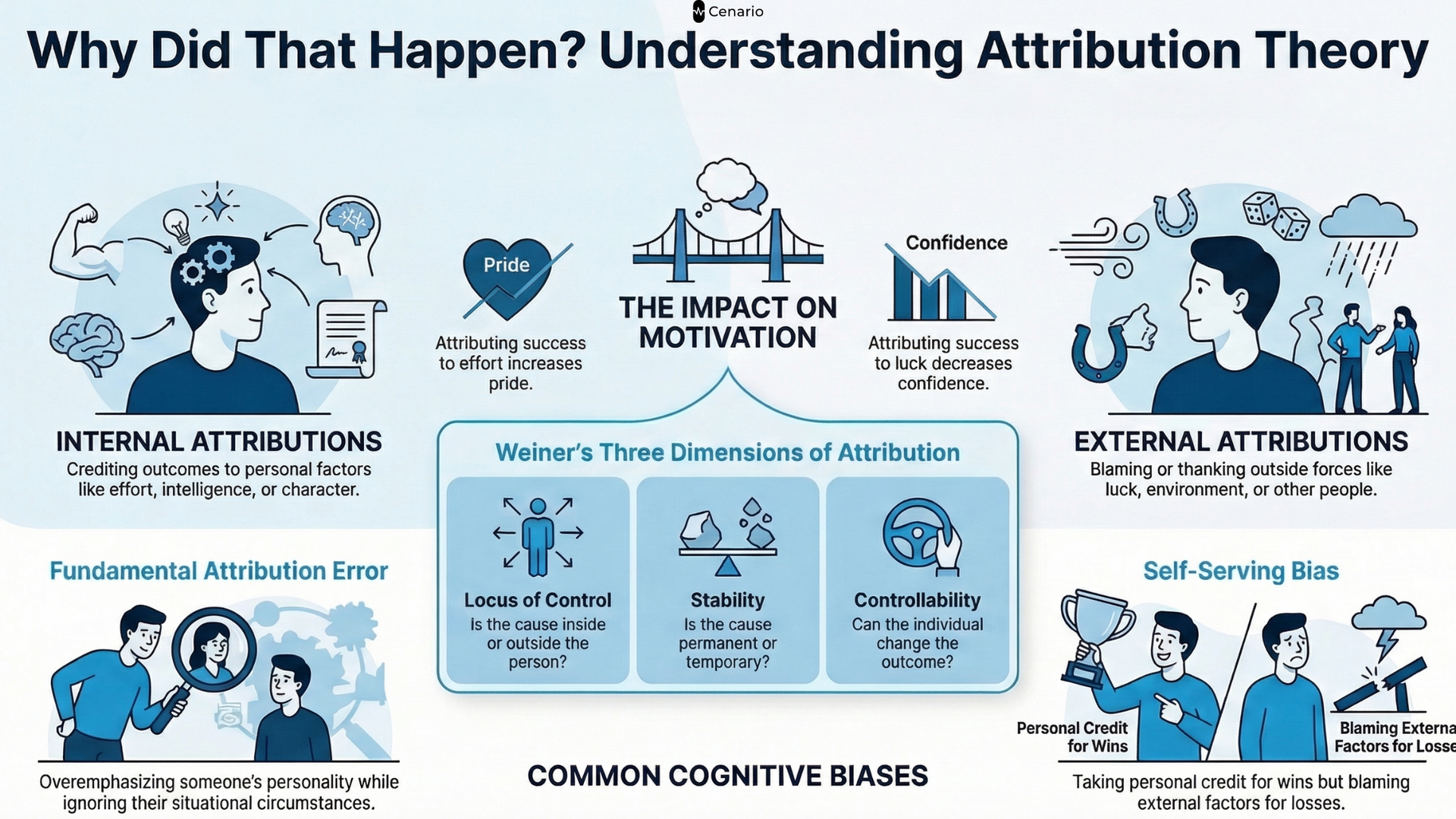
According to attribution theory, individuals often attribute outcomes to either internal factors or external factors.
Internal factors refer to causes within a person, such as personality, effort, intelligence, or motivation. External factors refer to influences outside the individual, such as luck, environmental conditions, or the actions of other people.
For example, if someone performs well on a test, they might attribute the result to their intelligence or hard work (internal factors). Alternatively, they might believe the exam was easy or that they were lucky (external factors).
These explanations influence how people feel about themselves and how they approach future situations.
Internal and External Attributions
A central idea in attribution theory is the distinction between internal and external causes.
An internal attribution occurs when a person believes that an event or behavior is caused by personal characteristics. These may include abilities, personality traits, or effort.
For instance, if an athlete wins a competition and believes the victory resulted from training and dedication, they are making an internal attribution.
An external attribution, on the other hand, occurs when someone believes that external circumstances caused the outcome. These may include luck, environmental conditions, or actions by others.
For example, if the same athlete believes they won because their competitors were weaker or the weather conditions favored them, this would be considered an external attribution.
These two types of explanations influence how individuals evaluate success and failure.
The Role of Attribution in Human Behavior
Attributions significantly affect how people respond to events in their lives. The explanations individuals choose can shape their motivation, confidence, and emotional reactions.
For example, if someone attributes success to their own effort or ability, they may feel proud and motivated to continue improving. However, if they believe success happened purely by chance, they may feel less confident about repeating that achievement.
Similarly, how people explain failure can influence their response. If someone attributes failure to lack of effort, they may be motivated to work harder in the future. If they attribute failure to uncontrollable external factors, they may feel discouraged or helpless.
Because of this influence, attribution theory is often studied in areas such as academic performance, workplace behavior, and personal relationships.
The Work of Bernard Weiner
Psychologist Bernard Weiner expanded attribution theory by focusing on how people explain success and failure, particularly in educational settings.
Weiner proposed that attributions can be categorized based on three main dimensions:
- Locus of control – whether the cause is internal or external
- Stability – whether the cause is stable (permanent) or unstable (temporary)
- Controllability – whether the individual can control the cause
For example, intelligence might be viewed as an internal and stable factor, while effort is internal but controllable. Luck is external and unstable because it can change from situation to situation.
These dimensions influence how people respond emotionally and behaviorally to different outcomes.
Attribution Biases
While people often attempt to explain behavior logically, their judgments are not always accurate. Psychological research has identified several common attribution biases that affect how people interpret events.
One well-known bias is the fundamental attribution error. This occurs when individuals tend to overemphasize personal characteristics while underestimating situational factors when explaining someone else’s behavior.
For example, if a coworker arrives late to a meeting, someone might assume the coworker is irresponsible rather than considering possible external reasons such as traffic or unexpected events.
Another common bias is the self-serving bias. This occurs when individuals attribute their successes to internal factors but blame failures on external circumstances.
For instance, a student who performs well on a test may credit their intelligence or preparation, but if they perform poorly, they may blame the difficulty of the exam.
These biases demonstrate that human reasoning about causes is often influenced by emotions and personal perspectives.
Attribution Theory in Everyday Life
Attribution theory plays a role in many aspects of daily life, including relationships, education, and work environments.
In relationships, people often interpret the actions of others and assign motives or intentions. Misunderstandings can occur when individuals make inaccurate attributions about someone else’s behavior.
In educational settings, students’ beliefs about the causes of success or failure can affect their motivation to learn. Students who attribute success to effort are often more likely to persist and improve over time.
In workplaces, managers and employees frequently interpret the causes of performance, productivity, and workplace behavior. Understanding attribution patterns can help create fair evaluations and better communication.
Because attribution influences perception and judgment, it shapes how individuals interact with others and respond to challenges.
Importance of Attribution Theory in Psychology
Attribution theory is important because it helps explain how people interpret events, make judgments, and form beliefs about themselves and others.
By studying attribution patterns, psychologists can better understand how individuals develop confidence, motivation, and emotional responses to success or failure.
The theory has also influenced research in social psychology, cognitive psychology, and educational psychology. It provides insight into why people sometimes misinterpret situations and how these interpretations affect behavior.
Understanding attribution processes can also help individuals become more aware of their own thinking patterns and make more balanced evaluations of events.
Final Thoughts
Attribution theory provides a powerful framework for understanding how people explain the causes of behavior and life events. By examining whether outcomes are attributed to internal or external factors, the theory reveals how these explanations shape emotions, decisions, and motivation.
From academic achievement to social relationships, attribution processes influence many aspects of human behavior. While people often try to interpret events logically, biases and personal perspectives can affect how causes are perceived.
Recognizing these patterns can help individuals develop greater awareness of their thinking processes and improve how they interpret the actions of themselves and others.
Supporting cognitive clarity and mental well-being can also contribute to better decision-making and focus. Take our quick quiz to get personalized supplement recommendations designed to support memory, concentration, and long-term brain health, helping you make informed choices for your cognitive wellness.
Frequently Asked Questions
What is attribution theory in simple terms?
Attribution theory is the psychological idea that people naturally try to explain the reasons behind events and behaviors. When something happens such as success, failure, or someone’s actions people often ask “why?” The answer they come up with is called an attribution. These explanations can influence emotions, confidence, and future decisions. For example, someone who believes they succeeded because of hard work may feel motivated to continue putting in effort.
Who developed attribution theory?
Attribution theory was first introduced by Fritz Heider, an Austrian psychologist often referred to as the “father of attribution theory.” In the 1950s, Heider proposed that people behave like “everyday psychologists,” constantly analyzing the causes of behavior in themselves and others. Later researchers, especially Bernard Weiner, expanded the theory by studying how people explain success and failure and how those explanations affect motivation and emotions.
Why is attribution theory important in psychology?
Attribution theory is important because it helps explain how people interpret events and make judgments about themselves and others. These interpretations influence emotions such as pride, guilt, frustration, or motivation. For example, someone who attributes failure to lack of effort may be motivated to improve, while someone who blames uncontrollable factors may feel discouraged. Understanding attribution patterns helps psychologists study motivation, learning behavior, relationships, and decision-making.