
Behavioral adaptation refers to the changes in behavior that organisms develop in order to survive, function, or succeed in their environment. In psychology and biology, behavioral adaptation describes how individuals or species adjust their actions, habits, or responses to better cope with environmental challenges, social situations, or life demands.
These adaptations are important because they help organisms respond to changes in their surroundings, avoid danger, obtain resources, and improve their chances of survival and reproduction. Behavioral adaptations can be learned through experience or developed gradually over time through evolutionary processes.
You can read or explore more here at the Knowledge Hub for more mental health and psychology-related articles to better understand topics such as behavior, cognitive development, stress management, and emotional well-being. If you want to support your brain health and daily performance, you can also take the quiz to get personalized supplement recommendations designed to support focus, mood balance, stress resilience, and overall cognitive health.
Understanding Behavioral Adaptation
Behavioral adaptation involves actions or patterns of behavior that increase an organism’s ability to survive and function effectively in its environment. These behaviors can be temporary responses to immediate situations or long-term habits that develop over time.
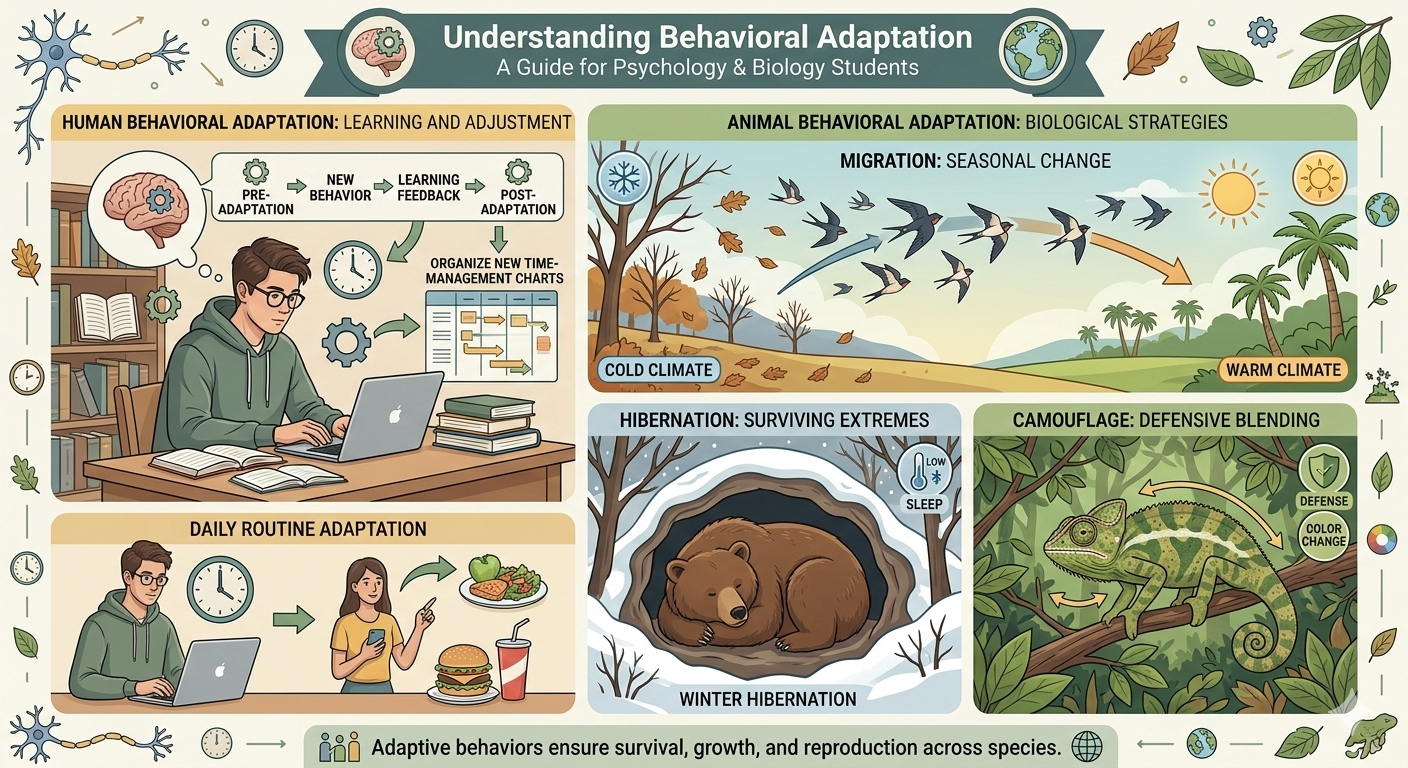
For example, humans may adapt their behavior by wearing warm clothing in cold weather, studying new skills to succeed in school, or learning social rules that help them interact effectively with others. Similarly, animals display behavioral adaptations such as migration, hunting strategies, or protective behaviors.
In psychology, behavioral adaptation also refers to the ways individuals adjust their behavior to manage stress, solve problems, and maintain emotional well-being.
Behavioral Adaptation in Humans
Humans constantly adapt their behavior to deal with new situations and challenges. This process is closely connected to learning, experience, and cognitive development.
For instance, when a student receives poor grades on a test, they may change their study habits, spend more time reviewing material, or seek help from teachers. These changes in behavior represent an adaptation aimed at improving future performance.
Behavioral adaptation is also important in social life. People learn to adjust their communication style, emotional responses, and social behavior depending on cultural expectations, relationships, and social environments.
Behavioral Adaptation in Animals
Behavioral adaptation is widely observed in the animal kingdom. Animals develop specific behaviors that help them survive in their natural habitats.
Examples include:
- Migration, where animals travel long distances to find food or suitable climates
- Hibernation, where animals conserve energy during winter when food is scarce
- Nocturnal activity, where animals become active at night to avoid predators or extreme temperatures
- Protective behaviors, such as camouflage, warning calls, or group defense
These behaviors often evolve over generations because they increase the chances of survival.
Types of Behavioral Adaptation
Behavioral adaptations can be classified into different types depending on how they develop and function.
Learned Behavioral Adaptation
Learned adaptations occur when individuals change their behavior based on experience, learning, or observation. Humans and many animals learn from past events and modify their actions accordingly.
For example, a child learning not to touch a hot surface after being burned is demonstrating learned behavioral adaptation.
Instinctive Behavioral Adaptation
Instinctive adaptations are behaviors that organisms are born with. These behaviors occur naturally without the need for learning or experience.
For example, newborn babies automatically suckle for food, and many animals instinctively build nests or care for their young.
Social Behavioral Adaptation
Social adaptation refers to behavioral changes that allow individuals to function effectively within a group or society. This includes learning social norms, communication styles, cooperation, and conflict resolution.
In humans, social behavioral adaptation is essential for building relationships, maintaining communities, and participating in cultural practices.
Factors Influencing Behavioral Adaptation
Several factors influence how individuals or organisms adapt their behavior.
Environmental Conditions
Changes in climate, resources, and physical surroundings often require organisms to modify their behavior in order to survive.
Learning and Experience
Past experiences help individuals learn which behaviors are successful and which are not, leading to adjustments in future actions.
Biological Factors
Genetic traits, brain development, and nervous system function can influence how easily an organism adapts to new situations.
Social and Cultural Influences
Human behavior is strongly influenced by cultural norms, family expectations, education, and social interactions.
Importance of Behavioral Adaptation
Behavioral adaptation plays a crucial role in survival and development. It allows individuals to respond to challenges, adjust to new environments, and improve their ability to meet life’s demands.
In humans, behavioral adaptation supports:
- Learning and academic success
- Emotional regulation
- Problem-solving abilities
- Social interaction and cooperation
- Mental resilience during stressful situations
In animals, it helps ensure survival, reproduction, and successful interaction with their environment.
Behavioral Adaptation and Psychology
In psychology, behavioral adaptation is closely connected to concepts such as learning, conditioning, coping mechanisms, and resilience. Psychologists study how individuals change their behavior when facing stress, trauma, or new experiences.
Healthy behavioral adaptation may include developing coping strategies, seeking social support, or changing habits to improve well-being. On the other hand, maladaptive behaviors—such as avoidance or harmful habits, may develop when individuals struggle to adapt effectively.
Understanding behavioral adaptation helps psychologists design therapies and interventions that encourage healthier behavioral responses.
Conclusion
Behavioral adaptation refers to the changes in behavior that help organisms survive, function, and adjust to their environment. These adaptations may be learned through experience, influenced by social and cultural factors, or developed as instinctive behaviors.
By studying behavioral adaptation, psychologists and scientists gain insight into how individuals respond to challenges, learn from experiences, and improve their ability to cope with changing environments. This understanding plays an important role in promoting human development, emotional well-being, and successful interaction with the world.
If you’re interested in improving your mental performance and overall well-being, take the quiz to get personalized supplement recommendations designed to support focus, mood balance, stress management, and cognitive health. The quick quiz helps match you with options tailored to your individual needs and lifestyle.
Frequently Asked Questions
What is behavioral adaptation?
Behavioral adaptation refers to changes in behavior that help individuals or organisms survive and function effectively in their environment. These behaviors allow them to respond to challenges, obtain resources, and adjust to changing conditions.
What are some examples of behavioral adaptation?
Examples include animals migrating to warmer climates, humans adjusting study habits to improve academic performance, or individuals developing coping strategies to manage stress and difficult situations.
What is the difference between behavioral adaptation and physical adaptation?
Behavioral adaptation involves changes in actions or habits, while physical adaptation refers to structural changes in the body, such as fur thickness in animals or body features that help them survive in certain environments.
Why is behavioral adaptation important in psychology?
Behavioral adaptation is important because it helps psychologists understand how people respond to challenges, learn from experiences, and adjust their behavior to maintain emotional well-being and function effectively in society.