
The behavioral perspective in psychology is an approach that focuses on understanding human and animal behavior by studying observable actions and responses to environmental stimuli. This perspective emphasizes that behavior is learned through interaction with the environment rather than being primarily influenced by internal thoughts or emotions.
Behavioral psychologists believe that behaviors can be measured, observed, and scientifically studied. Instead of focusing on mental processes that cannot be directly seen, the behavioral perspective concentrates on how external factors such as rewards, punishments, and experiences shape behavior over time.
You can read or explore more here at the Knowledge Hub for more mental health and psychology-related articles to learn about topics such as behavior, cognitive development, emotional regulation, and stress management. If you want to support your mental performance and overall well-being, you can also take the quiz to get personalized supplement recommendations designed to support focus, mood balance, stress resilience, and cognitive health.
Definition of the Behavioral Perspective
In simple terms, the behavioral perspective suggests that behavior is learned and maintained through interactions with the environment. According to this view, people and animals respond to stimuli in their surroundings, and their actions are shaped through processes such as reinforcement, punishment, and conditioning.
The behavioral perspective became one of the most influential approaches in psychology during the early twentieth century and helped establish psychology as a more scientific and experimental discipline.
Historical Background
The behavioral perspective emerged in the early 1900s as psychologists sought to study behavior in a more objective and measurable way. Before behaviorism developed, psychology focused heavily on introspection, which involved examining one’s own thoughts and feelings. However, this method was considered difficult to measure scientifically.
One of the key figures in the development of behaviorism was John B. Watson, who argued that psychology should focus only on observable behavior rather than internal mental processes. Watson believed that human behavior could be understood through the study of stimulus and response relationships.
Later, psychologists such as Ivan Pavlov and B. F. Skinner expanded the behavioral perspective by developing theories of learning based on conditioning.
Key Concepts of the Behavioral Perspective
The behavioral perspective is based on several important concepts that explain how behaviors are learned and maintained.
Stimulus and Response
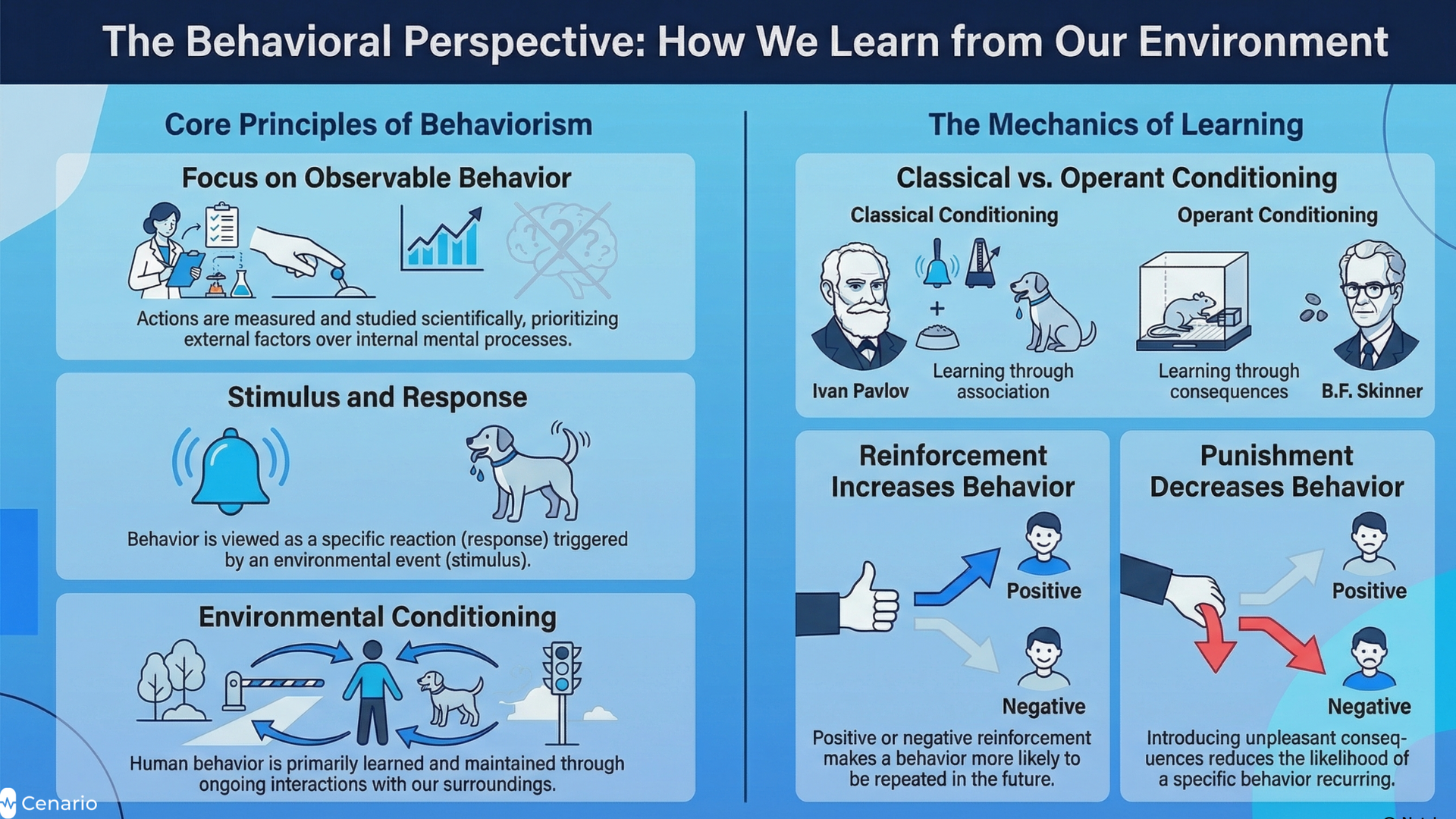
Behaviorists describe behavior as a response to a stimulus in the environment. A stimulus is any event or situation that triggers a reaction, while the response is the behavior that follows.
For example, the sound of a school bell (stimulus) may cause students to leave the classroom (response).
Conditioning
One of the central ideas in the behavioral perspective is conditioning, which refers to the process through which behavior is learned.
Two major forms of conditioning are commonly studied.
Classical conditioning involves learning through association. This concept was first demonstrated by Ivan Pavlov in his experiments with dogs, where the animals learned to associate a bell sound with the presentation of food.
Operant conditioning, developed by B. F. Skinner, involves learning through consequences. Behaviors that are rewarded are more likely to be repeated, while behaviors followed by punishment are less likely to occur.
Reinforcement and Punishment
Reinforcement and punishment are important tools in shaping behavior.
Reinforcement increases the likelihood that a behavior will occur again. It can be positive (adding a reward) or negative (removing an unpleasant condition).
Punishment, on the other hand, decreases the likelihood of a behavior being repeated by introducing an unpleasant consequence.
These principles are widely used in education, parenting, and behavior modification programs.
Behavioral Perspective in Everyday Life
The behavioral perspective can be observed in many areas of daily life. Teachers may use praise or rewards to encourage students to complete assignments. Parents may set rules and consequences to guide children’s behavior. Employers may offer incentives or bonuses to motivate employees.
These examples show how behavior can be influenced by environmental factors and reinforcement.
Applications of the Behavioral Perspective
The behavioral perspective has practical applications in many fields.
In education, behavioral techniques help teachers encourage positive learning behaviors and reduce disruptive actions in classrooms.
In clinical psychology, behavioral therapies are used to treat various mental health conditions such as anxiety disorders, phobias, and addiction. Techniques such as behavior modification and exposure therapy are based on behavioral principles.
In organizational settings, behavioral strategies are used to improve employee performance and motivation.
Strengths of the Behavioral Perspective
One major strength of the behavioral perspective is its emphasis on scientific observation and experimentation. Because behavior can be directly observed and measured, behavioral research often produces reliable and objective data.
Another advantage is that behavioral principles can be applied in many practical situations, including education, therapy, and behavior management.
Limitations of the Behavioral Perspective
Despite its contributions, the behavioral perspective also has limitations. Critics argue that it focuses too much on observable behavior and does not fully consider internal mental processes such as thoughts, emotions, and motivation.
Modern psychology often combines behavioral principles with cognitive and biological approaches to provide a more complete understanding of human behavior.
Conclusion
The behavioral perspective in psychology focuses on studying observable behavior and how it is shaped by environmental influences. Through concepts such as stimulus and response, conditioning, reinforcement, and punishment, behaviorists explain how behaviors are learned and maintained.
Although it does not fully address internal mental processes, the behavioral perspective has made significant contributions to psychology and continues to influence fields such as education, therapy, and behavioral research. Understanding this perspective helps explain how experiences and environmental factors shape human and animal behavior.
If you’re looking to support your brain health and daily mental performance, take the quiz to get personalized supplement recommendations designed to support focus, mood balance, stress management, and overall cognitive wellness. The quick quiz helps match you with options tailored to your individual needs and lifestyle.
Frequently Asked Questions
What is the behavioral perspective in psychology?
The behavioral perspective in psychology is an approach that focuses on studying observable behaviors and how they are influenced by environmental stimuli, reinforcement, and punishment rather than internal mental processes.
Who are the major contributors to the behavioral perspective?
Important contributors include John B. Watson, who promoted behaviorism as a scientific approach to psychology, Ivan Pavlov, known for classical conditioning, and B. F. Skinner, who developed the concept of operant conditioning.
What is the difference between classical conditioning and operant conditioning?
Classical conditioning involves learning through association between two stimuli, while operant conditioning involves learning through the consequences of behavior, such as rewards or punishments.
How is the behavioral perspective used in real life?
The behavioral perspective is widely used in education, parenting, therapy, and workplace management to encourage positive behaviors and reduce negative ones through reinforcement, consequences, and structured learning environments.