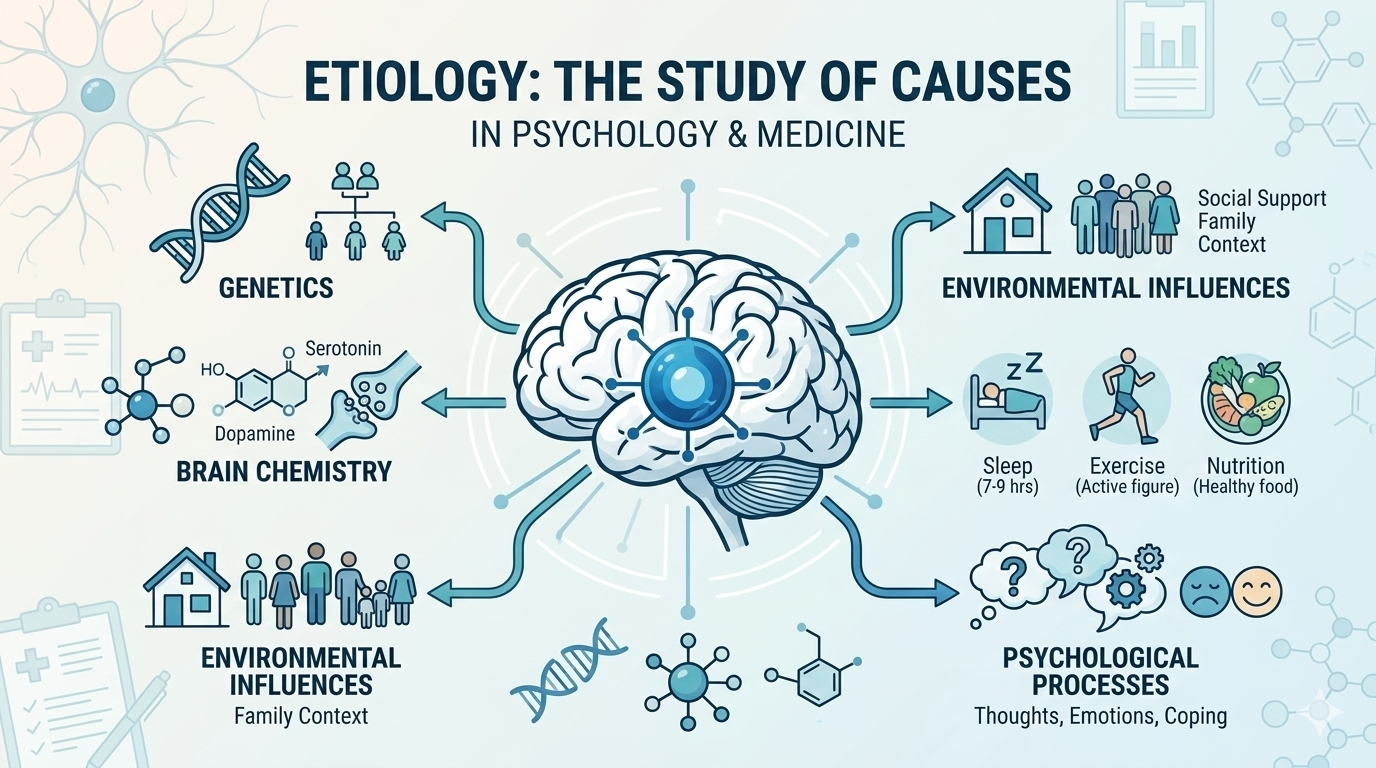

Etiology refers to the study of the causes or origins of a disease, disorder, or condition. In psychology, medicine, and health sciences, etiology focuses on understanding why a particular condition develops and what factors contribute to its onset. These causes can include biological influences, environmental conditions, psychological factors, lifestyle habits, or a combination of several elements.
The term “etiology” comes from the Greek words aitia, meaning “cause,” and logos, meaning “study” or “explanation.” Together, the term literally means the study of causes. In mental health and medical fields, identifying the etiology of a condition is an essential step in understanding how the condition develops and how it may affect individuals.
Etiology does not simply look at a single cause. Most health conditions, especially mental health disorders, develop through multiple interacting factors. Researchers and clinicians study these contributing elements in order to better understand the mechanisms behind illnesses and human behavior.
If you would like to explore more psychological concepts, mental health topics, and scientific explanations of how the mind and brain work, you can explore additional articles in the Knowledge Hub, where complex ideas are explained in clear and practical ways.
If you want to learn more about psychology, mental health, and how the brain and behavior work, explore more articles here in the Knowledge Hub, where complex topics are explained in clear and practical ways. You can also take the Cenario quiz to get personalized supplement recommendations designed to support focus, emotional balance, stress management, and overall mental well-being.
Etiology in Psychology
In psychology, etiology refers to the investigation of the causes behind mental health conditions, emotional difficulties, and behavioral patterns. Understanding the etiology of a psychological disorder helps researchers and clinicians understand how the condition develops and what influences may increase the likelihood of experiencing it.
Mental health conditions rarely have a single cause. Instead, they often develop through a combination of biological vulnerabilities, environmental experiences, and psychological processes. For example, conditions such as anxiety disorders, depression, or post-traumatic stress disorder may arise from the interaction between genetic predispositions, stressful life events, and patterns of thinking or coping.
Because mental health is complex, psychologists often take a multifactorial approach to etiology, meaning they consider many different contributing factors rather than focusing on one single cause.
Biological Etiology
Biological etiology refers to physical or biological factors that contribute to the development of a condition. These may include genetics, brain structure, neurochemistry, hormonal influences, and overall physical health.
For instance, some mental health conditions may have genetic components, meaning individuals may inherit certain biological traits that increase their vulnerability. Brain chemistry also plays an important role, as neurotransmitters such as serotonin, dopamine, and norepinephrine influence mood, motivation, and emotional regulation.
Biological etiology does not mean a condition is entirely determined by biology. Instead, biological factors often interact with environmental and psychological influences.
Psychological Etiology
Psychological etiology focuses on mental and emotional processes that may contribute to the development of a disorder or behavior. These factors can include patterns of thinking, coping strategies, personality traits, and emotional responses to life experiences.
For example, persistent negative thought patterns, low self-esteem, or chronic stress may influence emotional well-being and increase vulnerability to mental health challenges. Psychological theories often examine how individuals interpret events, process emotions, and learn behaviors over time.
Different psychological approaches, such as cognitive psychology, behavioral psychology, and psychodynamic theory, offer different explanations for how psychological factors contribute to the development of certain conditions.
Environmental and Social Etiology
Environmental factors also play a major role in etiology. A person’s surroundings, life experiences, and social environment can influence both physical and mental health.
Examples of environmental influences include childhood experiences, family dynamics, education, cultural expectations, social support systems, and exposure to stressful or traumatic events. Long-term stress, social isolation, or unstable environments may increase the risk of developing certain mental health difficulties.
Social conditions such as economic hardship, discrimination, and community support can also shape psychological outcomes.
Because human behavior and health are deeply connected to social contexts, many psychologists emphasize the importance of examining environmental influences when studying etiology.
Multifactorial Etiology
Most modern psychological and medical research recognizes that many conditions have multifactorial etiology, meaning they develop from multiple interacting causes rather than a single source.
For example, depression may develop through a combination of genetic vulnerability, stressful life events, changes in brain chemistry, and patterns of negative thinking. Similarly, anxiety disorders may involve biological sensitivity to stress combined with environmental triggers and learned behavioral responses.
This multifactorial perspective helps explain why two individuals exposed to similar situations may respond very differently. One person may develop a condition while another may not, depending on the combination of biological, psychological, and environmental factors involved.
Etiology and Diagnosis
Understanding the etiology of a condition is an important part of psychological and medical research. By studying causes, researchers can better understand how disorders develop, which risk factors may increase vulnerability, and which protective factors may support resilience.
However, it is important to note that diagnosis focuses on identifying symptoms and patterns of behavior, while etiology focuses on understanding why those symptoms developed.
Because many mental health conditions have complex causes, researchers continue to study etiology in order to improve scientific understanding and support better approaches to mental health care and prevention.
Etiology vs. Pathology
Etiology is sometimes confused with pathology, but the two terms refer to different aspects of health.
Etiology focuses on the causes or origins of a disease or condition. Pathology, on the other hand, refers to the study of the structure and functional changes in the body that occur because of disease.
In simple terms, etiology answers the question “What caused this condition?”, while pathology focuses on “What changes occur in the body because of it?”
Both fields are important for understanding how diseases and disorders develop and how they affect individuals.
Final Thoughts
Etiology plays a central role in psychology, medicine, and health sciences because it helps explain how and why conditions develop. By studying the causes of diseases, disorders, and behaviors, researchers gain deeper insight into the complex interactions between biology, psychology, and the environment.
Rather than focusing on a single cause, modern approaches to etiology recognize that many health conditions emerge from multiple interconnected influences. Understanding these causes helps researchers and professionals better understand human health, behavior, and the factors that shape mental and physical well-being.
Frequently Asked Questions
What does etiology mean in psychology?
In psychology, etiology refers to the study of the causes or origins of mental health conditions, behaviors, or psychological disorders. Researchers examine biological, psychological, and environmental factors that may contribute to the development of a condition.
What is an example of etiology?
An example of etiology can be seen in depression. Researchers may study genetic factors, brain chemistry, stressful life events, and patterns of thinking to understand how these factors together may contribute to the development of depressive symptoms.
What is the difference between etiology and pathology?
Etiology focuses on the causes of a disease or condition, while pathology focuses on the physical or functional changes in the body that occur because of the disease. In simple terms, etiology asks why a condition develops, while pathology examines what happens in the body after it develops.
Why is etiology important in mental health?
Understanding etiology helps researchers and mental health professionals explore the underlying causes of psychological conditions. This knowledge can support better understanding of risk factors, prevention strategies, and approaches to mental health care.