
What Cortisol Really Does
Cortisol is a steroid hormone produced in the adrenal cortex. People treat it like an enemy, but the real problem is not cortisol itself. The problem is losing control of its rhythm. Once the rhythm breaks, symptoms appear in a predictable order.
Persistently elevated cortisol affects sleep, mood, energy, and long-term health. This article builds on the foundational concepts of stress physiology explored in our stress regulation and cortisol education section.
The Cortisol Curve Explained
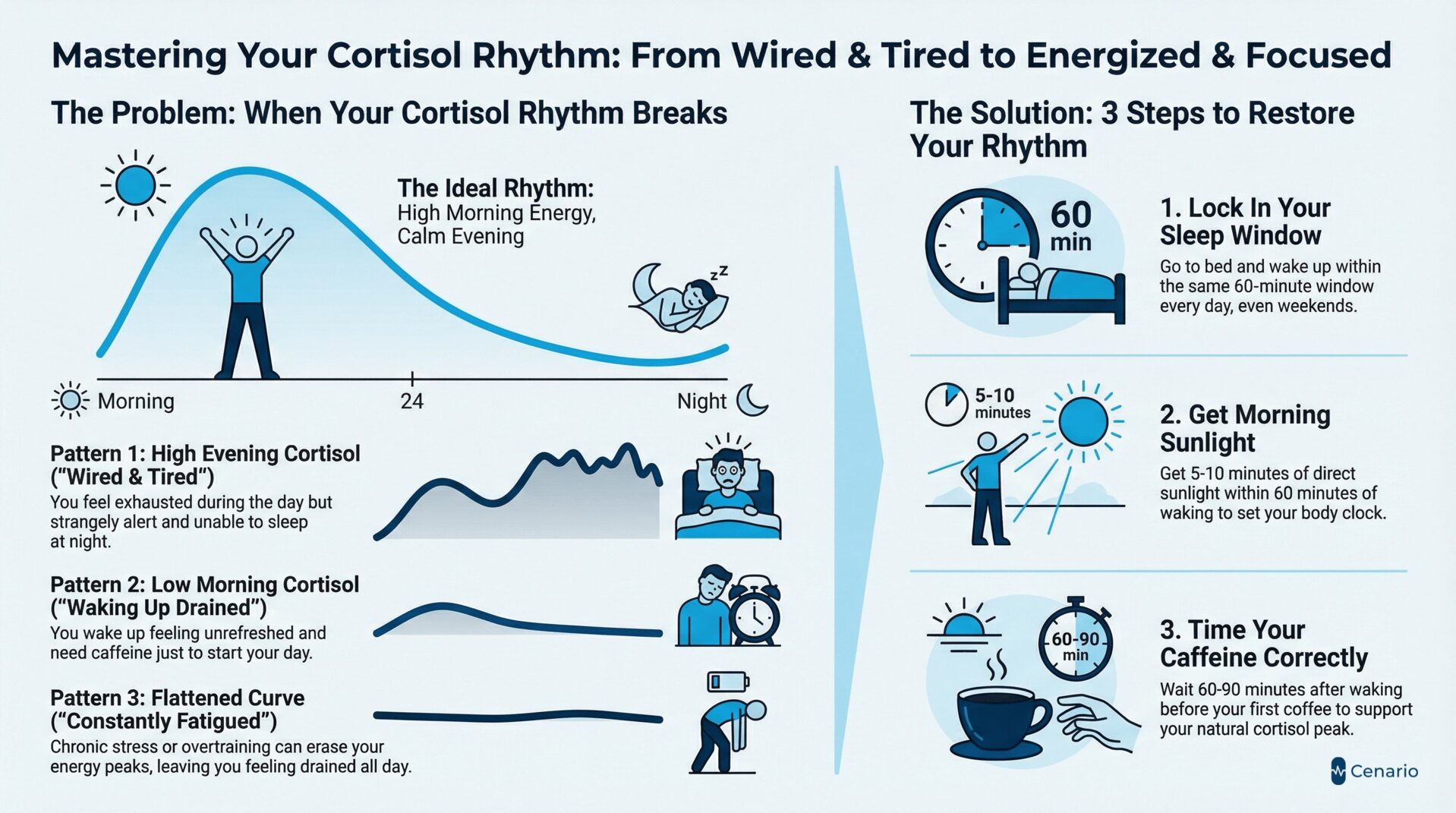
Your body follows a 24 hour cycle controlled by the hypothalamus. Cortisol is supposed to rise sharply in the first hour after waking. This surge is called the Cortisol Awakening Response. It sets your alertness, drives your morning energy, clears brain fog, and prepares your metabolism for food.
From that peak, cortisol should gradually fall across the day. It should reach its lowest point in the late evening so your brain can initiate sleep. When this pattern works, you feel alert in the morning, productive in the afternoon, and sleepy at night.
That is the ideal curve. Most people do not have it.
What Happens When the Curve Breaks
There are three failure patterns. Each one comes from a different underlying problem, and each one produces specific symptoms.
Pattern One: High Evening Cortisol
This is the most common pattern. You feel tired during the day but strangely alert at night. You may get a “second wind” after 9 pm. Sleep is shallow. You wake up at 2 or 3 am. You think the issue is anxiety, but the real issue is that cortisol stays elevated too late in the day.
Common drivers:
- Late caffeine
- Inconsistent sleep timing
- Late high intensity training
- Blue light at night
- Chronic mental load with no off switch
This pattern explains people who say they are wired and tired.
Pattern Two: Low Morning Cortisol
You wake up feeling like you never slept. You need caffeine to function. You feel slow for the first two to three hours. You often feel worse after sleeping in.
This is not adrenal fatigue. Your adrenal glands are not broken. The timing of your cortisol output is misaligned. Your body does not get the morning spike. When the spike is low, everything downstream suffers. Alertness, blood sugar control, and motivation all drop.
This pattern often comes from:
- Irregular sleep windows
- Very late bedtimes
- Lack of morning light
- Chronic stress flattening the curve
Pattern Three: Flattened Curve
Cortisol should peak high and drop low. When you are chronically stressed, dieting hard, or overtraining, the body stops making large shifts. The curve becomes flat. You feel the same all day. Not terrible, not good. Just drained with no real energy peaks.
Common causes:
- Overtraining
- Undereating
- Long term sleep loss
- Chronic psychological stress
A flat curve usually shows up as persistent fatigue, weak training output, low motivation, and slow recovery.
Why These Patterns Matter
Your cortisol rhythm dictates multiple downstream systems. Break the rhythm and these systems break with it.
Sleep quality
High evening cortisol blocks melatonin. You can fall asleep late or wake repeatedly. Deep sleep time falls. Recovery drops.
Blood sugar
Cortisol controls glucose release. High cortisol creates afternoon crashes. Low morning cortisol causes morning hunger swings and irritability.
Metabolism
Chronically high cortisol pushes fat storage toward the abdomen. You get more cravings and less satiety because cortisol interacts with ghrelin and insulin.
Mood and cognition
Flattened cortisol curves correlate with lower motivation, increased anxiety, and slower cognitive performance. People mistake this for depression, but often the rhythm is the root problem.
The Core Idea
You do not fix cortisol by chasing relaxation hacks or random supplements. You fix it by restoring the curve. Morning high. Evening low. Clear rise, clear fall. Everything that works for cortisol works because it reinforces this rhythm.
-min.png)
Why Cortisol Goes High
High cortisol is not random. It happens for specific biological reasons. If you target the wrong cause, nothing improves. Most people assume they are “stressed,” but the real drivers are predictable and mechanical. You correct cortisol by identifying which of these inputs is breaking the rhythm.
Driver One: Inconsistent Sleep Timing
Your brain expects a fixed sleep window. When bedtime or wake time shifts, your internal clock cannot predict when to raise or lower cortisol. This scrambles the curve.
Mechanism:
The suprachiasmatic nucleus sets the daily cortisol rhythm, but it uses sleep timing as a major signal. If you shift that signal by two to three hours across the week, your adrenal output loses coherence. Morning cortisol drops, evening cortisol rises, and you end up with poor sleep and daytime fatigue.
Symptoms that confirm this cause:
- You feel alert late at night
- You wake groggy even after long sleep
- You feel worse after sleeping in
- Your energy pattern changes every day
Driver Two: High Perceived Stress
Stress itself is not a problem. The problem is how long your nervous system stays in threat mode. When the brain interprets constant pressure, uncertainty, or unresolved tasks as danger, you get sustained release of CRH and ACTH which drive cortisol output.
Mechanism:
Chronic psychological load keeps the HPA axis activated. The curve stops behaving like a wave and becomes a long plateau. You stay activated all day. Cortisol stays elevated even when nothing urgent is happening.
Symptoms:
- Difficulty relaxing even in silence
- Mind racing at night
- Feeling “tired but wired”
- Muscle tension in jaw, neck, traps
Driver Three: Excess Caffeine
Caffeine is useful, but mistiming it breaks cortisol control. The worst habit is drinking caffeine immediately after waking. Morning cortisol is supposed to rise naturally. When you add caffeine on top, you spike it higher and push the drop later in the day.
Mechanism:
Caffeine increases cortisol through adenosine receptor blockade. When the morning spike becomes exaggerated, the downward curve is delayed. This creates high evening cortisol and poor sleep.
Symptoms:
- Afternoon anxiety
- Poor sleep despite being tired
- Reliance on multiple caffeine doses
- Shakiness when meals are delayed
Driver Four: Under Eating or Chronic Dieting
Cortisol maintains blood glucose. If you do not eat enough or go long periods without food while under stress, your body uses cortisol to raise blood sugar. This creates unnecessary spikes.
Mechanism:
Low energy intake reduces leptin and signals the hypothalamus to raise sympathetic activity. The body interprets underfeeding as a scarcity threat and boosts cortisol to compensate. This is why chronic dieters often feel anxious or cold with low libido.
Symptoms:
- Feeling better instantly after eating
- Crashing mid afternoon
- Cold hands and feet
- Low libido and irritability
Driver Five: Lack of Morning Sunlight
Light hitting the retina is the number one signal that tells your brain what time of day it is. Without morning light, the cortisol peak drifts later and later. This pushes alertness into the evening.
Mechanism:
Morning light triggers melanopsin activation which sends a signal to the SCN. This confirms the start of the biological day. If this signal is weak or delayed, the cortisol rhythm shifts. Evening cortisol stays high because your brain thinks it is earlier.
Symptoms:
- Not tired at night
- Morning sluggishness
- Slow mental start
- Relying on caffeine to feel normal
Driver Six: Overtraining
Training is a stressor. That is how you adapt. But too much high intensity work without recovery flattens the cortisol curve.
Mechanism:
Hard training releases cortisol to mobilize energy. When the frequency or intensity is too high, the body stops producing clear peaks. You get chronic elevation and a blunted response. This is why overtrained people feel tired all day while struggling to recover.
Symptoms:
- Elevated resting heart rate
- Poor sleep after training
- Loss of strength or power
- Heavy legs and constant soreness
Driver Seven: Blood Sugar Instability
Cortisol rises when glucose drops too fast. This is why people with poor meal timing or extreme fasting get mood swings, irritability, or late night hunger.
Mechanism:
Low blood glucose triggers the adrenals to release cortisol so the liver can dump stored glycogen. If your diet is erratic, the body uses cortisol to stabilize you. This trains your cortisol rhythm to spike at the wrong times.
Symptoms:
- Irritability when hungry
- Afternoon crashes
- Waking up hungry at night
- Brain fog relieved by food
The Core Point
Cortisol is not emotional. It is mechanical. Fix the drivers and the curve returns to normal. If you skip this step and go straight to supplements, you mask the problem and nothing improves long term.

The Most Reliable Ways To Lower Cortisol
Lowering cortisol is not about relaxation hacks. It is about restoring the biological rhythm that controls energy, focus, mood, and sleep. This section breaks down the interventions that consistently work because they target the underlying mechanisms, not the symptoms.
Intervention One: Fix Your Sleep Window
Sleep timing drives cortisol timing. If your bedtime shifts by two to three hours across the week, you cannot stabilize cortisol. You fix this by choosing a sleep window and locking it in.
Mechanism:
The SCN uses your sleep pattern as a time anchor. When that anchor is stable, cortisol rises and falls predictably. When it changes, the curve drifts and evening cortisol stays elevated.
Action steps:
- Go to bed within the same 60 minute window every night
- Wake within the same 60 minute window
- Avoid large sleep ins
- Stop training or caffeine late at night
Expected result:
Most people see evening cortisol drop within five to seven days of consistent timing. Sleep becomes deeper. You wake earlier and feel clearer.
Intervention Two: Control Morning Light
This is the most underrated cortisol intervention. Morning sunlight triggers the strongest circadian signal available. It sets the cortisol peak early which allows a clean decline through the day.
Mechanism:
Light activates melanopsin containing retinal cells. These send a timing signal that synchronizes cortisol release. Without this signal, the peak drifts later which causes night time alertness.
Action steps:
- Get direct light exposure within the first 30 to 60 minutes after waking
- Aim for at least five minutes outdoors
- If weather is poor, extend to ten to fifteen minutes
- Windows filter wavelengths and are weaker
Expected result:
Higher morning alertness and lower evening tension. Night time sleep pressure starts earlier.
Intervention Three: Reduce Stimulant Load
Caffeine is not the enemy. Mistiming it is. You eliminate the cortisol problems by shifting caffeine later in the morning and lowering total intake.
Mechanism:
Caffeine blocks adenosine and pushes cortisol higher. When taken immediately after waking, it exaggerates the morning spike and delays the decline. When taken late in the afternoon, it disrupts the evening drop and sleep.
Action steps:
- Wait 60 to 90 minutes after waking before your first caffeine
- Limit total intake to 200 to 300 mg daily if you are anxious
- Avoid caffeine after 2 pm
- Combine caffeine with L theanine if you get jittery
Expected result:
Cleaner energy curve, fewer afternoon crashes, easier sleep onset.
Intervention Four: Stabilize Blood Sugar
Cortisol rises to correct blood sugar. If your eating pattern is chaotic, you force cortisol spikes. You lower cortisol by keeping glucose stable.
Mechanism:
Low blood glucose triggers cortisol release to free glycogen. Balanced meals prevent these dips and stop cortisol from acting as your backup fuel system.
Action steps:
- Eat meals with protein, fats, and slow digesting carbs
- Avoid skipping meals if you get irritable or shaky
- Add a small protein snack in the afternoon if you crash
- Eat your last meal two to three hours before bed
Expected result:
Reduced irritability, stable energy, fewer night time wakeups.
Intervention Five: Reduce Training Stress
Training should improve your stress tolerance, not break your cortisol rhythm. If every workout is maximal, cortisol stays elevated.
Mechanism:
High intensity training spikes cortisol. Without recovery days, the body never returns to baseline and the curve flattens. Lower intensity work regulates the rhythm.
Action steps:
- Keep hard sessions to two or three per week
- Add low intensity training or walking on alternate days
- Avoid intense training after 6 pm if you struggle with sleep
- Track resting heart rate to gauge recovery
Expected result:
Better sleep, improved recovery, increased strength and endurance over time.
Intervention Six: Use Evidence Based Supplements
Supplements do not fix cortisol alone. They enhance the response when the lifestyle drivers are corrected. Use ingredients that have real human data.
Ashwagandha
Dose: 300 to 600 mg extract daily
Effect: Reduces perceived stress and lowers cortisol in several trials. Best for people who feel anxious or wired.
Phosphatidylserine
Dose: 200 to 400 mg
Effect: Reduces acute cortisol spikes. Ideal for evening stress or people who ruminate.
Rhodiola Rosea
Dose: 200 to 400 mg
Effect: Supports fatigue resistance. Best for people who feel drained and flat.
Magnesium Glycinate
Dose: 200 to 400 mg
Effect: Improves sleep depth and reduces muscle tension.
L Theanine
Dose: 200 mg
Effect: Calms the nervous system with no sedation.
Poor options:
- Proprietary adrenal blends
- Caffeine heavy “energy” formulas
- Under dosed mixed adaptogen blends
Intervention Seven: Reduce Evening Light
Evening light suppresses melatonin. Lower melatonin means higher cortisol. You cannot lower cortisol at night while bathing in bright LED light.
Mechanism:
Blue and bright white light suppress melatonin production. When melatonin stays low, the evening cortisol drop never happens. This keeps the brain in wake mode.
Action steps:
- Dim lights two hours before bedtime
- Avoid overhead lighting
- Reduce screen brightness
- Avoid scrolling in bed
Expected result:
Earlier sleep onset, deeper sleep, reduced nighttime wakeups.
You lower cortisol by restoring the morning peak and restoring the evening drop. All effective interventions push the rhythm in one direction. Morning light up. Evening stimulation down. Stable food intake. Proper training load. Correct caffeine timing. Targeted supplements. When these align, cortisol normalizes regardless of stress level.
If you are not sure what supplements is evidence based and match your needs, Take The Quiz and get your personalized formula today!
Frequently Asked Questions
How long does it take to lower cortisol?
Most people see improvements within five to seven days after fixing their sleep window and morning light exposure. Full rhythm correction can take three to six weeks.
Can supplements fix cortisol alone?
No. Supplements enhance the process but cannot correct a broken rhythm. If sleep, light exposure, food intake, and caffeine timing are poor, supplements will only mask symptoms.
Is adrenal fatigue real?
No. The adrenals do not “burn out.” The issue is a dysregulated HPA axis and a disrupted circadian rhythm. The glands still function. The timing is wrong.
Why do I feel worse when I wake up early?
If your cortisol peak occurs too late because of poor sleep timing or lack of morning light, waking early means you are waking before the peak. You feel dull because the body has not begun the activation phase.
Why do I wake up at 2 or 3 am?
This usually comes from either unstable blood sugar or elevated evening cortisol. Poor meal timing and late caffeine are common causes.
Can intermittent fasting raise cortisol?
Yes. Extended fasting can raise cortisol if you are stressed, under eating, or training hard. It is less of a problem for people with low stress, adequate calories, and stable sleep.
Is it possible to have low cortisol?
Yes, but it is rare without disease. Most people who think they have low cortisol actually have a delayed peak. Fixing sleep timing and morning light often corrects it.
Should I avoid all high intensity training?
No. You should avoid doing it every day. Two or three hard sessions weekly is enough. Daily high intensity spikes cortisol too often and flattens the curve.
Do naps affect cortisol?
Short naps do not. Long naps in the late afternoon can shift your rhythm and push your cortisol peak later. Keep naps earlier and under 40 minutes.
What is the fastest cortisol lowering protocol?
Morning sunlight, consistent wake time, delayed caffeine, balanced meals, dim lights at night, magnesium in the evening, and caffeine reduction after 2 pm. This combination produces the quickest change.