
Boost Your Mood With Natural Supplements Today
Interest in natural supplements for mental health has risen sharply as people look for ways to manage depression, anxiety, and low mood with fewer side effects. Many readers are drawn to herbal remedies, omega-3s, vitamins, and probiotics because these options can feel more approachable than prescription medications. That appeal grows when supplements are used alongside lifestyle steps like better sleep, exercise, and a nutrient-rich diet.
Mental Health Challenges And Accessibility
Mental health conditions are common worldwide, and access to care remains uneven. Long wait times, cost, and concerns about medication adverse effects push people to explore complementary approaches. Natural supplements are often presented as a practical supplement to therapy and medication, especially for mild to moderate symptoms. Still, the choice is personal and depends on medical history, current medications, and symptom severity.
How Supplements Fit Into A Care Plan
Natural supplements for mental health work through a few common mechanisms: reducing inflammation, supporting neurotransmitter production, improving gut-brain communication, and providing nutrients needed for brain function. They are not magic fixes. For many people the most reliable results come from combining targeted supplements with therapy, sleep hygiene, movement, and a balanced diet.
What To Expect From This Guide
This guide is designed to give you a clear, evidence-based framework for understanding which natural supplements are actually worth considering for mental health, and which ones are overhyped or poorly supported. Rather than listing every supplement on the market, the focus is on options that have been studied in clinical trials and are commonly discussed in real-world care.
The next section breaks down the most researched supplements, including St. John’s wort, omega-3 fatty acids, saffron, vitamin D, and probiotics. For each, you will see what the research shows, how they are typically dosed in studies, how they may work in the body, and where caution is needed. Emerging options such as magnesium, lavender, and B vitamins are also covered, with attention to where evidence is strong and where it is still developing.
Later sections address additional supplements that appear frequently in mood discussions, along with practical safety considerations. This includes interactions with medications, who should avoid certain supplements, and how long it realistically takes to see changes. The goal is to help you move from curiosity to informed decision-making without guesswork.
If you want help narrowing options based on your symptoms, goals, and lifestyle, a structured self-assessment can help identify where supplements may add the most value. The aim is not to replace professional care, but to give you a clearer starting point so conversations with your healthcare provider are more focused and productive.
Stop guessing and get a personalized starting point.
Take the Cenario quiz to identify which supplements and lifestyle areas are most relevant for your mood, stress, sleep, and focus, and use the results as a foundation for smarter decisions with your clinician.
Key Supplements and Benefits
This section goes deeper into evidence, typical doses used in trials, mechanisms, and safety notes for the most-studied natural supplements for mental health. Use this as a practical reference when discussing options with a clinician.
St. John’s wort
What trials show: meta-analyses pool about 38 randomized trials that find St. John’s wort effective for mild to moderate depression. Most positive studies use standardized extracts.
- Common trial dose: standardized extract equivalent to 300 mg two to three times daily.
- How it may work: modulates serotonin, dopamine, and norepinephrine transporters and has mild anti-inflammatory effects.
- Safety and interactions: significant interaction risk with SSRIs, oral contraceptives, blood thinners, and many other drugs due to enzyme induction. Never combine with prescription antidepressants without medical supervision.
Omega-3 fatty acids (EPA/DHA)
What trials show: more than 30 randomized studies indicate benefit for depression and anxiety, especially when EPA is the dominant component.
- Effective formulations: EPA-predominant products (for example, EPA 1 to 2 g daily). Some trials tested up to 4 g per day for stronger effects.
- How it may work: reduces neuroinflammation, supports cell membrane function, and influences neurotransmitter signaling.
- Quality tips: look for third-party testing, specify total EPA/DHA content, and check for low oxidation values.
Saffron
What trials show: about 18 randomized studies report saffron reduces depressive and anxiety symptoms compared with placebo and in some trials matches antidepressants.
- Typical dose: 30 mg per day of a standardized saffron extract, often split into two doses.
- Mechanisms: likely anti-inflammatory, antioxidant, and neurochemical effects that influence serotonin pathways.
- Considerations: generally well tolerated, but follow dosing used in clinical trials and verify source to avoid adulteration.
Vitamin D
What trials show: roughly 14 trials find vitamin D supplementation helps depressive symptoms, especially when baseline deficiency is present.
- Dosing guidance: many studies use daily doses between 1,000 and 4,000 IU, or larger weekly doses, tailored to baseline serum 25(OH)D levels.
- How it may work: affects immune regulation, neurotrophic factors, and neurotransmitter synthesis.
- Testing and safety: check serum levels before high-dose therapy and coordinate with a clinician to avoid excessive dosing.
Probiotics
What trials show: probiotic interventions across multiple trials show modest improvements in depression and anxiety, supporting the gut-brain axis concept.
- Strains and doses: benefit most often reported with combinations of Lactobacillus and Bifidobacterium at doses commonly in the billions of CFU range per day.
- How they may work: influence inflammation, vagal signaling, and neurotransmitter precursors.
- Safety: generally safe for healthy adults; use caution in severely immunocompromised people.
Emerging Options and Practical Choices
Several supplements show growing but less consistent evidence. These can be reasonable adjuncts, but expect more variable results.
Magnesium
- Forms: L-threonate and glycinate are favored for brain effects and sleep; oxide has lower absorption.
- Dose range: 200 to 400 mg elemental magnesium daily is common in studies.
- Effects: may calm through GABA and serotonin modulation; useful for anxiety and sleep complaints.
B vitamins and folate
- Role: methylfolate and B12 variants may enhance antidepressant response and support methylation pathways linked to mood.
- Clinical note: adding folate to SSRI therapy has improved remission rates in some trials.
Herbal anxiolytics (lavender, passionflower, chamomile)
- Evidence: several randomized trials find these herbs reduce anxiety symptoms with favorable tolerability.
- Formulations: oral lavender oil capsules (example trial doses around 80 mg) and standardized chamomile extracts are commonly studied.
How to choose and combine supplements
Choosing supplements works best when it follows a structured process rather than trial and error. Most negative experiences come from poor product selection, incorrect dosing, or stacking too many products at once. The steps below reflect how supplements are evaluated and introduced in clinical practice.
First, clarify the goal. Supplements should address a specific issue such as low mood, anxiety, sleep disruption, or stress resilience. Vague goals lead to vague results. This is also the point where current medications must be reviewed, since some supplements change how drugs are absorbed or metabolized.
Second, prioritize quality and standardization. Supplements used in clinical trials rely on standardized extracts and defined doses. Products with third-party testing provide reassurance that the label reflects what is actually in the capsule. Without this, even a well-studied ingredient may be ineffective.
Third, match dose and form to research, not marketing. Many products use doses far below what studies show to be effective, or use poorly absorbed forms. When possible, follow the dosing ranges and formulations used in trials rather than headline claims.
Fourth, introduce changes slowly. Add one supplement at a time and allow enough time to evaluate its effect. Most mood-related supplements require 4 to 12 weeks of consistent use before benefits become clear. Starting multiple products at once makes it impossible to know what is helping or causing side effects.
Finally, monitor and communicate. Track changes in mood, sleep, anxiety, and energy. Any new symptoms, worsening mood, or unusual side effects should be discussed promptly with a healthcare provider. Supplements are supportive tools, not passive additions.
Get a clearer starting point instead of guessing.
Take the Cenario quiz to identify which supplement categories and lifestyle areas are most relevant to your symptoms, then use the results to guide informed discussions with your clinician.
Additional Supplements to Consider
Beyond the most established options, several supplements attract attention despite mixed evidence. These compounds can help some people, but results vary widely and product quality is inconsistent. They should be treated as secondary options rather than first-line choices.
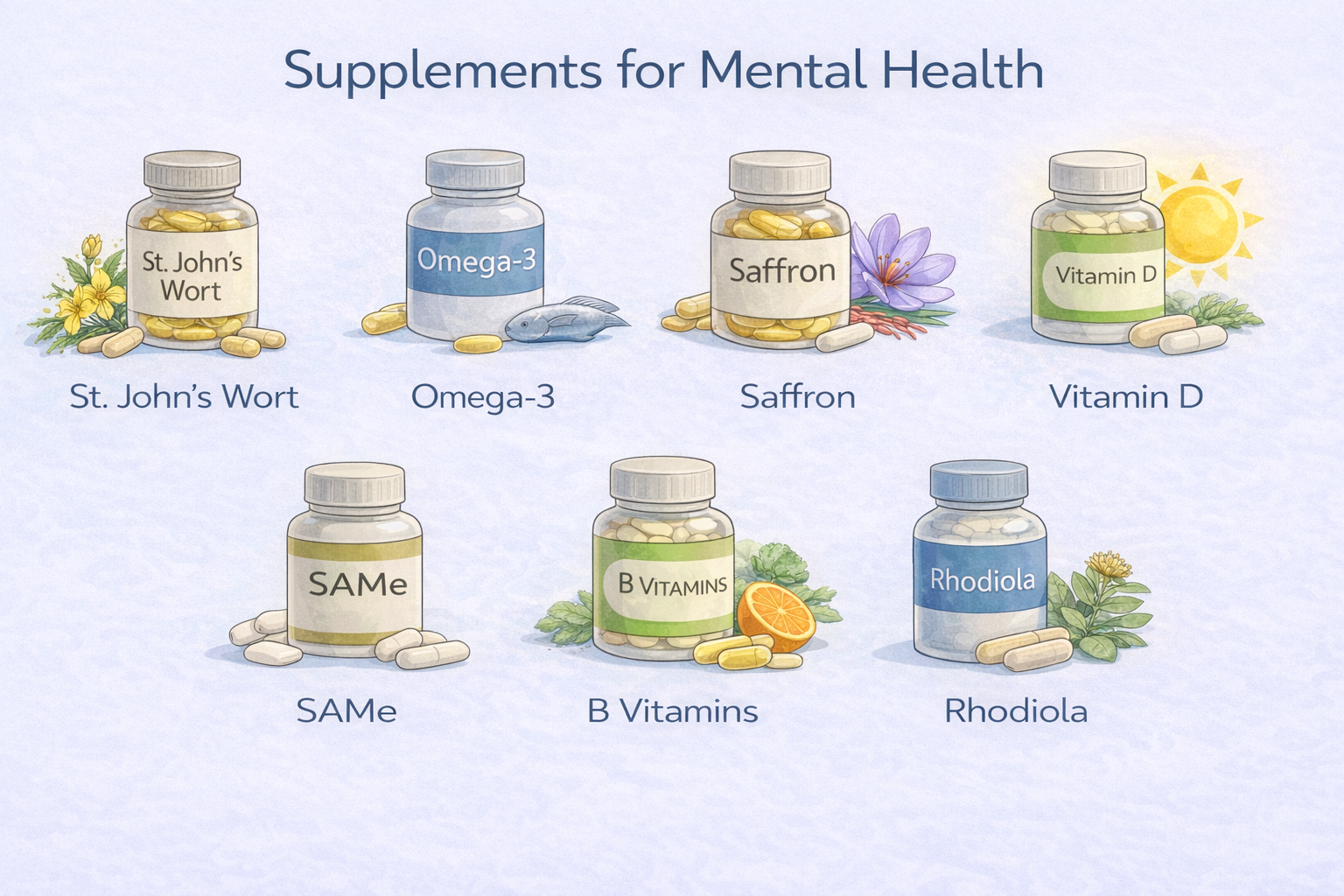
SAMe has shown antidepressant effects in some trials, but responses differ and it carries risks for people with bipolar tendencies. Curcumin shows anti-inflammatory and mood-related benefits in certain formulations, yet outcomes depend heavily on absorption and dosing. Rhodiola may support stress-related fatigue and mild depressive symptoms, but effects are typically modest and context-dependent.
These supplements may be reasonable adjuncts when core options are insufficient, but expectations should remain realistic. Use them deliberately, monitor closely, and avoid stacking multiple experimental products at the same time.
Sam E
- Evidence: several trials and meta-analyses suggest SAMe can improve depressive symptoms compared with placebo and may work faster than some options.
- Dosing and effects: common trial doses range from 400 to 1,600 mg per day in divided doses.
- Risks: SAMe can trigger mania in people with bipolar disorder and interact with antidepressants. Always screen for mood instability before use.
Curcumin
- Evidence: curcumin shows antidepressant and anti-inflammatory effects in some trials, but results vary by formulation and bioavailability.
- Formulations: look for enhanced-absorption products; standard turmeric powders are unlikely to match trial formulations.
- Safety: generally well tolerated but can affect blood clotting and interact with some medications.
Rhodiola
- Evidence: rhodiola is an adaptogen with small trials suggesting benefits for stress-related fatigue and mild depressive symptoms.
- Dosing: typical study doses are 200 to 600 mg of standardized extract per day.
- Considerations: avoid high doses late in the day if it causes stimulation, and consult a clinician for drug interaction checks.
Safety, quality, and practical cautions
Choosing effective natural supplements for mental health means balancing potential benefits against safety and product quality. Follow these practical steps.
- Review medical history and current medications with a clinician to screen for interactions, especially with SSRIs, blood thinners, and hormonal contraceptives.
- Select products with third-party testing or clear standardization. Look for USP, NSF, or independent lab certificates where available.
- Start with a single change. Introduce one supplement at a time so you can observe effects and side effects.
- Use trial-based doses when possible rather than marketing claims. Document baseline symptoms so you can track progress objectively.
- If you have bipolar disorder, are pregnant, breastfeeding, or immunocompromised, avoid self-prescribing and seek specialist advice first.
How to monitor progress and when to seek help
Keep simple records. Use mood scales, a sleep log, and notes on anxiety and energy. Expect different timelines: some effects may appear in days while others take 6 to 12 weeks. If mood worsens, new thoughts of self-harm appear, or you suspect mania, stop supplements and contact a healthcare provider immediately.
Conclusion and next steps
SAMe, curcumin, and rhodiola can expand the range of natural supplements for mental health, but they are not guaranteed fixes and they are not interchangeable with first-line options. Results depend on individual biology, correct dosing, product quality, and how well supplements are integrated into an overall care plan.
The most reliable outcomes come from a structured approach. Start with supplements that have the strongest evidence. Choose products that match clinical trial doses and forms. Introduce changes gradually, monitor responses objectively, and keep medical oversight in place. Supplements work best when they support therapy, sleep consistency, movement, and nutrition rather than trying to replace them.
Get clarity before you add anything new.
Take the Cenario quiz to identify which supplement categories and lifestyle factors are most relevant to your mental health goals, then use those insights to have a more focused, informed conversation with your clinician.
Frequently Asked Questions
What are the most effective natural supplements for mental health?
Evidence points strongest to St. John’s wort, omega-3s (EPA-predominant), saffron, vitamin D when deficient, and certain probiotics. Use natural supplements for mental health as evidence-based adjuncts and review choices with your clinician for safety and dosing.
Can natural supplements replace antidepressants?
For most people natural supplements for mental health are best used as adjuncts rather than replacements. In mild to moderate cases some supplements may match antidepressants in trials, but do not stop prescribed medication without direct medical guidance.
How long does it take to see results from natural supplements for mental health?
Response times vary. Some supplements may show effects in days to weeks, while others require 6 to 12 weeks. Track symptoms and consult your clinician if there is no improvement or if side effects occur.