
Why Sleep Supplements Matter
Sleep problems follow predictable biological patterns. They are not random, and they do not respond well to generic sleep aids or sedatives. When the sleep–wake cycle is disrupted, the body enters a state where normal sleep signals fail to activate.
For example:
- High evening cortisol keeps the brain locked in a wake state.
- Delayed melatonin release shifts circadian timing so your body tries to sleep at the wrong hour.
- Low GABA activity keeps the cortex firing even when you feel exhausted.
- Failure of core body temperature to drop blocks the transition into deep, restorative sleep.
These patterns are measurable, repeatable, and explain why many people fall asleep late or wake up repeatedly throughout the night.
Most individuals never target the correct biological pathway. They buy sleep products with long ingredient lists but no meaningful action. This leads to short-term sedation, not real sleep restoration. Sedation forces unconsciousness, but it does NOT repair the underlying problem. Once the body adapts, the effect fades, leaving you sleepless again.
Effective sleep support depends on choosing the right compounds and using them correctly. This article supports our broader, evidence-driven approach to supplementation covered throughout the supplement science and usage hub.
Correct supplementation is different. It aims to restore natural sleep architecture by influencing:
- Sleep timing
- Sleep depth
- Neurotransmitter transitions
- Stress hormone patterns
This leads to predictable, long-term improvements not a temporary “knockout” effect.
Why Generic Sleep Products Fail
Most sleep supplements are built backward. They contain 10–20 ingredients, but in tiny ineffective doses. It looks impressive on a label, but the body does not respond to “everything at once.” It responds to targeted, clinical-dose active ingredients.
For example:
- Magnesium boosts GABA activity and reduces neural firing.
- Glycine lowers core body temperature critical for deep sleep.
- L-Theanine reduces glutamate and calms racing thoughts.
- Apigenin binds to GABA-A receptors to improve sleep continuity.
- Ashwagandha lowers evening cortisol and regulates stress.
- Melatonin shifts circadian timing.
Each ingredient works for a specific reason. If the reason doesn’t match your underlying sleep problem, the supplement won’t work.
Examples:
- Melatonin helps with circadian delays, not stress insomnia.
- Magnesium helps with tension but can’t fix poor sleep–wake timing.
- Theanine calms the mind but doesn’t help inflammation-driven awakenings.
This mismatch is why many people think sleep supplements do not work. The issue is not the ingredients it’s improper targeting.
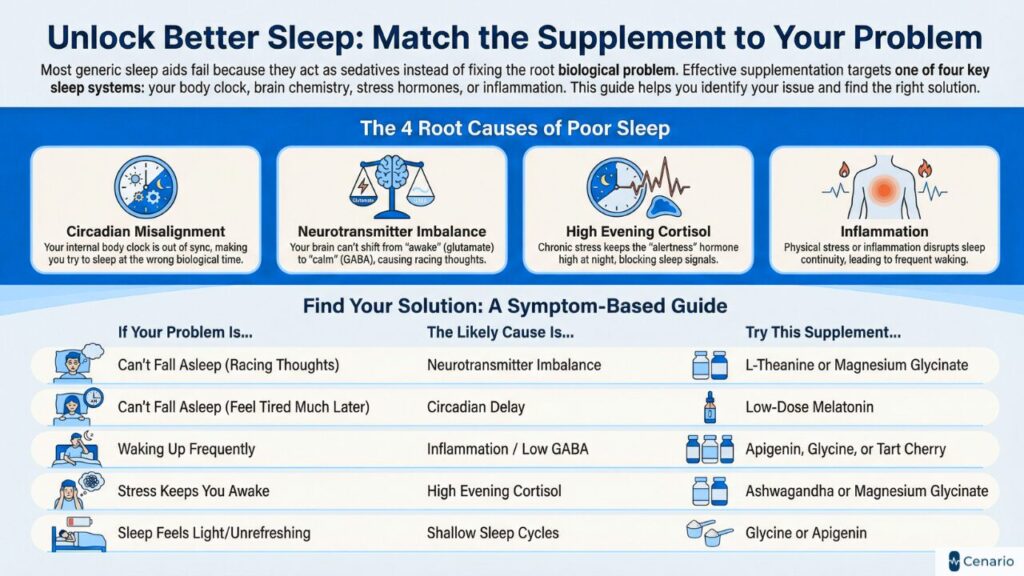
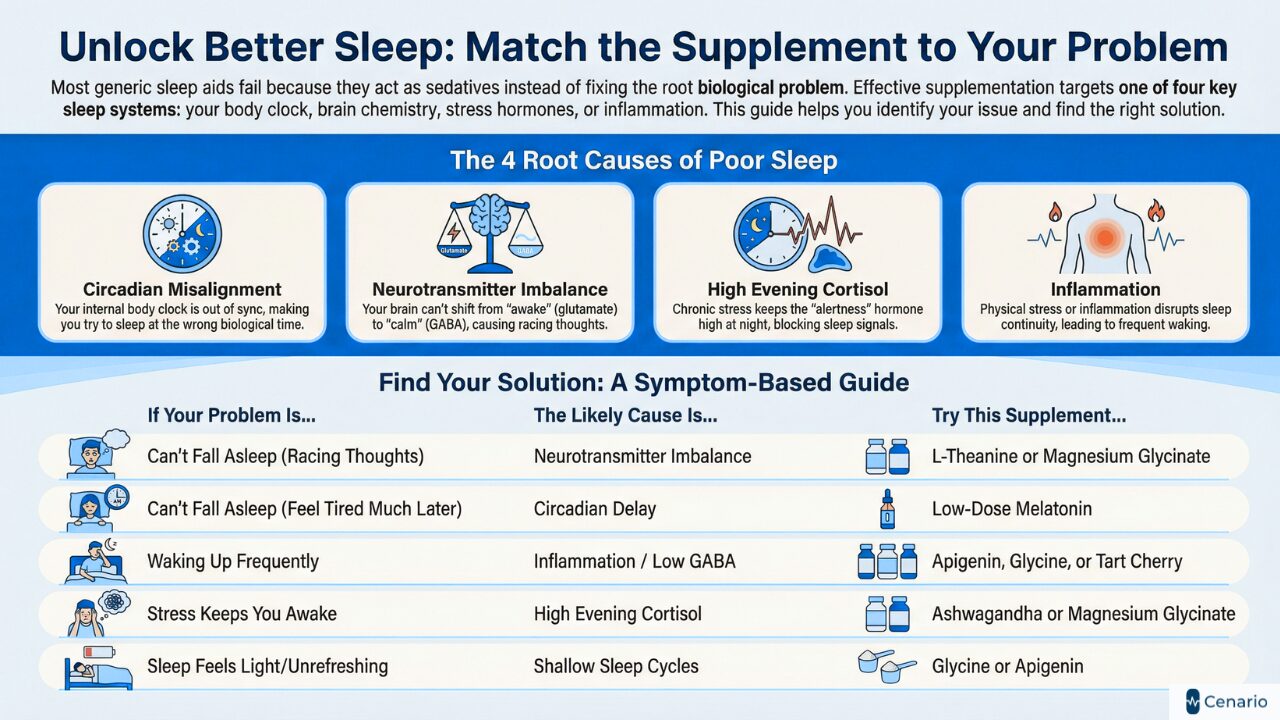
Most sleep issues fall into four categories:
- Circadian misalignment
- Neurotransmitter imbalance
- High evening cortisol (HPA axis dysfunction)
- Inflammatory load
The goal of supplementation is not sedation. The goal is to restore natural sleep patterns so the brain can cycle properly through deep sleep and REM.
The Core Mechanisms Behind Sleep
Sleep is a sequence of biological steps that must occur in the correct order. When one step fails, the entire system collapses. These four mechanisms determine nearly all sleep outcomes:
1. Circadian Rhythm Control
Your circadian clock regulates when you feel awake and when you feel sleepy. It is influenced by:
- Morning sunlight
- Evening light
- Core body temperature
- Melatonin release
When this clock shifts late, you try to sleep while your biology is still in “day mode.” This leads to:
- Long sleep onset
- Shallow first sleep cycles
- Poor REM timing
Circadian issues require melatonin and timing-based corrections not sedatives.
2. Neurotransmitter Balance
To fall asleep, the brain must shift from excitatory chemicals to inhibitory ones.
Excitatory:
- Glutamate
- Dopamine
- Norepinephrine
Inhibitory:
GABA
If this transition is weak, the brain stays alert even when tired. People experience:
- Racing thoughts
- Mental loops
- Difficulty calming down
These individuals need GABA-supportive ingredients such as magnesium, theanine, or apigenin not melatonin.
3. Stress and the HPA Axis
Cortisol should be high in the morning and low at night. But chronic stress keeps evening cortisol elevated. High cortisol:
- Blocks melatonin
- Raises body temperature
- Activates alertness pathways
Until cortisol drops, nothing else will work not melatonin, not glycine, not sedatives.
Ingredients that help here include ashwagandha and phosphatidylserine.
4. Inflammation and Recovery
Inflammation disrupts sleep continuity. It leads to:
- Fragmented sleep
- Trouble staying asleep
- Light, unrefreshing sleep
- Poor next-day energy
Helpful ingredients include tart cherry extract and glycine, which reduce inflammation and support natural melatonin production.
How These Systems Interact
The four systems are interconnected:
- A circadian delay weakens neurotransmitter transitions.
- High cortisol suppresses melatonin and GABA.
- Low GABA prevents body temperature from dropping.
- Inflammation disrupts deep sleep even when timing is correct.
This means most sleep problems involve two or more pathways. This is why single-ingredient solutions often fail.
Sleep Supplements Table
| Supplement | Main Mechanism | Evidence Strength | Ideal Use Case | Where It Fails |
|---|---|---|---|---|
| Magnesium Glycinate | Supports GABA receptors | Strong human trials | Tension insomnia, mental overstimulation | Circadian delays |
| Melatonin | Shifts circadian timing | Very strong evidence | Difficulty falling asleep on time | Stress insomnia |
| L-Theanine | Reduces glutamate | Strong for stress insomnia | Racing thoughts | Inflammation issues |
| Glycine | Lowers core temperature | Solid human trials | Hot sleepers, shallow sleep | Circadian issues |
| Ashwagandha | Reduces cortisol | Strong evidence | Stress-driven insomnia | Timing problems |
| Apigenin | GABA-A activation | Promising studies | Night wakings | Cortisol-related issues |
| Tart Cherry Extract | Reduces inflammation | Good trials | Inflammation-based sleep issues | Stress insomnia |
Explanation of Each Supplement
Magnesium Glycinate
Magnesium glycinate is one of the best forms of magnesium for sleep because it increases GABA activity, the neurotransmitter responsible for slowing down the brain. This makes it ideal for people who feel mentally wired, tense, or overstimulated at night.
However, magnesium does not fix problems related to circadian timing or high evening cortisol. If your issue is a delayed sleep schedule or stress-induced insomnia, magnesium alone will not fully solve it.
Melatonin
Melatonin is not a sedative it’s a hormone that controls circadian rhythm. It tells the body when it’s time to wind down. Low, precise doses help correct delayed sleep timing, jet lag, or inconsistent sleep–wake cycles.
Melatonin will not keep you asleep throughout the night, and it does not calm a busy mind or reduce stress. If your problem is waking up often or feeling anxious at bedtime, melatonin will be ineffective.
L-Theanine
L-Theanine is an amino acid found in green tea that promotes a state of relaxed alertness. It reduces glutamate (an excitatory neurotransmitter) and increases alpha brain waves, helping to quiet racing thoughts.
It’s ideal for people who lie in bed with mental chatter or cognitive overload.
However, L-theanine does not target inflammation, so it will not help if your sleep is disrupted by physical stress, soreness, or inflammatory load.
Glycine
Glycine is a simple amino acid with a powerful effect on sleep. It helps lower core body temperature, which is essential for entering deep, restorative slow-wave sleep.
It works especially well for:
- Hot sleepers
- People who feel physically tired but mentally wired
- Those who fall asleep late due to temperature dysregulation
- Glycine does not address circadian rhythm problems or cortisol issues, so it must be matched to the right sleep profile.
Ashwagandha
Ashwagandha is an adaptogen that helps regulate the HPA axis, which controls cortisol. When evening cortisol is too high, the brain stays alert even if you feel physically exhausted.
Ashwagandha helps lower stress-driven stimulation, allowing natural sleep signals to activate.
However, it will not fix delayed sleep timing or temperature-related sleep issues. It is a hormone-modulating tool, not a circadian one.
Apigenin
Apigenin is a natural compound found in chamomile that binds to GABA-A receptors, increasing the brain’s ability to transition into and maintain sleep.
It is particularly effective for:
- Nighttime awakenings
- Fragmented sleep
- Difficulty staying asleep
- However, if high cortisol is the main issue, apigenin will have limited impact because stress hormones override GABA signaling.
Tart Cherry Extract
Tart cherry extract naturally boosts melatonin production and reduces inflammatory markers. Because inflammation can disrupt sleep cycles, this supplement improves sleep continuity and helps people stay asleep longer.
It is most effective for:
- Athletes
- People with chronic stress
- Individuals with light or fragmented sleep
- It does not quiet racing thoughts, reduce anxiety, or fix stress-induced insomnia.
How to Choose the Right Sleep Supplement Stack
Choosing the right supplement depends on what’s broken, not what sounds relaxing.
If You Cannot Fall Asleep
1. Timing problem (circadian delay)
Use:
- Melatonin (0.3–1 mg)
- Avoid screens 1 hour before bedtime
- Get bright sunlight in the morning
2. Racing thoughts or mental activity
Use:
- L-Theanine (150–300 mg)
- Magnesium Glycinate (200 mg)
- Add Apigenin if thought loops persist
Do NOT combine high-dose melatonin with sedating herbs it increases side effects including grogginess.
If You Fall Asleep but Wake Up Often
This is a sleep continuity issue (low GABA or inflammation).
Use:
- Apigenin (50–100 mg)
- Glycine (3 g)
- Tart Cherry Extract (500–1500 mg)
Do not add melatonin unless you also have timing issues.
If Stress Blocks Sleep
This is an HPA axis problem: high cortisol at night.
Use:
- Ashwagandha (125–300 mg)
- L-Theanine (200 mg)
- Magnesium Glycinate (200–300 mg)
Avoid melatonin early cortisol overrides it.
If Sleep Feels Light or Unrefreshing
Use:
- Glycine (3 g)
- Magnesium Glycinate (200 mg)
- Apigenin (50 mg)
This deepens sleep and improves recovery.
If Circadian Rhythm Is Unstable
Use:
- Low-dose Melatonin (0.3 mg)
- Morning sunlight
- Fixed wake time every day
Avoid combining melatonin with sedating herbal stacks.
Final Thoughts
Most sleep problems don’t come from a lack of effort they come from targeting the wrong biological system. When you understand why you can’t fall asleep, stay asleep, or wake up refreshed, choosing the right supplement becomes simple, predictable, and effective. Sleep improves not by sedating the brain, but by restoring the natural systems that were designed to regulate sleep in the first place.
If you want personalized guidance based on your symptoms, your stress levels, and your sleep patterns, take the quiz below. It will help you identify which pathway is most likely disrupted and which supplement is the best match for your biology.
Take the Cenario Quiz
Find your personalized sleep supplement recommendation here:
[TAKE THE QUIZ – Find Your Sleep Formula]
Frequently Asked Questions
Are sleep supplements safe to take every night?
Most sleep supplements are generally safe for short-term use, especially ingredients like magnesium, glycine, L-theanine, and tart cherry extract, which support natural sleep processes. However, melatonin supplements should be used carefully because long-term reliance may affect your circadian rhythm. Always check with a healthcare professional especially if you are pregnant or breastfeeding before starting any supplement.
Why do sleep supplements stop working after a few days?
Sleep supplements often stop working when they do not match the real biological problem. For example, melatonin will not help if your issue is high evening cortisol or inflammation. Many people rely on sedative-type products that only provide short-term effects. Targeting the correct mechanism circadian rhythm, neurotransmitters, cortisol, or inflammation is the key to lasting improvement.
What is the best supplement for staying asleep through the night?
If your main issue is staying asleep, the most helpful ingredients are those that stabilize sleep architecture:
- Glycine (for lowering body temperature)
- Apigenin (for improving sleep continuity)
- Tart cherry extract (for reducing inflammation)
These ingredients deepen sleep rather than sedate you, making them effective for people who wake up repeatedly during the night.
Can I combine multiple sleep supplements?
Yes, but only when each supplement addresses a different biological pathway. Stacking several ingredients that all do the same thing can cause grogginess or side effects. A smart combination targets different mechanisms for example:
- Magnesium + L-Theanine for racing thoughts
- Glycine + Apigenin for deeper sleep
- Ashwagandha + Magnesium for stress-related insomnia
Avoid combining high-dose melatonin with sedating herbs, as it does not improve results and may disrupt your sleep–wake cycle.
How long before bedtime should I take sleep supplements?
Most supplements work best when taken 30 minutes to 1 hour before bedtime.
- Melatonin: 45–60 minutes before bed to shift circadian timing
- Magnesium & L-Theanine: 30–45 minutes before bed to calm the mind
- Glycine: 1 hour before bed to help lower core body temperature
- Ashwagandha: Late afternoon or early evening to reduce cortisol
Taking them too early or too late may reduce effectiveness.
.