
Why Sleep Problems Start in the First Place
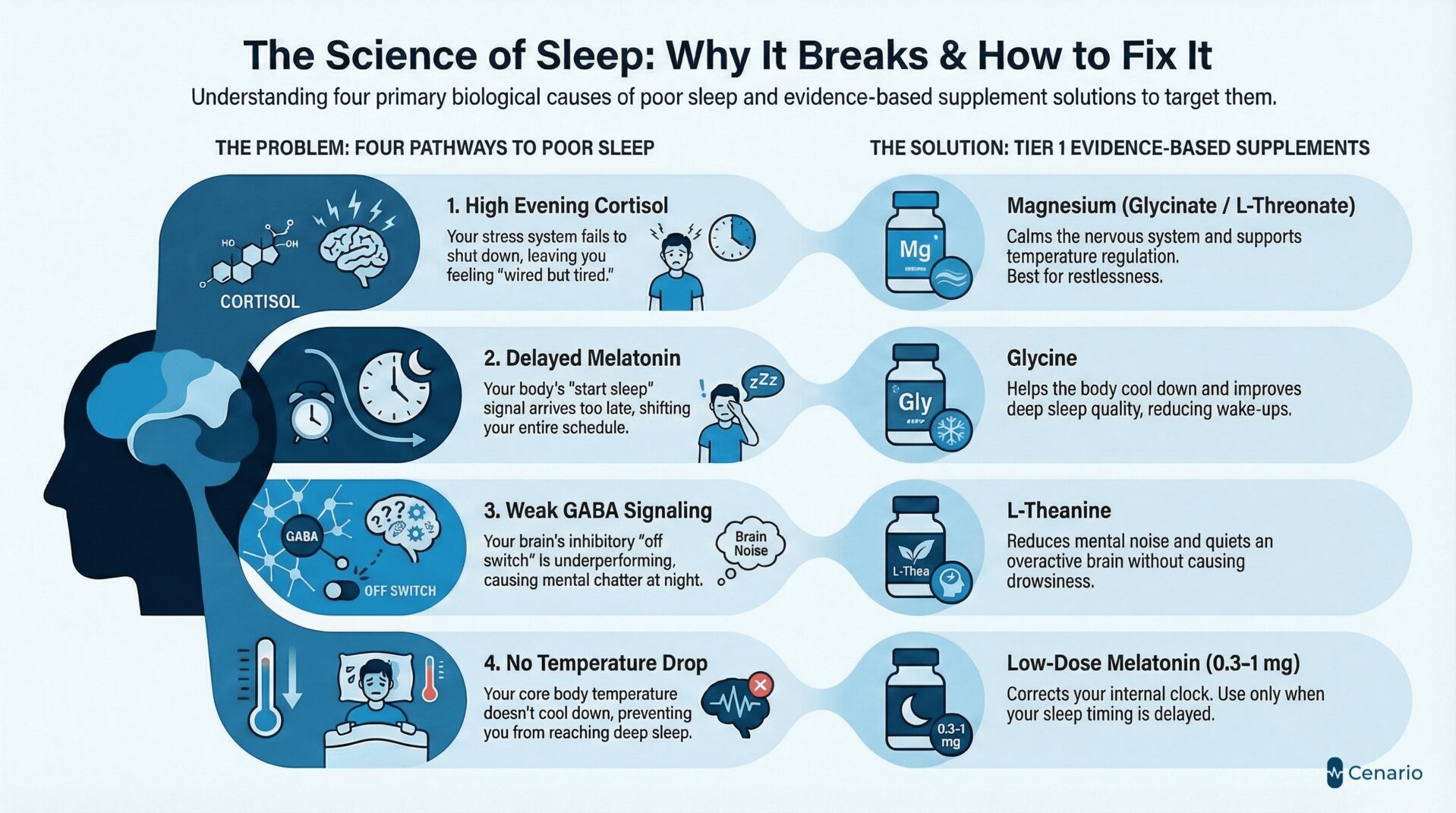
Sleep breaks down for reasons that are measurable. People treat insomnia as if it is a mood issue or a randomness problem, but every pattern traces back to one or more biological systems that failed to shift at the correct time. When you understand these systems, you stop guessing and you stop relying on sedatives that only force unconsciousness. Below are the four mechanisms that drive almost all chronic sleep issues.
Not all sleep supplements address the underlying causes of insomnia. This article ties into our broader evaluation of supplement efficacy and mechanisms in the evidence-based supplements category.
Cortisol That Fails to Shut Off
Cortisol is supposed to peak in the morning then decline steadily through the day. The drop in the evening is what unlocks the transition into a sleep state. When cortisol stays elevated, the brain does not disengage. You feel physically tired but internally wired. You get stuck in cognitive loops, you replay the day, and you cannot stop the mental output. This is not anxiety in the psychological sense. It is an HPA axis timing error.
Common causes: evening work, blue light, late caffeine, constant notifications, chronic stress, poor meal timing, and irregular sleep windows.
Observable signs:
- You feel alert at night even when exhausted
- You get a second wind around 9 to 11 pm
- You fall asleep late and wake easily from small noises
Melatonin That Arrives Too Late
Melatonin is not a sleep drug. It is the signal that informs the body when night begins. When melatonin is delayed, the entire sleep schedule shifts forward. The body tries to fall asleep at the wrong time. People often think they have “insomnia” but the real problem is that their clock is running in a different time zone.
Common causes: screens in the evening, lack of morning sunlight, inconsistent wake times, travel, and shift work.
Observable signs:
- You feel awake late into the night
- You can fall asleep only past midnight
- You wake in the morning but feel misaligned and groggy
GABA Signaling That Underperforms
GABA is the main inhibitory neurotransmitter. It reduces neuronal firing so the cortex can transition out of the daytime high-output mode. If GABA function is weak, the body feels ready for bed but the mind stays active. People describe this as “brain chatter” or internal restlessness. It is often mistaken for anxiety but the underlying issue is overactive excitatory signaling relative to inhibitory tone.
Common causes: chronic stress, nutrient deficiencies, high inflammation, alcohol rebound, and heavy stimulants.
Observable signs:
- Your body feels tired but the mind keeps producing thoughts
- You can fall asleep but sleep is shallow
- You wake after one or two hours because the cortex never fully shut down
Temperature That Does Not Drop on Time
Deep sleep requires a predictable drop in core body temperature. If this drop does not occur, the brain cannot enter slow wave stages. People often blame the mattress or room temperature, but the real problem is that their thermoregulation is delayed.
Common causes: late exercise, late meals, alcohol, stress, thyroid fluctuations, and warm environments.
Observable signs:
- You feel warm or agitated at night
- You kick off blankets or wake up sweating
- You fall asleep but wake repeatedly because deep sleep could not stabilize
The Sleep Supplements That Actually Work
Most sleep products fail because they ignore the four pathways from Section 1. Ingredients work only when they target the correct mechanism. Below are the compounds with real biological leverage, grouped by the pathway they influence. No hype. No cosmetic blends.
Pathway Target: Cortisol Shutdown
These supplements help the body exit daytime alert mode so the transition into sleep becomes predictable.
Magnesium Glycinate or L Threonate
Magnesium supports the enzymes and receptors that shut down excess neural firing. It helps stabilize the shift from wake mode to rest mode.
Consumer version: it calms the system without sedating it.
Mechanism: regulates NMDA and GABA signaling. Reduces evening sympathetic activation.
Dose: 200 to 400 mg elemental magnesium.
L Theanine
One of the only ingredients that reduces mental tension without causing drowsiness. Good for people whose brain stays too active at night.
Consumer version: it reduces mental noise so you can settle.
Mechanism: increases alpha wave activity and balances excitatory neurotransmission.
Dose: 100 to 300 mg.
Ashwagandha (Sensoril or KSM66)
Useful only when sleep issues are stress driven. It stabilizes the HPA axis so cortisol drops when it should.
Consumer version: it lowers the internal stress drive that keeps you wired.
Mechanism: reduces ACTH and normalizes cortisol curves.
Dose: 200 to 600 mg.
Pathway Target: Melatonin Timing
These ingredients do not “put you to sleep”. They correct the clock so your body knows when to initiate the sleep process.
Melatonin (low dose only)
Melatonin’s job is timekeeping. High doses distort the circadian system, so the correct use is low dose.
Consumer version: it tells your body what time it is.
Mechanism: aligns the circadian rhythm by acting on MT1 and MT2 receptors in the SCN.
Dose: 0.3 to 1 mg. Large doses cause rebound waking.
Light Support Combo: Melatonin + Morning Light
The supplement works only when paired with consistent morning light. Without morning anchoring, the timing shift is unstable.
Consumer version: you fix the night only if you fix the morning.
Mechanism: strengthens phase shift and stabilizes the circadian oscillation.
Pathway Target: GABA Inhibition
These ingredients help the brain switch from daytime high output to low frequency sleep rhythms.
Apigenin
A reliable way to boost inhibition and quiet cortical firing without pharmaceutical side effects.
Consumer version: it smooths the transition into sleep.
Mechanism: modulates GABA A receptors and reduces excitatory noise.
Dose: 25 to 50 mg.
Glycine
One of the simplest but most effective sleep ingredients. Improves sleep quality and reduces nighttime awakenings.
Consumer version: it helps your body shift into the deeper sleep stages.
Mechanism: acts as an inhibitory amino acid and supports thermoregulation.
Dose: 3 g.
GABA (limited use)
Most supplemental GABA does not cross the blood brain barrier effectively. Some people respond, others do not.
Consumer version: mild calming effect for some but inconsistent.
Mechanism: gut brain pathways may mediate effects.
Dose: 100 to 300 mg.
Pathway Target: Temperature Drop
These supplements help the body achieve the required cooling to stabilize deep sleep.
Glycine (again, because it works for two pathways)
It improves heat dissipation by increasing peripheral blood flow.
Consumer version: helps your body cool down so deep sleep can start.
Mechanism: reduces core body temperature by supporting spinal thermoregulation.
Magnesium (cross listed)
Helps with vasodilation and muscle relaxation which indirectly supports temperature drop.
Consumer version: makes the body less tense and more able to cool.
Mechanism: regulates vascular tone.
Pathway Target: Multi System Support
Some ingredients work across several pathways and can be used strategically.
Taurine
Supports GABA activity, calms the stress system, and helps regulate excitatory signaling.
Consumer version: steadying effect without sedation.
Mechanism: modulates GABA and glycine receptors and stabilizes calcium signaling.
Dose: 500 to 1500 mg.
Phosphatidylserine (only for high evening cortisol)
Useful only when labs or symptoms clearly indicate excessive nighttime cortisol.
Consumer version: removes the “wired at night” pattern if the cause is cortisol.
Mechanism: reduces ACTH signaling and helps shift the HPA curve earlier.
Dose: 100 to 300 mg at dinner.
Evidence Summary and Study Count Breakdown
Sleep supplements look similar on labels but the evidence behind them is not equal. Some ingredients have dozens of controlled trials. Others exist only in marketing copy. Below is the evidence landscape in a way that is simple to understand and easy to compare.
Study Count by Ingredient
This table shows the approximate number of controlled human studies that evaluate sleep effects or sleep related mechanisms.
Table. Number of Human Studies per Ingredient
(Counts rounded to group by strength of evidence)
| Ingredient | Approx Study Count | Evidence Strength | Notes |
|---|---|---|---|
| Magnesium | 20 to 30 | Strong | Consistent improvements in sleep quality and stress reduction. |
| Glycine | 10 to 15 | Strong | Reproducible results for sleep onset, sleep depth, and next day alertness. |
| L Theanine | 15 to 25 | Strong | Reduces stress and improves relaxation without sedation. |
| Melatonin (low dose) | 100 plus | Very strong | Excellent for circadian timing. Not a sedative. |
| Ashwagandha | 10 to 15 | Strong | Useful for stress driven insomnia only. |
| Apigenin | 3 to 5 | Moderate | Small but promising data on GABA modulation. |
| GABA | 5 to 8 | Weak to moderate | Effects inconsistent due to limited brain penetration. |
| Taurine | 5 to 10 | Moderate | Helps stress, GABA activity, and sleep onset. |
| Phosphatidylserine | 5 to 7 | Moderate | Only effective when cortisol is high at night. |
This is the real hierarchy. Melatonin dominates research because it is a circadian hormone. Magnesium, glycine, and L theanine have strong human data. Many other ingredients rely on mechanistic studies rather than consistent human trials.
Typical Dosing Ranges Across the Evidence
Consumers often overdose or underdose because product labels are inconsistent. Here are the clinically relevant ranges.
Table. Evidence Based Dosing Ranges
| Ingredient | Effective Dose Range | Notes |
|---|---|---|
| Magnesium (glycinate, threonate) | 200 to 400 mg | Do not mix multiple magnesium forms to hit dose. |
| L Theanine | 100 to 300 mg | Works best 60 minutes before bed. |
| Glycine | 3 g | Works reliably for temperature and deep sleep. |
| Melatonin | 0.3 to 1 mg | Higher doses distort circadian timing. |
| Ashwagandha | 200 to 600 mg | Works when taken earlier in the day, not at bedtime. |
| Apigenin | 25 to 50 mg | Heavier doses have no added benefit. |
| Taurine | 500 to 1500 mg | Helps steady the nervous system. |
| Phosphatidylserine | 100 to 300 mg | For high evening cortisol only. |
| GABA | 100 to 300 mg | Inconsistent. Works for some through gut pathways. |
Evidence Tier Breakdown
This section groups supplements into tiers based on consistency and mechanism quality. Good for readers who want a simple hierarchy.
Tier 1. Strong Evidence and Strong Mechanism
These ingredients produce consistent improvements and fit directly into the pathways that control sleep.
• Magnesium
• Glycine
• L Theanine
• Low dose melatonin
These four cover 80 percent of non medical sleep problems because they target timing, inhibition, and temperature.
Tier 2. Good Mechanism and Moderate Evidence
Useful for specific patterns but not universal.
• Ashwagandha
• Taurine
• Phosphatidylserine
These work when the underlying issue is stress driven or cortisol related.
Tier 3. Promising but Inconsistent
Not useless, but results vary.
• GABA
• Apigenin
These are often added to stacks but should not be used as primary solutions.
Get a personalized supplement plan in under 60 seconds.
Take the Cenario Quiz and find out exactly what your brain needs.
This removes trial and error, cuts out wasted supplements, and gives you a formula built for your symptoms, lifestyle, and biology.
Frequently Asked Questions
How long does it take for sleep supplements to work?
Most pathway-based ingredients work within the first 3–7 days. Magnesium and glycine improve sleep depth steadily over a week, while L-theanine and low-dose melatonin work on the first night. Cortisol-focused supplements (like ashwagandha or phosphatidylserine) require 1–2 weeks because they correct timing, not sedation.
Can I rely on supplements alone if I have chronic insomnia?
Supplements help only when paired with proper light exposure, consistent wake time, reduced evening stimulation, and cooling habits. They correct biological pathways, but chronic insomnia also involves behavioral patterns that must be aligned with the circadian system.
What’s the safest sleep supplement to start with if I’m unsure of my pathway?
The safest universal starting point is magnesium glycinate or L-threonate because magnesium supports multiple pathways cortisol downshift, inhibition, and temperature regulation without forcing sedation or altering circadian timing.
Can I take sleep supplements every night?
Yes, magnesium, glycine, and L-theanine can be taken nightly because they support natural pathways rather than shutting the system down. Melatonin should be used short-term or only for circadian timing issues, not daily “sedation.”
What should I avoid combining with sleep supplements?
Avoid alcohol, late caffeine, and high-dose melatonin. Alcohol disrupts sleep architecture, caffeine blocks adenosine receptors, and high-dose melatonin pushes your internal clock in the wrong direction. These create biological conflicts that overpower supplements.
What time of day should I take ashwagandha for better sleep?
Take ashwagandha in the morning or early afternoon, not at night. Its job is to stabilize cortisol timing, and taking it too late can interfere with your natural nighttime cortisol drop.
Are sleep gummies effective or just marketing?
Most gummies are underdosed and rely on sugar + high melatonin to sedate you rather than correcting pathways. They may help you fall asleep but often worsen rebound waking and disrupt timing. Look for evidence-based doses instead of gummy convenience.
.